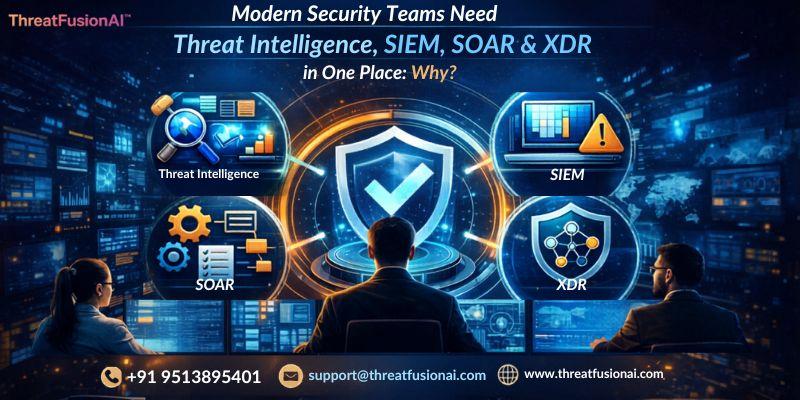
Are you confused about why Threat Intelligence, SIEM, SOAR, and XDR in One Place are in huge demand from modern security teams? If yes, then you are at the right place. Here, we will ensure that you understand how you can get all these things on one platform.
Moreover, we will introduce you to a reliable platform that can offer you such services without any hassle. What are we waiting for? Let’s get into it!
Introduction to Unified Cybersecurity for Modern Security Teams
Unified Cybersecurity unifies diverse security solutions, data streams, and procedures into a single, cohesive ecosystem to reduce visibility gaps across hybrid settings. Centralizing threat knowledge and automating responses, it helps modern security teams move beyond fragmented defense methods toward a more proactive, synchronized posture that can outperform sophisticated adversaries.
The Rising Complexity of Today’s Cyber Threat Landscape
The dramatic growth of automated exploit chains and Agentic AI, which enable attackers to run highly targeted, multi-stage campaigns at machine speed, characterizes the current cyber threat scenario.
Organizations currently operate in a "perpetual breach" environment where identity-centric security and AI-driven resilience are prioritized over basic perimeter defense due to geopolitical dispersion and the industrialization of ransomware.
This increasing complexity is accentuated by the confluence of IT and Operational Technology (OT), rendering critical infrastructure more vulnerable than ever to sophisticated, state-aligned adversaries.
The Problem with Managing Separate Security Tools
|
S.No. |
Factors |
What? |
|
1. |
Visibility Gaps and Blind Spots |
Because siloed technologies don't share data, complex, multi-stage attacks might lurk in "dark corners" of the network. |
|
2. |
Alert Fatigue and False Positives |
Critical dangers are obscured by a mountain of noise when disconnected systems bombard analysts with redundant or contradictory signals. |
|
3. |
Operational Inefficiency and High Overhead |
Managing dozens of different interfaces necessitates specific training for each, consuming funds and manpower for upkeep rather than defense. |
|
4. |
Slow Incident Response |
By manually switching between technologies to piece together an assault timeline, teams waste valuable time, which lets threats linger longer and do more harm. |
|
5. |
Configuration Inconsistency |
Maintaining security policies across diverse vendors leads to human error and conflicting guidelines that might inadvertently leave the firm susceptible. |
The Challenge of Data Silos and Alert Fatigue
The following are the challenges of Data Silos and Alert Fatigue:
1. Incomplete Threat Context: When data is stuck in silos, analysts cannot view the whole "kill chain," making it nearly hard to separate a simple malfunction from a concerted breach.
2. Context Switching Penalty: By manually switching between many consoles to correlate data, analysts lose crucial time and concentration, which significantly raises the "Mean Time to Respond."
3. The "Cry Wolf" Effect: Independent instruments often create separate alarms for the same event, leading to a tremendous volume of redundant noise that desensitizes security personnel to true dangers.
4. Missed Low-and-Slow Attacks: Data silos allow sophisticated attackers to go unnoticed for months by preventing the connection of minor, seemingly unconnected events over extended periods of time.
5. Inconsistent Data Formats: It is challenging to compile data into a consolidated platform without substantial, expensive human normalization since different manufacturers utilize proprietary logging standards.
What Is Threat Intelligence in Cybersecurity?
The gathering and analysis of information about current or potential threats to assist companies in comprehending the goals, targets, and assault tactics of adversaries is known as threat intelligence.
By foreseeing dangers and putting preventative measures in place before an incident happens, this actionable data enables security teams to go from a reactive to a proactive defense.
What Is SIEM?
In order to enable real-time monitoring and historical analysis of security occurrences, Security Information and Event Management (SIEM) is a centralized solution that gathers log data from all of an organization's infrastructure.
Correlating various data points, it helps security teams discover abnormalities, automate incident responses, and maintain thorough audit trails for regulatory compliance.
Why Is SIEM Important?
SIEM is important for the following reasons:
● Centralized Visibility: It pulls log data from across your whole ecosystem, cloud, on-premises, and endpoints into a single pane of glass, removing the need to examine dozens of distinct systems.
● Real-Time Threat Detection: SIEM detects intricate attack patterns in real time, such as several unsuccessful logins followed by a successful one from a new IP, by employing sophisticated correlation criteria.
● Accelerated Incident Response: It gives analysts the forensic breadcrumbs they need for quick examination, enabling them to piece together an attacker's actions and stop breaches before they get out of hand.
● Regulatory Compliance: SIEM makes the reporting process easy and accurate by automating the gathering and archiving of audit logs needed by frameworks like GDPR, HIPAA, and PCI-DSS.
● Reduced "Dwell Time": SIEM drastically cuts down on the amount of time an attacker can spend hiding within your network by identifying small anomalies that could otherwise go undiscovered.
What Is SOAR?
A stack of interoperable software applications called Security Orchestration, Automation, and Response (SOAR) enables enterprises to gather information about security risks and react to low-level security events without the need for human intervention.
Through the integration of several security tools and the execution of automated "playbooks," SOAR simplifies incident workflows, resulting in much shorter reaction times and less work for security analysts.
How Does SOAR Improve Response?
|
S.No. |
Factors |
How? |
|
1. |
Automated Incident Triaging |
By extracting context from internal databases and threat intelligence feeds, SOAR automatically enhances alerts, enabling it to reject false positives without human intervention. |
|
2. |
Standardized Playbook Execution |
By carrying out pre-established playbooks, it guarantees that every incident is managed in accordance with best practices, removing the unpredictability and mistakes that come with human reaction. |
|
3. |
Drastic Reduction in MTTR |
By automating repetitive actions like isolating an infected workstation or blocking a malicious IP, SOAR cuts the Mean Time to Respond (MTTR) from hours to seconds. |
|
4. |
Inter-Tool Orchestration |
By serving as a link between disparate security technologies, SOAR enables you to concurrently initiate coordinated actions across your firewall, EDR, and email security gateway with a single command. |
|
5. |
Analyst Empowerment |
By taking care of "grunt work," SOAR frees up highly qualified analysts to concentrate on strategic security enhancements and intricate threat hunting instead of clicking through tedious warnings. |
What is XDR?
In order to provide a comprehensive picture of the threat landscape, Extended Detection and Response (XDR) is a unified security solution that combines data from several security levels, such as endpoints, networks, servers, and cloud workloads.
XDR can identify complex assaults that evade conventional siloed defenses and expedite the investigation process by applying sophisticated analytics and automation to this cross-domain data.
This progress helps security teams to identify, correlate, and respond to complex threats more effectively than standalone EDR or outdated systems.
How does XDR bridge the gap?
In the following ways, XDR bridges the gap:
a) Cross-Layer Data Correlation: XDR intelligently integrates seemingly unrelated signals from endpoints, networks, and cloud workloads into a single, cohesive attack tale.
b) Elimination of Visibility Blind Spots: XDR makes sure that attackers cannot hide in the "seams" between isolated tools by dismantling the silos between various security products.
c) Unified Management Interface: It gives security operations a single point of truth, enabling analysts to keep an eye on the whole environment without having to switch between several disjointed interfaces.
d) Context-Aware Automated Response: XDR initiates synchronized defense measures throughout the whole infrastructure, such as isolating the targeted endpoint and blocking an IP at the firewall.
e) Streamlined Forensic Investigations: Investigators can quickly understand the full extent of a breach and its underlying cause thanks to the platform's pre-correlated map of the occurrence.
Why Modern Security Teams Need Threat Intelligence, SIEM, SOAR, and XDR in One Platform?
|
S.No. |
Factors |
Why? |
|
1. |
Unified Data Context |
By combining these tools, it is possible to create a single source of truth that combines real-time telemetry, threat actor profiles, and raw logs into an understandable and useful picture. |
|
2. |
End-to-End Automation |
From the time a threat is identified by XDR/SIEM until its automatic neutralization by SOAR playbooks, a unified platform facilitates a smooth transition. |
|
3. |
Elimination of "Tool Sprawl" and Friction |
The technological debt and integration issues that usually impede security operations are reduced when there are fewer distinct vendors and interfaces. |
|
4. |
Accelerated Decision Making |
The technology offers pre-validated, high-confidence alerts that are ready for quick action, eliminating the need for analysts to manually check threats against intelligence streams. |
|
5. |
Holistic Risk Management |
A single platform gives a high-level picture of the organization's total security posture, making it easier to spot systemic weaknesses and report on overall resilience. |
Benefits of a Unified Security Operations Platform
The following are the benefits of a Unified Security Operations Platform:
1. Radical Efficiency Through Consolidation: Dozens of disjointed tools are replaced with a unified interface, simplifying daily tasks and removing the need for frequent platform switching.
2. Lower Mean Time to Detect and Respond (MTTD/ MTTR): Teams can detect and eliminate risks in seconds instead of days thanks to integrated automation and pre-correlated data.
3. Cost Optimization and Reduced Tool Sprawl: Expensive license fees, specific training expenses, and the technical debt of managing several vendors can all be decreased by consolidating your stack.
4. High-Fidelity Alerting with Less Noise: While background "noise" is automatically filtered out, cross-tool validation guarantees that analysts only see high-confidence, actionable alerts.
5. Seamless Scalability and Cloud Agnostic Defense: For on-premises, hybrid, and multi-cloud systems, a single platform offers centralized control and uniform security coverage.
How does Managed Detection and Response (MDR) complement unified platforms?
By offering top-tier security professionals who oversee the technology around-the-clock, MDR enhances unified platforms by guaranteeing that complex warnings are looked into and eliminated continuously.
This relationship bridges the "human gap," transforming the platform’s high-fidelity data into fast, expert-led defensive measures without expanding internal personnel.
Key Features to Look for in an Integrated Security Platform
|
S.No. |
Factors |
What? |
|
1. |
Unified Operational Data Layer |
A centralized data fabric that creates a single, high-performance repository by normalizing and correlating telemetry from all across the stack. |
|
2. |
Agentic AI & Autonomous Investigation |
Sophisticated AI agents that support human analysts by independently investigating warnings, gathering evidence, and suggesting corrective actions. |
|
3. |
Native Case Management & Orchestration |
An integrated system that initiates automated playbooks and converts alerts into actionable cases without the need for additional plugins. |
|
4. |
Advanced User and Entity Behavior Analytics (UEBA) |
Machine learning models that create baselines for normal behavior to discover insider threats and compromised accounts through small anomalies. |
|
5. |
Open Ecosystem & Model Context Protocol (MCP) |
A versatile framework that unifies how AI models access and engage with various security data sources and facilitates third-party integrations. |
The Role of AI and Automation in Unified Platforms
The following are the roles of AI and Automation in the Unified Platform:
● Autonomous Threat Hunting: Without the need for human query input, AI bots aggressively search the environment for subtle adversary patterns and hidden indications of compromise (IoCs).
● Intelligent Alert Correlation: Machine learning algorithms evaluate enormous datasets to gather related security signals across several layers into a single, high-confidence incident.
● Dynamic Playbook Adaptation: Automation workflows leverage real-time context to alter their reaction actions, ensuring the defense plan meets the precise details of an evolving threat.
● Automated Root Cause Analysis: The "Patient Zero" and the full lateral movement path are automatically mapped out by the platform, which rapidly tracks an attack back to its source.
● Predictive Security Posture: Predictive analytics uncover developing trends and internal flaws to offer hardening steps before vulnerabilities may be exploited by attackers.
The Future of Security Operations Is Unified
The smooth integration of detection, intelligence, and response into a single, machine-speed, AI-orchestrated ecosystem is the key to the future of security operations. Organizations can attain a state of "continuous resilience" where autonomous agents and unified data streams turn security from a reactive bottleneck into a proactive business facilitator by dismantling the silos between instruments.
Conclusion: Building Stronger Cyber Defense with One Platform
Now that we have talked about Threat Intelligence, SIEM, SOAR, and XDR in One Place, you might want a dedicated solution for that. If yes, then Threat Fusion AI offered by Craw Security is the right choice for you. It has all of the services that modern security teams need.
Moreover, it will help organizations to keep an eye on unknown threats while the staff is off board. It will automatically detect suspicious activity running over systems, and if it carries any malware, it will stop it then and there. What are you waiting for? Check it out, now!
Frequently Asked Questions
About Threat Intelligence, SIEM, SOAR, and XDR in One Place
1. What is a unified security platform?
In order to offer smooth visibility, automated correlation, and quick incident response, a unified security platform is a centralized ecosystem that combines SIEM, XDR, SOAR, and threat intelligence into a single interface.
2. What is the role of SIEM in cybersecurity?
The following are the roles of SIEM in cybersecurity:
a) Log Aggregation and Normalization,
b) Continuous Compliance Monitoring,
c) Complex Event Correlation,
d) Real-Time Threat Alerting, and
e) Historical Forensic Analysis.
3. How does SOAR help security operations?
In the following ways, SOAR helps security operations:
a) Automated Incident Response,
b) Workflow Orchestration,
c) Alert Enrichment,
d) Case Management, and
e) Reduction in Analyst Burnout.
4. What does XDR do in a modern security environment?
XDR combines and correlates security data from across endpoints, networks, and cloud workloads to enable unified awareness and automatic response to sophisticated attacks.
5. Why is it better to have SIEM, SOAR, and XDR in one platform?
A unified platform eliminates data silos and tool fragmentation, enabling seamless correlation, faster automated response, and a single source of truth for the full threat lifecycle.
6. How does a unified platform reduce alert fatigue?
In the following ways, a unified platform reduces alert fatigue:
a) Intelligent Alert Grouping,
b) Contextual Auto-Enrichment,
c) Automated Low-Level Remediation,
d) Unified Prioritization Scoring, and
e) Elimination of Duplicate Alerts.
7. What are the main benefits of combining threat intelligence with SIEM and XDR?
The following are the main benefits of combining threat intelligence with SIEM and XDR:
a) High-Fidelity Detection,
b) Adversary Context and Intent,
c) Proactive Threat Hunting,
d) Automated Risk Prioritization, and
e) Enhanced Forensic Investigations.
8. Who should use an integrated security operations platform?
The following individuals should use an integrated security operations platform:
a) Enterprises with Complex Hybrid Environments,
b) Security Operations Centers (SOCs) Facing Alert Fatigue,
c) Mid-Sized Organizations with Lean Security Teams,
d) Industries with Strict Regulatory Requirements, and
e) Organizations Transitioning to Proactive Defense.
9. What features should businesses look for in a unified cybersecurity platform?
Businesses should look for in a unified cybersecurity platform:
a) Unified Operational Data Store,
b) Native Integration of SIEM, XDR, and SOAR,
c) Agentic AI and Autonomous Investigation,
d) Built-in Threat Intelligence Integration, and
Open Ecosystem and Extensibility