Do you know what Confidence Scoring is and its benefits for organizations running in the IT Industry? If not, then you are at the right place. Here, we will talk about confidence scoring and related features in detail.
Moreover, we will introduce you to a reliable threat intel platform offered by a reputable VAPT service provider. What are we waiting for? Let’s get straight to the topic!
What Is Confidence Scoring?
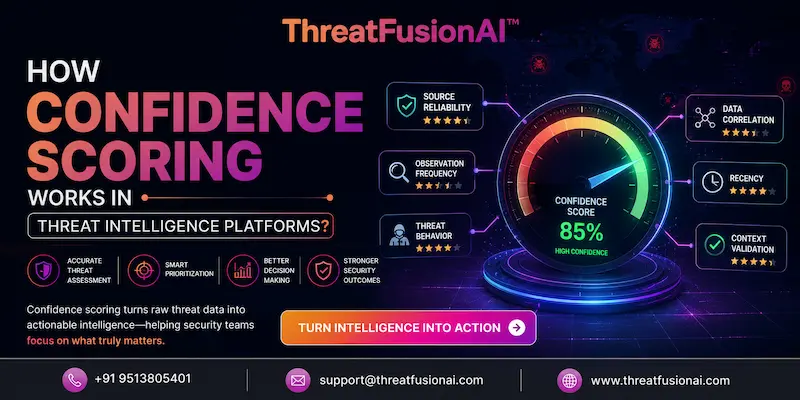
In cyber threat intelligence, confidence scoring is a metric-driven assessment that measures the dependability, precision, and certainty of a particular threat warning or piece of information. It evaluates indicators of compromise according to cross-platform correlation, data freshness, and source reliability using a combination of automated algorithms and analyst confirmation.
Security teams can quickly select serious risks and disregard low-certainty background noise thanks to this score, which basically indicates how much they should trust the data. Let’s talk about what Confidence Scoring is and its benefits for organizations in the IT Industry!
Why Confidence Scores Matter in Cyber Threat Intelligence?
|
S.No. |
Factors |
Why? |
|
1. |
Eliminates Alert Fatigue |
Eliminates background noise with low certainty, allowing analysts to concentrate just on confirmed, high-priority threats. |
|
2. |
Enables Automated Playbook Responses |
Enables safe, immediate, automated containment actions for high-confidence indicators to be triggered by orchestration tools. |
|
3. |
Optimizes Resource Allocation |
Focuses the limited funds and time available for human engineering on examining the risks that are most likely to be hazardous. |
|
4. |
Reduces Costly False Positives |
Avoids operational interruptions brought on by inadvertently obstructing benign system activities or genuine business flow. |
|
5. |
Improves Incident Response Speed |
Provides defenders with instant information on the reliability of a danger alarm, which speeds up decision-making. |
Confidence Levels Explained: Low, Medium, and High
The following are the differences between various levels of confidence:
1. Low: Before taking any protective action, the threat data must be manually investigated because it is unverified and originates from a single or unreliable source.
2. Medium: Although the data appears to mirror prior activities and comes from a generally trustworthy source, it lacks the hard, independent evidence required for automatic blockage.
3. High: The threat is safe to utilize for immediate, automatic mitigation, thoroughly validated by several reliable sources, and strongly connected with ongoing campaigns.
Key Factors Used to Calculate Confidence Scores
The following are the key factors used to calculate the confidence scores:
● Source Reliability: The reputation, track record, and historical accuracy of the particular feed or organization supplying the threat data.
● Multi-Source Validation and Correlation: The quantity of separate, independent security platforms that attest to the same threat behavior.
● Information Freshness and Temporal Decay: Scores naturally decline as the data matures and becomes less relevant, depending on how recently the indication was recorded.
● Behavioral Deviation and Baseline Matching: How much the observed activity deviates from the established, typical operating behavior of the network.
How Threat Intelligence Platforms Evaluate Evidence Quality?
|
S.No. |
Factors |
How? |
|
1. |
Checks Completeness and Contextual Depth |
Confirms that the indicator contains important background information, such as attack history, targeting information, and related malware. |
|
2. |
Analyzes Technical Specificity |
Favors distinct digital fingerprints over generic network indicators when evaluating the technical accuracy of the data. |
|
3. |
Verifies Data Ingestion Methods |
Evaluates the methods used to collect the data, giving direct telemetry and sandboxed analysis precedence over third-party scrapers. |
|
4. |
Applies Baseline Scoring Standards |
Compares all incoming data to well-accepted frameworks such as MITRE ATT&CK and STIX/TAXII. |
|
5. |
Tests Cryptographic and Form Integrity |
Ensures that data has not been altered by auditing digital signatures, file formats, and format schemas. |
The Role of Data Correlation in Confidence Scoring
The following are the roles of data correlation in confidence scoring:
a) Validates Isolated Alerts: Verifies whether an assault is genuine or an aberration by cross-referencing individual, unverified alarms with global threat feeds.
b) Connects Disparate Attack Vectors: Combines seemingly unconnected occurrences, such as an IP scan, a strange email, and a file modification, into a single, very confident campaign.
c) Overcomes Individual Source Biases: By combining various telemetry, it reduces the blind spots or false positives of any one security vendor.
d) Accelerates Threat Contextualization: Instantly applies past trends to current data to identify the precise threat actor and their motivations.
e) Establishes the Threshold for Automated Defense: Gives the tangible, multifaceted evidence needed to safely activate automatic firewalls and blocking policies.
Contextual Aging and Time-to-Live (TTL) of Intelligence
Threat intelligence expiration dates are represented by contextual aging and Time-to-Live (TTL), which specify how long an indication is valid before its confidence score automatically declines. Continuous temporal decay is crucial to preventing stale data from producing disruptive false positives since threat actors quickly rotate infrastructure, making it easy for a high-confidence malicious IP address or domain today to belong to a legitimate organization tomorrow.
Confidence Scoring for Indicators of Compromise (IOCs)
Based on how consistently certain data artifacts, such as file hashes, malicious IPs, and domains, indicate a real danger, the confidence score for Indicators of Compromise (IOCs) assigns a relative trust value.
Scoring systems consider the technological context of each signal to decide whether it calls for automatic blocking or merely a normal study because basic IOCs, such as IP addresses, change hands quickly while sophisticated behavioral patterns stay constant.
How Threat Intelligence Teams Validate Threat Data?
Threat intelligence teams validate threat data in the following ways:
1. Cross-Source Correlation: Verifies that the action isn't an isolated event by comparing incoming alerts to several worldwide feeds.
2. Sandbox and Malware Execution: Explodes dubious files in several systems to see and confirm their detrimental impacts in the actual world.
3. Syntax and Schema Validation: Ensures there is no tampering by auditing incoming data structures against stringent industry standards like STIX/TAXII.
4. Historical Infrastructure Auditing: Links questionable domains to known malicious actors by tracking their registration and ownership history.
5. Controlled Reverse Infiltration: Penetrates dark web marketplaces and closed hacker forums to confirm data drops at the source.
Machine Learning and Automation in Confidence Scoring
Automation and Machine Learning with Confidence: Massive amounts of worldwide threat data are ingested, cross-referenced, and evaluated in real time by scoring using predictive AI algorithms.
These self-learning algorithms provide instantaneous automated defenses against confirmed high-risk threats by analyzing dynamic behavioral baselines, calculating temporal data decay, and instantaneously adjusting confidence ratings to filter out noise instead of depending on strict, manual restrictions.
Reducing False Positives and Alert Fatigue through Scoring Thresholds
By defining precise numerical limits that control how security products process threat data, scoring thresholds prevent false positives and warning fatigue. Security teams may securely silence the deluge of low-certainty background alarms that tire security analysts while rapidly neutralizing verified assaults without human interaction by configuring automation rules to only stop threats beyond a high-confidence threshold.
Future Trends in Threat Intelligence Confidence Assessment
The following are the future trends in threat intelligence confidence assessment:
● Unified Platform Verdicts: Creates a single, uniform cross-industry certainty metric by combining scores from different vendors.
● Autonomous, AI-Driven Triage: Uses agentic AI to manage low-to-mid confidence alerts entirely without the need for human supervision.
● Risk-Based and Environmental Scoring: Dynamically modifies the degree of trust in an organization's unique network architecture and essential resources.
● Predictive Campaign Forecasting: Makes use of machine learning to predict and score changing hacker tactics prior to an assault.
● Continuous Behavioral Assessment: Instead of depending on a static, one-time calculation snapshot, it monitors long-term indicator patterns over time.
Conclusion
Now that we have talked about what Confidence Scoring is, you might want to get a dedicated threat intel solution to be safe against future cyber threats. For that, you can go for Threat Fusion AI, a dedicated threat intel tool offered by Craw Security.
Threat Fusion AI can offer you intel about recent and latest cyber attacks and cyber threats that can enhance your security measures by preparing in advance. What are you waiting for? Contact, Now!
Frequently Asked Questions
About Confidence Scoring
1. What is confidence scoring in threat intelligence platforms?
Security teams may quickly prioritize crucial warnings by using confidence scoring, a dynamic metric that measures threat data's accuracy, dependability, and credibility.
2. How do threat intelligence platforms calculate confidence scores?
Threat intelligence platforms calculate confidence scores in the following ways:
a) Evaluating Source Trustworthiness,
b) Measuring Sighting Frequency & Cross-Correlation,
c) Calculating Temporal Decay,
d) Analyzing Behavioral Severity & Context, and
e) Assessing Baseline Deviations.
3. Why is confidence scoring important for cybersecurity teams?
Confidence scoring important for cybersecurity teams for the following reasons:
a) Eliminates Critical Alert Fatigue,
b) Enables Safe, Automated Defenses,
c) Drastically Reduces False Positives,
d) Accelerates Incident Response Times, and
e) Optimizes Scarce Security Resources.
4. What factors influence the accuracy of a confidence score?
The following influences the accuracy of a confidence score:
a) Source Credibility & Bias,
b) Independent Multi-Source Corroboration,
c) The Speed of Temporal Decay,
d) Contextual Richness vs. Missing Data, and
e) Internal Environment Relevance.
5. What is the difference between confidence scoring and risk scoring?
Risk rating assesses the possible impact and financial harm that a danger may cause to your particular company, whereas confidence score assesses the degree of certainty that a threat is genuine and accurate.
6. How do machine learning algorithms improve confidence scoring?
Machine learning algorithms improve confidence scoring in the following ways:
a) Automating Advanced Behavioral Anomaly Detection,
b) Executing Complex, Non-Linear Data Correlation,
c) Dynamically Adjusting for Temporal Decay,
d) Eliminating Source Bias & Platform Noise, and
e) Continuous Feedback Loop & Model Retraining.
7. Can confidence scores change over time?
Yes, as fresh cross-source evidence is found or as indicators age and experience automatic temporal decay, confidence levels naturally change over time.
8. How should security analysts use confidence scores when investigating threats?
Security analysts use confidence scores when investigating threats in the following ways:
a) Automating Lower-Tier Triage Decisions,
b) Guiding Deep Manual Investigations,
c) Prioritizing the Incident Queue,
d) Corroborating Multi-Stage Alerts, and
e) Adjusting Threat Intelligence Rules.
9. What are the common challenges associated with confidence scoring?
The following are the common challenges associated with confidence scoring:
a) Over-Reliance on Stale or Outdated Data,
b) Vendor Feed Inconsistency and Lack of Standardization,
c) Echo Chambers and Circular Reporting,
d) Context Blindness to Internal Environments, and
e) The "Black Box" Problem of Machine Learning Models.
10. Which threat intelligence platforms use confidence scoring mechanisms?
Following threat intelligence platforms use confidence scoring mechanisms:
a) Anomali ThreatStream,
b) ThreatConnect,
c) MISP (Malware Information Sharing Platform),
d) EclecticIQ Intelligence Center, and
e) Filigran OpenCTI.