Do you want to know about the Best Threat Intelligence Platform and the facilities they offer to organizations running in the IT Industry? If yes, then you are at the right place. Here, we will talk about the threat intelligence platform and related features in detail.
Moreover, we will introduce you to a reliable threat intel solution offered by a reputable VAPT service provider. What are we waiting for? Let’s get straight!
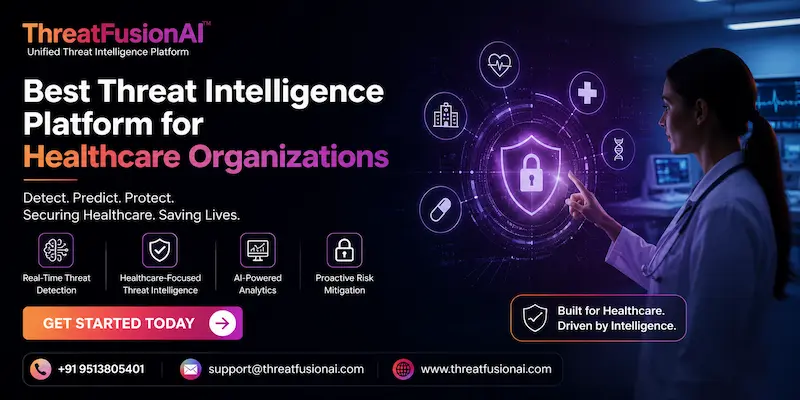
What Is a Threat Intelligence Platform for Healthcare Organizations?
A threat intelligence platform designed for healthcare organizations is a specialized cybersecurity solution that collects, analyzes, and contextualizes worldwide threat data to safeguard sensitive medical environments.
It takes the initiative to spot new methods aimed at Electronic Health Records (EHRs) and linked medical devices, converting unrefined signs into practical safeguards. It allows hospitals to safeguard essential healthcare infrastructure and provide continuous patient care while adhering to regulations by consistently tracking external risks.
Let’s take a look at the Best Threat Intelligence Platform and see what benefits it can offer to organizations in the IT Industry!
Threat Intelligence vs Traditional Security Tools in Healthcare
|
S.No. |
Topics |
Factors |
What? |
|
1. |
Threat Intelligence |
Proactive Global Visibility |
Gathers real-time external information to forecast and prevent developing global ransomware campaigns and specialized healthcare exploits before they reach the hospital network. |
|
Contextual Threat Landscape Analysis |
It clarifies the “who, why, and how” of an incident, enabling IT teams to determine whether an alert is a random commodity attack or a targeted assault on specific medical devices or EHR software. |
||
|
2. |
Traditional Security Tools |
Reactive Perimeter Defense |
Uses mainly established, unchanging signatures and past rules (such as traditional firewalls and antivirus) to prevent threats solely after they try to penetrate the perimeter. |
|
Isolated Alert Fragmentation |
Functions in isolation, producing a large number of unconnected alerts devoid of internal or external context, frequently resulting in significant alert fatigue for healthcare security teams. |
Why Healthcare Organizations Need a Threat Intelligence Platform in 2026?
Healthcare organizations need a threat intelligence platform in 2026 for the following reasons:
1. Combating Highly Targeted AI-Driven Phishing: Prevents hyper-realistic, AI-generated email scams and deepfakes from deceiving hospital staff.
2. Exploding Black-Market Value of Medical Records: Restricts the dark web data trade by forecasting targets for high-value Electronic Health Records (EHRs).
3. Vulnerabilities in Connected Medical Devices (IoMT): Monitors in real time weaknesses in crucial equipment such as networked infusion pumps and pacemakers.
4. Surge in Dual-Extortion Ransomware Operations: Stops contemporary cybercriminal organizations that are at the same time encrypting vital clinical systems and divulging patient data.
5. Stricter Global Regulatory and Compliance Mandates: Automated compliance mapping is fed to meet the requirements of evolving HIPAA audits and strict FDA security guidelines.
How Does Threat Intelligence Support HIPAA Compliance and Healthcare Regulations?
Threat intelligence supports HIPAA compliance and healthcare regulations in the following ways:
● Fulfills Mandated Risk Analysis Requirements: Offers ongoing, instantaneous risk monitoring that meets the requirements of obligatory HIPAA security evaluations with ease.
● Powers Proactive Technical Safeguards: Directly inputs current threat indicators into firewalls to automatically prevent unauthorized access to patient data.
● Enables Rapid Breach Discovery for the 72-Hour Rule: Reduces the time needed to detect incidents to such an extent that it becomes feasible to meet stringent regulatory reporting deadlines without difficulty.
● Secures Third-Party Vendor Risks: Watches over the external digital traces of supply chain associates to prevent cross-network data breaches.
● Mitigates Intentional and Unintentional Insider Threats: Identifies unusual user actions to immediately detect personnel who are improperly managing sensitive medical records.
Key Features to Look for in the Best Healthcare Threat Intelligence Platform
|
S.No. |
Factors |
What? |
|
1. |
Healthcare-Specific Threat Feeds |
Monitor specialized medical ransomware and targeted Electronic Health Record (EHR) exploits as they happen. |
|
2. |
Medical Device (IoMT) Vulnerability Profiling |
Recognizes defects and monitors ongoing exploits in linked hospital apparatus such as infusion pumps. |
|
3. |
Automated Third-Party and Vendor Risk Assessment |
Constantly monitors for data leaks and digital threats among supply chain associates. |
|
4. |
Seamless SIEM, XDR, and SOC Ecosystem Interoperability |
Shares raw threat data automatically with current tools for immediate defense coordination. |
|
5. |
Compliance Mapping and Regulatory Reporting |
Transforms unrefined cyber threat intelligence into audit-ready evidence that meets HIPAA and FDA standards. |
How AI-Powered Threat Intelligence Improves Healthcare Security?
AI-powered threat intelligence improves healthcare security in the following ways:
a) Instant Zero-Day Exploit Detection: Employs predictive machine learning models to immediately identify and prevent entirely new malware signatures.
b) Automated Defensive Triage and Speed: By instantly correlating telemetry data and executing isolated containment playbooks, it eliminates alert fatigue.
c) Proactive Shielding of Medical Devices (IoMT): Establish baseline normal network behavior to quickly detect anomaly spikes in connected clinical equipment.
d) Neutralizing Advanced AI-Crafted Phishing: Examines communication patterns as they occur to catch advanced deepfake and generative AI scams.
e) Predictive Dark Web Monitoring for Data Safety: Utilizes self-governing bots to examine criminal forums, intercepting compromised hospital credentials prior to breaches occurring.
Role of Threat Intelligence in Medical Device (IoMT) Security
The following are the roles of threat intelligence in medical device security:
1. Real-Time Vulnerability Discovery: Scans global feeds to link newly revealed software exploits to connected medical devices.
2. Automated Device Behavioral Profiling: Baselines anticipated transmission patterns to immediately identify clinical hardware that was compromised or malfunctioning.
3. Context-Aware Network Segmentation: Dynamically isolates medical devices that are vulnerable without disrupting essential clinical workflows.
4. Early Device-Tampering Prevention: Recognizes external, unauthorized configuration alterations or harmful firmware upgrades that are trying to run on devices.
5. Proactive Patch Prioritization: Utilizes real-time exploitability information to underscore the device vulnerabilities that represent the most urgent danger to patient safety.
How to Choose the Best Threat Intelligence Platform for Your Healthcare Organization?
|
S.No. |
Factors |
How? |
|
1. |
Prioritize Healthcare-Specific Threat Feeds |
Select a platform that has built-in tracking for clinical exploits, EHR vulnerabilities, and hospital-targeted ransomware strains. |
|
2. |
Evaluate Integration and Automation Capabilities |
Guarantee that it provides actionable indicators directly into your current SIEM, XDR, and firewall systems without any disruption. |
|
3. |
Look for AI-Powered Context and Scoring |
Select a solution that alleviates alert fatigue through automatic threat prioritization grounded in real clinical risk. |
|
4. |
Verify Built-in Regulatory Compliance Mapping |
Choose a platform that converts unprocessed technical intelligence into documentation for HIPAA and FDA audits. |
|
5. |
Assess Dark Web and Supply Chain Monitoring |
Look for external scanning features that monitor leaked employee credentials and vendor vulnerabilities before they affect you. |
Common Mistakes to Avoid When Selecting a Healthcare Threat Intelligence Solution
The following common mistakes should be avoided when selecting a healthcare threat intelligence solution:
● Relying on Generic Feeds Without Healthcare Context: Misses specialized medical system exploits and unique clinical ransomware targets.
● Ignoring Medical Device (IoMT) and Legacy Hardware Interoperability: Leaves connected hospital equipment unobserved and vulnerable to assaults.
● Choosing Data-Heavy Platforms That Increase Alert Fatigue: Floods security teams with raw data dumps that lack actionable clinical prioritization.
● Neglecting Out-of-the-Box Integrations with Current SIEM/XDR Ecosystems: Requires manual processes instead of automated threat prevention with the current tools.
● Overlooking Third-Party Vendor and Digital Supply Chain Visibility: Creates a lack of awareness regarding incoming data breaches from connected supply chain partners.
What is ThreatFusionAI?
ThreatFusionAI, developed by Craw Security, is a cyber defense platform and AI-driven threat intelligence database that aims to identify, assess, and mitigate digital risks in real time. Utilizing sophisticated machine learning, it compiles worldwide threat feeds, scans the dark web for exposed corporate credentials, and links data signals to preemptively thwart phishing and ransomware operations before they affect an organization’s infrastructure.
Benefits of ThreatFusionAI for Organizations
|
S.No. |
Benefits |
How? |
|
1. |
Proactive Phishing and Data Leak Visibility |
Monitors external digital footprints and dark web forums to prevent ongoing corporate credential transactions. |
|
2. |
Drastic Reduction in Alert Fatigue |
Utilizes massive datasets to cross-reference telemetry and reduce background noise by more than 50%. |
|
3. |
Lightning-Fast Automated Containment |
Via SOAR playbooks, triggers immediate firewall blocks and endpoint isolation workflows. |
|
4. |
Comprehensive Global Threat Intelligence Database |
Active hash pools, as well as harmful URLs and IPs gathered from over 195 nations. |
|
5. |
Quantifiable Cyber Risk Governance |
Translates technical indicators into straightforward data metrics that validate strategic investments in corporate security. |
Case Studies: ThreatFusionAI in Healthcare Environments
The following are some case studies related to Threatfusionai in healthcare environments:
a) Intercepting Targeted Healthcare Ransomware Campaigns: Uses active indicators to cross-reference and isolate server networks before the execution of clinical file-encryption strains.
b) Mitigating Medical Database Phishing Schemes: Compares incoming messages with real-time dark web leak databases to immediately identify attempts at credential theft.
c) Securing Connected Clinical Environments (IoMT): Monitors CVE indicators worldwide to provide immediate firewall updates that protect unpatched medical devices.
Conclusion: Choosing the Right Threat Intelligence Platform for Healthcare Organizations
Now that we have talked about the Best Threat Intelligence Platform, you might want to get your hands on a dedicated threat intelligence solution from a reliable source. For that, you can go for Threat Fusion AI, a dedicated threat intelligence platform offered by Craw Security.
Threat Fusion AI can automatically detect suspicious activities and give the alert to the system’s firewall to deal with them in time and offers information about the latest cyber threats running in the IT Industry. What are you waiting for? Contact, Now!
Frequently Asked Questions
About the Best Threat Intelligence Platform
1. What is the best threat intelligence platform for healthcare organizations?
One of the best threat intelligence platforms for healthcare organizations in the IT Industry is ThreatFusionAI offered by Craw Security.
2. Why do healthcare organizations need a threat intelligence platform?
Healthcare organizations need a threat intelligence platform for the following reasons:
a) Defends Lifesaving Medical Devices (IoMT),
b) Blocks Targeted AI-Driven Phishing,
c) Neutralizes High-Value Ransomware Operations,
d) Protects Medical Records and Credential Leaks, and
e) Simplifies Complex Regulatory Compliance.
3. How does a threat intelligence platform improve healthcare cybersecurity?
Threat intelligence platforms improve healthcare cybersecurity in the following ways:
a) Converts Massive Data Streams into Actionable Context,
b) Accelerates Incident Detection and Isolation,
c) Drastically Reduces Security Alert Fatigue,
d) Provides Digital Supply Chain Visibility, and
e) Automates Defense Mechanisms (SOAR Integration).
4. What features should healthcare organizations look for in a threat intelligence platform?
Healthcare organizations should look for the following features in a threat intelligence platform:
a) Healthcare-Specific Threat Feeds,
b) Medical Device (IoMT) Vulnerability Profiling,
c) Dark Web and Credential Leak Monitoring,
d) Out-of-the-Box Ecosystem Interoperability, and
e) Automated Risk Scoring and Triage.
5. How can threat intelligence help prevent ransomware attacks in hospitals?
Threat intelligence can help prevent ransomware attacks in hospitals in the following ways:
a) Intercepts Delivery Campaigns Early,
b) Identifies External Initial Access Vulnerabilities,
c) Exposes Dark Web Precursor Activity,
d) Disrupts Lateral Movement and Exfiltration, and
e) Profiles Specific Ransomware-as-a-Service (RaaS) Tactics.
6. Can a threat intelligence platform protect electronic health records (EHRs)?
Yes, a threat intelligence platform safeguards Electronic Health Records (EHRs) by proactively detecting compromised staff credentials on the dark web and preventing targeted attacks on medical databases before cybercriminals can reach or extract patient files.
7. How does threat intelligence integrate with SIEM and XDR solutions in healthcare?
Threat intelligence connects with SIEM and XDR by automatically inserting global threat data into hospital log repositories (SIEM) and deep telemetry streams (XDR), allowing for the immediate identification, contextualization, and prevention of specialized medical attacks or IoMT exploits throughout the entire clinical network.
8. What are the benefits of AI-powered threat intelligence for healthcare organizations?
The following are the benefits of AI-powered threat intelligence for healthcare organizations:
a) Flags Unseen Zero-Day Exploits,
b) Neutralizes Automated AI Phishing Campaigns,
c) Baselines and Protects Complex IoMT Networks,
d) Accelerates Machine-Speed Response (Lowers Dwell Time), and
e) Alleviates High Analyst Burnout and Alert Fatigue.
9. How do healthcare organizations choose the right cyber threat intelligence platform?
Healthcare organizations choose the right cyber threat intelligence platform in the following ways:
a) Insist on Sector-Specific Coverage,
b) Prioritize Dark Web and Credential Monitoring,
c) Evaluate Seamless Tech-Stack Interoperability,
d) Demand Risk-Based Triage and Contextual Scoring, and
e) Verify Automated Regulatory Compliance Mapping.
10. What are the future trends in threat intelligence for the healthcare industry?
The following are the future trends in threat intelligence for the healthcare industry:
a) Combating AI-on-AI Cyber Warfare,
b) Expansion of Supply Chain and Vendor Intelligence,
c) Predictive Zero-Day Exploitation Modeling,
d) Focus on Shift from Encryption to Pure Data Extortion, and
e) Integration of Agentic AI Security Workflows.