Do you know how amazing Threat Intelligence is, its benefits, and how you can protect yourself against cyberattacks with the help of such services? If not, then you are at the right place. Here, we will talk about Threat Intelligence in detail.
Moreover, we will introduce you to a reliable threat intelligence platform offered by a reputable VAPT service provider. What are we waiting for? Let’s get straight to the topic!
What Is Threat Intelligence in Cybersecurity?
Evidence-based knowledge about current or potential cyberthreats, including context, mechanisms, indicators, and practical recommendations, is known as threat intelligence. In order to help security teams comprehend their opponents, foresee potential attacks, and make proactive, well-informed defense decisions, it examines the motivations, targets, and actions of attackers.
Threat intelligence enables organizations to expedite incident response and successfully minimize risks before damage happens by converting raw data into useful context. Let’s take a look at what Threat Intelligence is and how it helps organizations!
Understanding Phishing Campaigns and Their Impact
Phishing campaigns are orchestrated cyberattacks that use phony emails, messages, or websites that impersonate reliable organizations to fool people into divulging private information, downloading malware, or approving fraudulent financial transfers.
Massive data breaches, severe financial losses, legal repercussions, and long-term harm to a brand's reputation and customer trust are just a few of the ways these tactics may destroy businesses.
How Modern Phishing Campaigns Work?
|
S.No. |
Factors |
How? |
|
1. |
Open-Source Intelligence (OSINT) Gathering |
Threat actors map out high-value targets and organizational hierarchies by scraping company websites, social media, and LinkedIn. |
|
2. |
Atypical and Evasive Infrastructure Setup |
To get around reputation screening, attackers create temporary, lookalike domains and conceal themselves behind reputable cloud providers. |
|
3. |
Hyper-Personalized Social Engineering |
Phishing emails resemble an organization's internal communication style by using generative AI to create faultless, context-aware emails. |
|
4. |
Advanced Security Control Bypasses |
To get beyond conventional email gateways, malicious links are concealed inside password-protected files, QR codes (quishing), or delayed URL redirects. |
|
5. |
Session Hijacking and MFA Bypass (AiTM) |
Adversaries can completely avoid multi-factor authentication by using Adversary-in-the-Middle proxies to capture active login cookies. |
Types of Phishing Attacks Detected by Threat Intelligence
The following are the types of phishing attacks detected by threat intelligence:
1. Business Email Compromise (BEC): Threat intelligence targets financial workflows by identifying unusual invoice requests, lookalike executive domains, and unauthorized email access.
2. Spear Phishing: Hyper-targeted emails with malicious attachments or links that are expressly designed for high-value persons or particular organizational jobs are flagged.
3. Adversary-in-the-Middle (AiTM) Phishing: It detects proxy server configurations intended to evade multi-factor authentication (MFA) by intercepting session tokens and real-time credentials.
4. Smishing and Vishing (SMS & Voice Phishing): It monitors harmful short links, rogue SMS gateways, and AI-generated voice clones that pose as company support centers.
5. Clone Phishing: It detects spoofs of authentic, previously sent emails in which malicious attachments or URLs have been substituted for the real ones.
Key Components of Threat Intelligence for Phishing Detection
The following are the key components of threat intelligence for phishing detection:
● Indicators of Compromise (IoCs): Current phishing campaigns use file hashes, domain reputations, and known malicious IPs that are tracked by real-time data feeds.
● Tactics, Techniques, and Procedures (TTPs): The way that particular threat groups set up their infrastructure and use evasive lures is outlined in behavioral blueprints.
● Strategic and Operational Intelligence: Security leaders may better comprehend the motivations, geographic origins, and future trends of active phishing syndicates by using high-level context.
● Brand Protection and Domain Monitoring Feeds: Typosquatting variations, freshly registered lookalike domains, and unauthorized usage of company emblems are all detected by automated scanning.
● Machine Learning and Advanced Textual Analytics: Before the existence of a recognized signature, predictive natural language processing (NLP) identifies intent abnormalities, emotional urgency, and structural patterns in communication.
Role of Threat Intelligence Feeds in Identifying Phishing Threats
|
S.No. |
Roles |
What? |
|
1. |
Real-Time Automated Blocking via IoCs |
In order to stop ongoing campaigns at the perimeter, feeds instantaneously send harmful URLs, IP addresses, and hashes straight to security gateways. |
|
2. |
Identification of Lookalike Domains and Typosquatting |
Before they can be used, freshly registered, fraudulent domain names created to resemble your brand are flagged by ongoing external scanning. |
|
3. |
Contextualizing Attacks via TTP Mapping |
It helps analysts comprehend the ultimate goals of the threat actor by connecting inbound lures to certain adversary behavior blueprints. |
|
4. |
Early Detection of Zero-Day Phishing Infrastructure |
Threat feeds use rogue autonomous systems (ASNs) and bulletproof hosting networks to detect harmful configurations before emails are even sent. |
|
5. |
Enhanced Incident Response and Triage Validation |
SOC analysts can prioritize genuine positives over secure emails and quickly confirm user-reported phishing alarms with the use of contextual telemetry. |
Threat Hunting for Advanced Phishing Attacks
Threat hunting for advanced phishing assaults is a proactive security technique in which analysts actively look for hidden signs of infiltration in network logs, email telemetry, and endpoint data by avoiding passive warnings.
Hunters can identify complex, elusive threats like Adversary-in-the-Middle (AiTM) installations or compromised internal accounts before conventional security gateways do by fusing threat information with behavioral analysis.
How Threat Intelligence Tracks Phishing Kits and Attackers?
In the following ways, threat intelligence tracks phishing kits and attackers:
a) Source Code Fingerprinting and Clustering: To categorize and monitor various phishing kits on the internet, analysts hash unique HTML, CSS, and variable structures.
b) Tracking Dropzones and Exfiltration Channels: Platforms keep an eye on email addresses, server endpoints where stolen credentials are delivered, and hardcoded Telegram tokens.
c) Analyzing Anti-Bot and Evasion Mechanics: Researchers map out the geofencing and IP-cloaking strategies used to evade security scanners by reverse-engineering blocking scripts.
d) Monitoring Phishing-as-a-Service (PaaS) Marketplaces: Analysts track newly leased platforms and active subscription models by breaking into Telegram channels and dark web forums.
e) Correlating Victim Data and Authentication Telemetry: Systems monitor the real-time development of an ongoing campaign by connecting unique authentication requests to known adversary infrastructure.
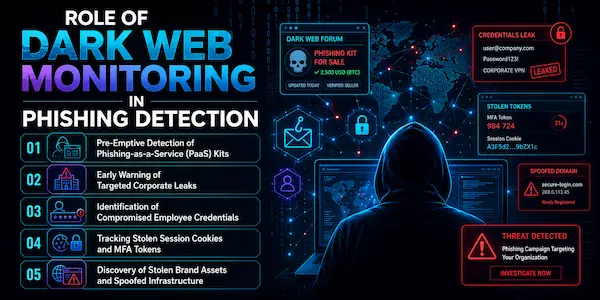
Role of Dark Web Monitoring in Phishing Detection
|
S.No. |
Roles |
What? |
|
1. |
Pre-Emptive Detection of Phishing-as-a-Service (PaaS) Kits |
Before campaigns start, defenders can examine new commercial phishing tools by breaking into illegal underground forums. |
|
2. |
Early Warning of Targeted Corporate Leaks |
When a company is being actively discussed or targeted by cybercriminals, monitoring hacker marketplaces alerts authorities. |
|
3. |
Identification of Compromised Employee Credentials |
Security teams are immediately notified of company passwords disclosed in external breaches by scanning dark web dump sites. |
|
4. |
Tracking Stolen Session Cookies and MFA Tokens |
Hackers may be able to get around multi-factor authentication by identifying compromised session tokens through the scraping of InfoStealer logs. |
|
5. |
Discovery of Stolen Brand Assets and Spoofed Infrastructure |
Monitoring underground communities reveals the exchange of phishing templates and proprietary company imagery for brand imitation. |
Benefits of Using Threat Intelligence Against Phishing Campaigns
The following are the benefits of using threat intelligence against phishing campaigns:
1. Proactive Defenses and Pre-Emptive Blocking: Stops assaults before phishing emails arrive in consumers' inboxes by blocking fraudulent URLs and lookalike infrastructure.
2. Rapid Detection of Advanced and Evasive Tactics: Uses behavioral telemetry to identify complex threats such as zero-day lures and Adversary-in-the-Middle (AiTM) proxies.
3. Accelerated Incident Response and Triage: Expedites containment by mapping adversary motives and automatically verifying phishing warnings reported by users.
4. Early Warning via Dark Web and Domain Monitoring: Warns teams about leaked session tokens, exposed corporate credentials, and brand typosquatting before exploitation.
5. Enhanced Employee Security Awareness Training: Provides security teams with actual, real-world phishing templates so that employees can be trained against contemporary cyberthreats.
Common Challenges in Detecting Phishing Campaigns
The following are some common challenges in detecting phishing campaigns:
● Short-Lived Infrastructure and Dynamic URLs: Before reputation-based security measures can identify a domain, attackers swiftly remove it.
● Adversary-in-the-Middle (AiTM) and Session Hijacking: Conventional gateways are unable to prevent real-time proxy servers from stealing active multi-factor authentication (MFA) tokens.
● Exploitation of Legitimate Cloud and SaaS Platforms: Standard blocklists are easily circumvented by phishing pages hosted on reliable platforms like Google Drive or Microsoft SharePoint.
● Advanced Evasion Techniques (Quishing and Obfuscation): Text concealed within QR codes or highly obfuscated JavaScript source code is difficult for security technologies to decipher.
● Generative AI-Driven Hyper-Personalization: Typos and grammatical problems are eliminated in AI-crafted emails, making it impossible for users to identify lures based just on writing quality.
Best Practices to Improve Phishing Detection
|
S.No. |
Practices |
What? |
|
1. |
Deploy AI-Driven Behavioral Email Security (ICES) |
Instead of depending only on static signatures, use natural language processing to examine communication patterns and identify social engineering anomalies. |
|
2. |
Implement Continuous Domain and Brand Monitoring |
To remove malicious infrastructure early, automate the tracking of newly registered lookalike domains and typosquatting attempts. |
|
3. |
Enforce Phishing-Resistant MFA |
To prevent Adversary-in-the-Middle (AiTM) session hijacking, switch from normal SMS or push-notification codes to FIDO2/WebAuthn hardware keys. |
|
4. |
Integrate Multi-Vector Telemetry with XDR |
If a user clicks on a malicious link, identify and isolate lateral movement by connecting email security logs with endpoint, cloud, and network data. |
|
5. |
Adopt Contextual, Behavior-Driven Employee Training |
Frequent, real-world phishing simulations catered to certain company responsibilities should take the place of general, yearly security slideshows. |
Future of Threat Intelligence in Combating Phishing Attacks
AI-driven predictive analytics, which map out attacker infrastructure before it goes live and enable preemptive blocklists, are the future of threat intelligence. In order to quickly neutralize hyper-personalized, AI-crafted lures and multi-factor authentication (MFA) bypass tactics at the perimeter, this development will concentrate on decentralized, real-time exchange of behavioral telemetry across XDR platforms.
Conclusion
Now that we have talked about what Threat Intelligence is, its features, and you might want to get your hands on a dedicated threat intelligence solution. For that, you can go for Threat Fusion AI offered by Craw Security.
The amazing Threat Fusion AI is a threat intelligence tool specially developed by Craw Security, which can give you alerts of recent and latest cyber threats. This can help you to estimate the risk of such threats, and you can prepare better security solutions beforehand. What are you waiting for? Contact, Now!
Frequently Asked Questions
About Threat Intelligence
1. What is Threat Intelligence in phishing detection?
The use of real-time data, such as known malicious URLs, attacker behavior patterns, and dark web leaks, to proactively identify, prevent, and evaluate deceptive campaigns before they compromise an organization, is known as threat intelligence in phishing detection.
2. How does Threat Intelligence identify phishing campaigns?
In the following ways, threat intelligence identifies phishing campaigns:
a) Correlating Indicators of Compromise (IoCs),
b) Analyzing Infrastructure and Registrar Patterns,
c) Tracking Adversary TTPs (Tactics, Techniques, and Procedures),
d) Deploying Behavioral and NLP Analytics, and
e) Scouring the Dark Web for Early Warning Signs.
3. What are the common indicators of phishing attacks?
The following are the common indicators of phishing attacks:
a) Mismatched Sender Addresses and Display Names,
b) High-Urgency or Threat-Based Language,
c) Suspicious or Unsolicited Links and Attachments,
d) Generic Greetings and Lack of Personalization, and
e) Requests for Sensitive Personal or Financial Information.
4. How does AI help in detecting phishing emails?
In the following ways, AI helps in detecting phishing emails:
a) Natural Language Processing (NLP) and Sentiment Analysis,
b) Computer Vision for Brand Spoofing,
c) Dynamic URL and Link Behavioral Analysis,
d) Communication Graph and Relationship Modeling, and
e) Automated QR Code Deconstruction (Anti-Quishing).
5. What is the role of threat intelligence feeds in cybersecurity?
The following are the roles of threat intelligence feeds in cybersecurity:
a) Automated Perimeter Defense and Real-Time Blocking,
b) Contextualizing Attacks with TTP Mapping,
c) Proactive Threat Hunting and Log Retro-Hunting,
d) Early Warning via Dark Web and External Attack Surface Monitoring, and
e) Accelerated Incident Response and Triage Prioritization.
6. Can Threat Intelligence detect zero-day phishing attacks?
Yes, threat intelligence uses machine learning to analyze real-time behavioral and natural language anomalies before the particular email or URL has a known security signature, tracking the underlying server infrastructure, and profiling anomalous registration metadata to identify zero-day phishing attacks.
7. How do organizations use Threat Intelligence to prevent phishing?
In the following ways, organizations use threat intelligence to prevent phishing:
a) Automated Perimeter Blocking via Gateway Integration,
b) Proactive Domain Takedowns and Brand Protection,
c) Infrastructure-Based URL Analysis and Sandboxing,
d) Dark Web Identity Monitoring, and
e) Tailored Cyber Security Awareness Training.
8. What are the benefits of real-time phishing detection?
The following are the benefits of real-time phishing detection:
a) Immediate Containment and Window of Vulnerability Reduction,
b) Prevention of Adversary-in-the-Middle (AiTM) Session Hijacking,
c) Neutralization of Short-Lived and Zero-Day Infrastructure,
d) Reduced Burden on the Security Operations Center (SOC), and
e) Dynamic, Contextual User Protection.
9. How does Threat Intelligence detect malicious domains and URLs?
In the following ways, threat intelligence detects malicious domains and URLs:
a) Real-Time Typosquatting and Brand Monitoring,
b) Heuristic Infrastructure and ASN Profiling,
c) Lexical and URL Structure Analysis,
d) Domain Age and WHOIS Metadata Tracking, and
e) Behavioral Sandboxing and Page Scraped Analytics.
10. What is the future of Threat Intelligence in combating phishing campaigns?
AI-driven predictive infrastructure mapping and real-time behavioral telemetry, which proactively neutralize hyper-personalized lures and multi-factor authentication (MFA) bypasses before they reach the network, are key components of threat intelligence's future in thwarting phishing operations.
Read More: