Do you know what Threat Intelligence and Ransomware Prevention are and how they can help businesses to stay protected against unknown threats? If not, then you are at the right place. Here, we will talk about both and their benefits in detail.
Moreover, we will introduce you to a reliable threat intel service offered by a reputed VAPT service provider. What are we waiting for? Let’s get straight to the topic!
What Is Ransomware?
Cybercriminals utilize ransomware, a harmful kind of software, to encrypt a victim's vital files, databases, or entire operating systems, making them utterly unusable. Then, in exchange for the decryption key needed to regain access, the attackers demand a hefty cash payment, usually in bitcoin.
Modern strains frequently employ "double extortion" strategies, in which the attackers threaten to sell or publicly reveal the stolen private information if the ransom is not paid. Let’s take a look at Threat Intelligence and Ransomware Prevention in detail!
Why Is Ransomware a Growing Cyber Threat?
|
S.No. |
Factors |
Why? |
|
1. |
Ransomware-as-a-Service (RaaS) |
Allows novice thieves to rent pre-made, advanced malware toolkits, lowering the technical barrier. |
|
2. |
Double and Triple Extortion Tactics |
Threatening to release stolen data and using encryption in conjunction with DDoS attacks are two ways to coerce payments. |
|
3. |
Exploitation of Decentralized Hybrid Work |
Uses unpatched personal devices and shoddy home networks to quickly penetrate corporate boundaries. |
|
4. |
Highly Target-Rich Environments |
Gives priority to hospitals, schools, and key infrastructure that must make immediate payments to save lives or resume essential operations. |
|
5. |
Anonymized Cryptocurrency Ecosystems |
Enables attackers to launder millions of dollars with almost complete anonymity by offering automated, untraceable payment rails. |
What is Threat Intelligence in Cybersecurity?
The gathering, processing, and analysis of information on current or potential threat actors and malevolent strategies in order to comprehend their goals, targets, and attack patterns is known as threat intelligence in cybersecurity.
Organizations may go from a reactive to a proactive defense thanks to this actionable data, which enables security teams to foresee, identify, and stop cyberattacks before they have a chance to impair operations.
Types of Threat Intelligence Used Against Ransomware
The following are some types of threat intelligence used against ransomware:
1. Strategic Threat Intelligence: Guides long-term security budgets by providing executive leadership with information on high-level risk trends, attacker motivations, and financial effects.
2. Tactical Threat Intelligence: Explains the precise techniques, equipment, and attack methods that ransomware gangs employ to help defenders map out architectural mitigations.
3. Operational Threat Intelligence: Provides early warning indicators of an impending attack by tracking real-time, incoming campaign data and active threat actor communications.
4. Technical Threat Intelligence: Gives quick, system-level indicators that may be sent straight into automatic blocking programs, such as known malicious IP addresses and malicious file hashes.
Common Ransomware Attack Techniques and Tactics
|
S.No. |
Factors |
What? |
|
1. |
Phishing and Social Engineering |
Tricking staff members into opening attachments or clicking on dangerous URLs that covertly install ransomware droppers on the network. |
|
2. |
Exploiting Vulnerabilities |
Searching for unpatched security holes in firmware, operating systems, or applications on publicly accessible infrastructure. |
|
3. |
Compromised Remote Access |
VPN gateways and inadequately secured Remote Desktop Protocol (RDP) connections can be taken over by brute-forcing or purchasing stolen credentials. |
|
4. |
Credential Stuffing and Identity Theft |
Millions of compromised password combinations are tested against business login sites using automated scripts until access is obtained. |
|
5. |
Supply Chain Exploitation |
Compromising managed service providers (MSPs) or reputable third-party vendors to spread ransomware to all of their clientele. |
How Threat Intelligence Identifies Emerging Ransomware Threats?
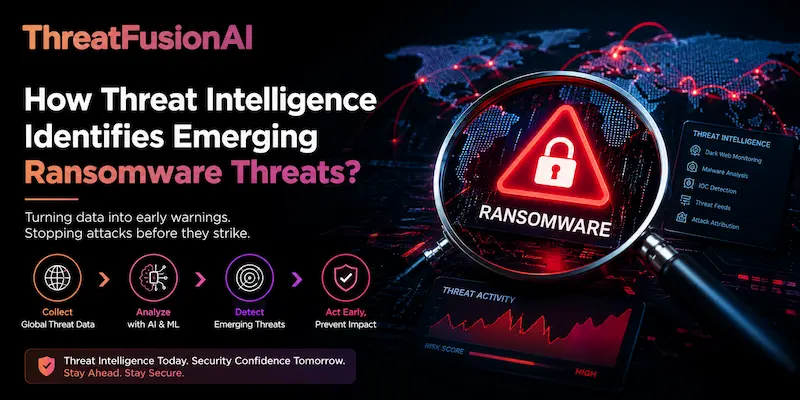
Threat intelligence identifies emerging ransomware threats in the following ways:
● Infiltrating Dark Web Marketplaces: Offers access credentials and intercepts conversations in criminal forums about recently developed malware tools.
● Tracking Adversary TTPs: Shows how ransomware gangs get around existing defenses by mapping hacker strategies to security frameworks.
● Analyzing Malware Sandboxes: Explores how unknown code encrypts files and steals data by detonating it in secure virtual environments.
● Harvesting Global Telemetry: Identifies coordinated infrastructure installations early by correlating real-time sensor data from millions of global networks.
● Identifying Vulnerability Exploitations: Monitors zero-day purchases and public vulnerabilities to identify the precise software issues that hackers are focusing on next.
Detecting Indicators of Compromise (IOCs) Before an Attack
Threat intelligence is used to identify early forensic footprints, such as strange registry changes, unauthorized outgoing connections, or particular malicious file hashes concealed within a network, in order to detect Indicators of Compromise (IOCs).
Security teams may locate and eliminate threat actors that are actively staging infrastructure before they have a chance to carry out their ransomware payload by spotting these digital breadcrumbs early in an incursion.
Role of Threat Intelligence Feeds in Ransomware Prevention
|
S.No. |
Roles |
What? |
|
1. |
Automating Real-Time Blocking |
Instructs firewalls and endpoint security programs to immediately block suspicious file hashes and known ransomware deployment servers. |
|
2. |
Accelerating Incident Response |
Gives defenders immediate context during an alarm, enabling them to swiftly identify, isolate, and stop an intrusion. |
|
3. |
Proactive Threat Hunting |
Provides targeted, high-fidelity signs to specialized security teams so they can look for sleeping, concealed attackers within the network. |
|
4. |
Vulnerability Prioritization |
Identifies the specific unpatched software vulnerabilities that ransomware groups are actively using as weapons so that IT can address them first. |
|
5. |
Enhancing Security Awareness Training |
Incorporates active, real-world phishing lures that have been intercepted from ongoing attacks into simulations for staff testing. |
Challenges in Implementing Threat Intelligence
The following are the challenges in implementing threat intelligence:
a) Data Overload and Signal-to-Noise Ratio: Sends millions of raw, unconfirmed alerts to security professionals, concealing real, serious ransomware threats.
b) Lack of Contextual Relevance: Provides generic, worldwide data packages that don't correspond to a company's particular assets, geography, or industry.
c) Actionability and Operational Delays: Delivers historical information too late to stop the rapid-fire, highly automated stages of ransomware dissemination.
d) The Severe Cybersecurity Skills Shortage: Deprives companies of the skilled tier-three analysts required to decipher intricate threat actor activities.
e) Integration with Legacy Infrastructure: Large blind spots result from the inability of contemporary intelligence formats to seamlessly integrate into outdated security infrastructures.
Future of Threat Intelligence in Combating Ransomware Attacks
The transition from static, reactive indications to autonomous, AI-driven behavioral profiling, which can anticipate and stop fast multi-extortion ransomware attacks in real time, is essential to the future of threat intelligence.
Next-generation threat intelligence will be able to detect moving attacker infrastructures, break up automated Ransomware-as-a-Service (RaaS) supply chains, and isolate compromised identities before encryption starts by combining deep learning with global telemetry.
Conclusion: Building a Proactive Defense Against Ransomware with Threat Intelligence
Now that we have talked about what Threat Intelligence and Ransomware Prevention are, you might want to get your hands on dedicated threat intel services. For that, you can go for Threat Fusion AI, a dedicated threat detection platform offered by Craw Security.
Threat Fusion AI can offer you intel about the latest cyber threats running in the IT Industry and can cause financial and data loss. Thus, you will be able to work in a dedicated, secure working environment. What are you waiting for? Contact, Now!
Frequently Asked Questions
About Threat Intelligence and Ransomware Prevention
1. What is threat intelligence in cybersecurity?
In cybersecurity, threat intelligence refers to the data that has been examined on active hackers and their tactics, which are used by businesses to anticipate, detect, and prevent cyberattacks before they cause harm.
2. How does threat intelligence help prevent ransomware attacks?
Threat intelligence helps prevent ransomware attacks in the following ways:
a) Exposing Early Attack Infrastructure,
b) Spotting Early Warning Signs (IOCs),
c) Prioritizing Critical Vulnerability Patching,
d) Fueling Proactive Threat Hunting, and
e) Uncovering Dark Web Access Sales.
3. What are Indicators of Compromise (IOCs) in ransomware detection?
Indicators of Compromise (IOCs) are forensic digital signs that demonstrate the presence of a ransomware attacker within a network, such as strange IP addresses, malicious file hashes, or odd system changes.
4. Can threat intelligence stop ransomware attacks completely?
No, because ransomware cannot be totally prevented by threat intelligence, even if it greatly reduces the chance of infection. This is because zero-day exploits and human error that evade security filters are always emerging.
5. How do threat intelligence feeds work?
Threat intelligence feeds work in the following ways:
a) Global Data Aggregation,
b) Normalization and Enrichment,
c) Real-Time Delivery,
d) Automated Security Integration, and
e) Instant Actionable Enforcement.
6. What role does threat hunting play in ransomware prevention?
Threat hunting plays the following roles in ransomware prevention:
a) Finding Dwell-Time Intruders,
b) Intercepting Lateral Movement,
c) Stopping Data Exfiltration,
d) Exposing Living-off-the-Land Tactics, and
e) Validating Defensive Controls.
7. How can businesses use threat intelligence to improve cybersecurity?
Businesses use threat intelligence to improve cybersecurity in the following ways:
a) Prioritizing Vulnerability Patching,
b) Automating Security Operations.
c) Monitoring Supply Chain Risks,
d) Accelerating Incident Response, and
e) Guiding Executive Strategy and Budgets.
8. What are the different types of threat intelligence?
The following are the different types of threat intelligence:
a) Strategic Intelligence,
b) Tactical Intelligence,
c) Operational Intelligence, and
d) Technical Intelligence.
9. How does threat intelligence help detect phishing-based ransomware attacks?
Threat intelligence helps detect phishing-based ransomware attacks in the following ways:
a) Flagging Newly Registered and Lookalike Domains,
b) Identifying Known Malicious Attachments and Loaders,
c) Recognizing Evolving Phishing Templates and Lures,
d) Blocking Dropper Infrastructure and Callbacks, and
e) Uncovering Compromised Third-Party Senders.
10. Which tools are commonly used for threat intelligence and ransomware defense?
The following tools are commonly used for threat intelligence and ransomware defense:
a) Threat Intelligence Platforms (TIPs) — e.g., Anomali, Cyware, MISP,
b) Endpoint Detection and Response (EDR / XDR) — e.g., CrowdStrike Falcon, SentinelOne, Microsoft Defender,
c) Dark Web & Exposure Monitoring Tools — e.g., Flare, FalconFeeds,
d) Vulnerability and Attack Surface Managers — e.g., Tenable Nessus, Shodan, and
e) Immutable Backup & Disaster Recovery Software — e.g., Cohesity, N2WS, Backblaze.