Do you know what help Threat Intelligence can offer you if your whole business is online? If not, then you are at the right place. Here, we will explore what threat intelligence is, its uses, importance, and where you can get such amazing services.
Moreover, we will introduce you to a reliable threat intelligence platform offered by a reputable VAPT service provider. What are we waiting for? Let’s get straight to the topic!
What is Threat Intelligence?
The information gathered, examined, and refined about new cyberthreats, malevolent individuals, and active attack vectors that companies employ to comprehend the intentions and strategies of their enemies is known as threat intelligence.
It enables security companies to move from reactive monitoring to proactive protection by converting raw data into usable insights like malicious IP addresses, malware signatures, and hacking group tactics.
In the end, this setting enables security analysts and automated SOC technologies to anticipate, detect, and thwart sophisticated cyberattacks before they can penetrate the network footprint. Let’s take a look at what Threat Intelligence is, its uses, and where you can get this facility!
Why Application Modernization Needs Strong Security?
|
S.No. |
Factors |
Why? |
|
1. |
Expanded Attack Surface from Microservices |
Hackers can target a large number of new APIs and network communication points that are created when monoliths are divided into microservices. |
|
2. |
Rapid CI/ CD Deployment Risks |
Traditional safety checks can be easily circumvented by fast-moving shipping pipelines, allowing untested vulnerabilities to enter active production. |
|
3. |
Secrets Management and Credential Leakage |
The potential of catastrophic data leaks is greatly increased when tokens, passwords, and API keys are hardcoded into container systems. |
|
4. |
Insecure Open-Source Dependencies |
Third-party code packages, which often contain dangerous backdoors or hidden vulnerabilities, are a major component of modern apps. |
|
5. |
Loss of Traditional Perimeter Defenses |
Because cloud-native and containerized apps don't have a single physical barrier, legacy firewalls are totally ineffective against contemporary attacks. |
Types of Threat Intelligence: Strategic, Tactical, Operational, and Technical
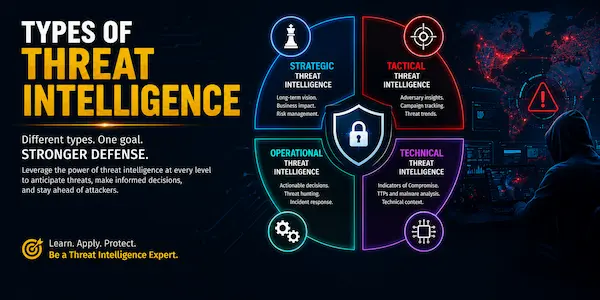
The following are some types of threat intelligence:
1. Strategic Threat Intelligence: Executive-level business decisions based on high-level summaries of evolving risk environments, attacker motivations, and geopolitical changes.
2. Tactical Threat Intelligence: Threat actor tactics, methods, and procedures (TTPs) are thoroughly analyzed to assist defenders in mapping out and comprehending adversary assault approaches.
3. Operational Threat Intelligence: Real-time, actionable information about particular, developing cyberattacks that enables incident response teams to foresee and stop ongoing efforts.
4. Technical Threat Intelligence: Malicious IP addresses, file hashes, and phishing URLs are examples of high-volume, transient security data that are utilized to directly update automatic firewall and SIEM blocklists.
The Challenges of Modernizing Legacy Applications
The following are the challenges of modernizing legacy applications:
● Accumulated Technical Debt and Complexity: Legacy systems are very challenging to disentangle and rework due to decades of unpatched, poorly documented code.
● Severe Data Migration and Integrity Risks: Large amounts of outdated, unstructured data are often corrupted or lost when transferred to contemporary cloud databases.
● Fragile System Interdependencies: Because legacy apps are intricately linked to other essential business systems, even a minor modification might have disastrous knock-on effects.
● The Shrinking Talent and Expertise Pool: It's getting harder and more expensive to find engineers who can still understand outdated programming languages like COBOL or Fortran.
● High Operational Downtime and Budget Overruns: Initiatives for modernization are infamous for causing operations to slow, interfering with user experiences, and significantly surpassing initial budgetary estimates.
Common Security Risks in Application Modernization
|
S.No. |
Risks |
What? |
|
1. |
API Vulnerabilities and Broken Object-Level Authorization |
Attackers can immediately access restricted company data and modify object IDs by exposing vulnerable API endpoints. |
|
2. |
Secrets Sprawl and Misconfigured Cloud Containers |
Catastrophic data breaches are encouraged when cloud storage buckets and API keys are left open in code repositories. |
|
3. |
Software Supply Chain Attacks via Third-Party Dependencies |
Hackers can insert malicious backdoors directly into production environments by relying on unapproved, open-source code packages. |
|
4. |
Over-Privileged Identity and Access Management (IAM) |
If a single asset is compromised, lateral movement is made possible by giving automated service accounts extensive administrative permissions. |
|
5. |
Bypassing Security Checks in Fast-Paced CI/ CD Pipelines |
Critical security screening tools are frequently completely ignored when code deployments are rushed in order to maximize speed. |
The Role of Threat Intelligence in Proactive Security
The following are the roles of threat intelligence in proactive security:
a) Enables Proactive Threat Hunting: Enables defenders to search for concealed attackers already present in the network by providing unique adversary techniques and indicators of compromise (IoCs).
b) Accelerates Incident Response and Triage: Provides quick context for incoming warnings, assisting analysts in determining the attack's severity, source, and motivation.
c) Optimizes Automated Defenses (SOAR): Dynamically blocks harmful IPs and domains at machine speed by feeding real-time, high-fidelity blocklists straight into automation tools.
d) Powers Vulnerability Management: Identifies the system vulnerabilities that hackers are actively using in the wild, which aids security teams in setting patching priorities.
e) Informs Strategic Risk Decisions: Gives executive leadership hard data on industry threat trends so they can deploy cybersecurity expenditures appropriately and fortify long-term defenses.
Threat Intelligence in Cloud Migration Security
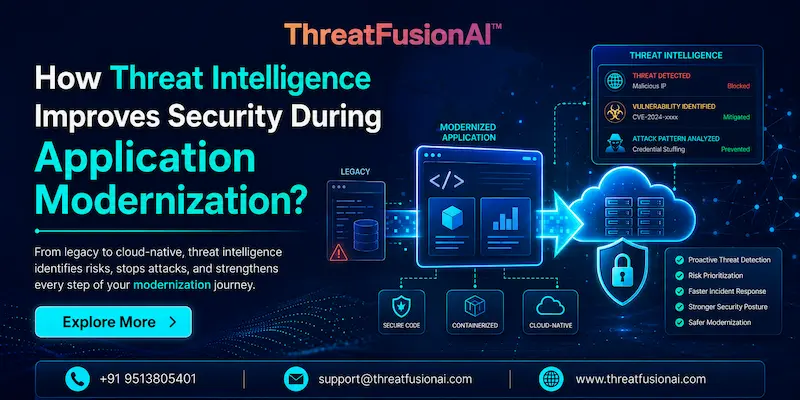
Threat intelligence serves as a proactive security blueprint throughout cloud migration by pinpointing the precise strategies used by cloud-native attackers to target misconfigured infrastructure, exposed storage buckets, and API endpoints.
Security teams can proactively harden their new cloud infrastructures, prioritize patches for active in-the-wild vulnerabilities, and set up hyper-targeted monitoring rules before any production data is migrated by incorporating these real-time attacker insights into the migration lifecycle.
Protecting Containerized and Microservices Architectures
A zero-trust defense strategy that incorporates security tools directly into the CI/CD pipeline and uses micro-segmentation via a service mesh to separate network traffic between individual services is necessary to safeguard containerized and microservices systems.
In order to quickly identify unwanted behavioral anomalies, misconfigurations, and compromised open-source dependencies throughout the container ecosystem, security teams must also implement automatic vulnerability scanning and continuous runtime protection.
Integrating Threat Intelligence into DevSecOps
By incorporating threat intelligence into DevSecOps, real-time adversary insights are immediately injected into the CI/CD pipeline, enabling automated scanners to fail builds in the event that newly discovered, actively exploited dependencies are found.
By converting static code analysis into a threat-aware testing procedure that fortifies applications against contemporary, practical attack techniques before they even make it to production, this ongoing feedback loop pushes security to the left.
Enhancing Secure Coding Practices with Threat Insights
In the following ways, you can enhance secure coding practices with threat insights:
1. Context-Driven Vulnerability Prioritization: Concentrates developer remediation efforts on addressing software vulnerabilities that are being actively exploited by adversaries in the real world.
2. Proactive API and Architecture Hardening: Uses known attacker patterns against endpoints to inform the creation of rigorous input validation and rate-limiting rules.
3. Targeted Threat Modeling for New Features: Anticipates and codes defenses against future feature abuse by incorporating active adversary strategies into the earliest design phase.
4. Simulating Real-World Attacks in Code Reviews: Gives reviewers the tools they need to manually find and fix small logic errors in source code using modern hacker techniques.
5. Mitigating Software Supply Chain Risks: Prevents developers from importing contaminated third-party packages by offering real-time alerts on hacked open-source repositories.
Best Practices for Embedding Threat Intelligence Across Teams
|
S.No. |
Practices |
What? |
|
1. |
Establish a Centralized Threat Intelligence Platform (TIP) |
Ensures that all security teams have access to identical, deduplicated intelligence by combining raw threat data into a single source of truth. |
|
2. |
Tailor Intelligence Deliverables to the Audience |
Transforms technical data into actionable indicators for front-line analysts and strategic briefings for executives. |
|
3. |
Integrate Intelligence via Automated APIs and Webhooks |
Enables immediate, automated defenses by immediately feeding real-time threat data into SIEM, SOAR, and CI/CD systems. |
|
4. |
Create a Bidirectional Feedback Loop |
Enables developers and incident responders to share real-world discoveries with the intelligence team so that detection models can be improved over time. |
|
5. |
Conduct Cross-Functional Threat Briefings and Tabletop Exercises |
Before a live breach happens, multiple teams are trained on coordinated response processes using real-world threat scenarios. |
Case Studies: Success Stories in Threat-Intelligence-Driven Modernization
The following are some of the amazing case studies:
● Global Retailer (Dollar Tree) Modernizes Threat Detection Operations: Saved 60 hours a month on threat research and reduced cloud SIEM migration time by months by utilizing automated threat intelligence and a worldwide feed of detection algorithms.
● Global IT & Digital Transformation Firm (LTIMindtree) Optimizes Enterprise Content: To save 4,000 hours annually on threat research and custom coding across numerous client SIEM/EDR instances, automated, behavior-based threat detection streaming was implemented and tied to MITRE ATT&CK.
● Managed Detection and Response Provider (Netox Oy) Overhauls False Positives: Reduce false positives by 35% and detection engineering efforts by 70% by integrating AI-powered threat intelligence feeds and automated rule translation.
The Future of Application Security with Threat Intelligence
Fully autonomous, self-healing code ecosystems powered by agentic AI and ongoing threat intelligence are key to the future of application security. Intelligent systems can instantaneously map incoming real-time global threat feeds against live applications, eliminating zero-day vulnerabilities at the millisecond scale by automatically creating and distributing hot patches to runtime code. This eliminates the need for manual security testing.
Conclusion: Achieving Resilient and Secure Modern Applications
Now that we have talked about Threat Intelligence, you might want a dedicated threat detection solution for yourself. For that, you can go for Threat Fusion AI offered by a reputed VAPT service provider, Craw Security.
This amazing platform can offer you the latest and current cybersecurity & threats insights. That will help you to be prepared for the unknown threats in time so that you can be safe against risky losses. What are you waiting for? Contact, Now!
Frequently Asked Questions
About Threat Intelligence
1. What is threat intelligence, and why is it important for application modernization?
Organizations may proactively safeguard newly expanded attack surfaces and prevent vulnerabilities throughout the application modernization lifecycle by using threat intelligence, which offers real-time insights into active adversary tactics.
2. How does application modernization introduce new security risks?
Application modernization introduces new security risks in the following ways:
a) Fragmented Attack Surface via Microservices,
b) Secrets Sprawl Across Distributed Pipelines,
c) Complex Software Supply Chains and Open-Source Dependencies,
d) Loss of Traditional Network Perimeters, and
e) Over-Privileged Identity and Access Management (IAM) Roles.
3. What types of threat intelligence can organizations leverage?
Organizations can leverage the following types of threat intelligence:
a) Strategic Threat Intelligence,
b) Tactical Threat Intelligence,
c) Operational Threat Intelligence, and
d) Technical Threat Intelligence.
4. How can threat intelligence improve DevSecOps practices?
Threat intelligence can improve DevSecOps practices in the following ways:
a) Context-Driven Vulnerability Prioritization,
b) Automated CI/CD Build Breaking,
c) Dynamic Threat Modeling during Sprint Planning,
d) Proactive Security Test Case Generation, and
e) Real-Time Runtime Protection Tuning.
5. Can threat intelligence help secure cloud-native applications?
Yes, threat intelligence protects cloud-native apps by giving security teams real-time insight into active attacker strategies aimed at cloud infrastructure, allowing them to proactively harden APIs, containers, and access restrictions before they are exploited.
6. How does threat intelligence support vulnerability management during modernization?
Threat intelligence can support vulnerability management during modernization in the following ways:
a) Prioritizing Exploitable Flaws over Raw CVSS Scores,
b) Accelerating Patching Cycles for Legacy Systems,
c) Validating Third-Party Code Safety in Real-Time,
d) Contextualizing Cloud-Native Misconfigurations, and
e) Informing Virtual Patching and WAF Rules.
7. What role does threat intelligence play in protecting microservices and containers?
Threat intelligence plays the following roles in protecting microservices and containers:
a) Detecting Rogue Container Activity via Runtime Behavioral Analysis,
b) Securing Inter-Service Communications in Service Meshes,
c) Flagging Poisoned Base Images in Container Registries,
d) Throttling Rapid API Attacks and Data Exfiltration, and
e) Optimizing Cloud-Native Incident Response and Forensic Investigation.
8. How can organizations use threat intelligence for proactive incident response?
Organizations can use threat intelligence for proactive incident response in the following ways:
a) Preemptive Threat Hunting,
b) Automated Playbook Execution via SOAR,
c) Accurate Alert Triage and Prioritization,
d) Intelligence-Driven Tabletop Simulations, and
e) Proactive Perimeter and WAF Hardening.
9. Are there real-world examples of threat intelligence improving application security?
Yes, big businesses employ threat intelligence to instantaneously stop automated botnet attacks that target production APIs, prioritize vulnerabilities based on active in-the-wild exploits, and dynamically update Web Application Firewalls (WAFs).
10. What are the best practices for integrating threat intelligence into modernization projects?
The following are the best practices for integrating threat intelligence into modernization projects:
a) Establish a Centralized Threat Intelligence Platform (TIP),
b) Automate Intelligence Ingestion into CI/CD Pipelines,
c) Tailor Threat Insights for Multi-Disciplinary Teams,
d) Map Modern Architectures to Threat Frameworks, and
e) Implement a Bidirectional Feedback Loop.
Read More:
Top Benefits of Cyber Threat Intelligence for Businesses