Do you know what Threat Actor Attribution is and how it can help businesses to protect their data against unknown cyber threats? If not, then you are in the right place. Here, we will talk about threat actor attribution and related facilities in detail.
Moreover, we will introduce you to a reliable threat intel solution offered by a reputable VAPT service provider. What are we waiting for? Let’s get straight to the topic!
What Is Threat Actor Attribution in Cybersecurity?
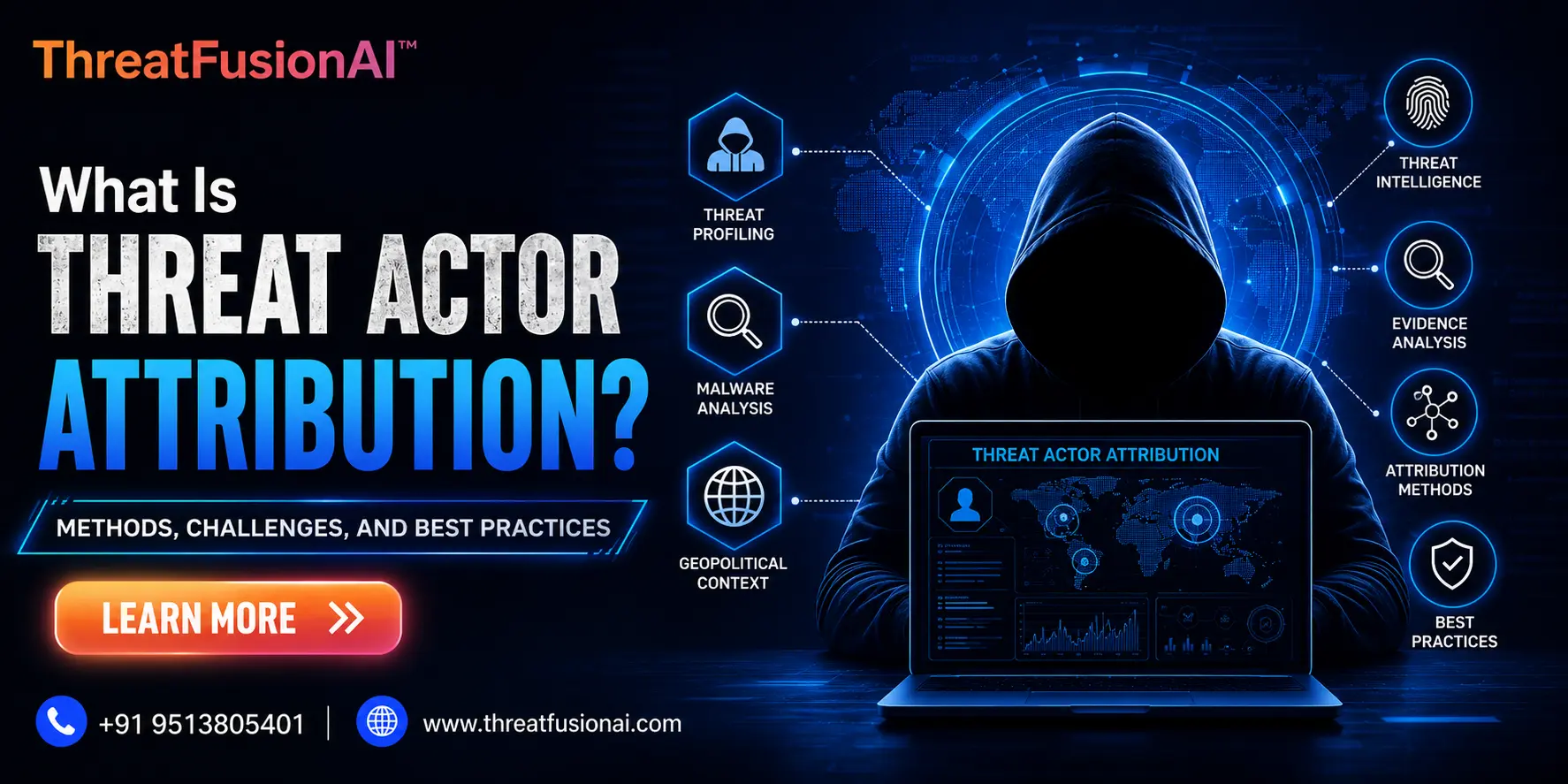
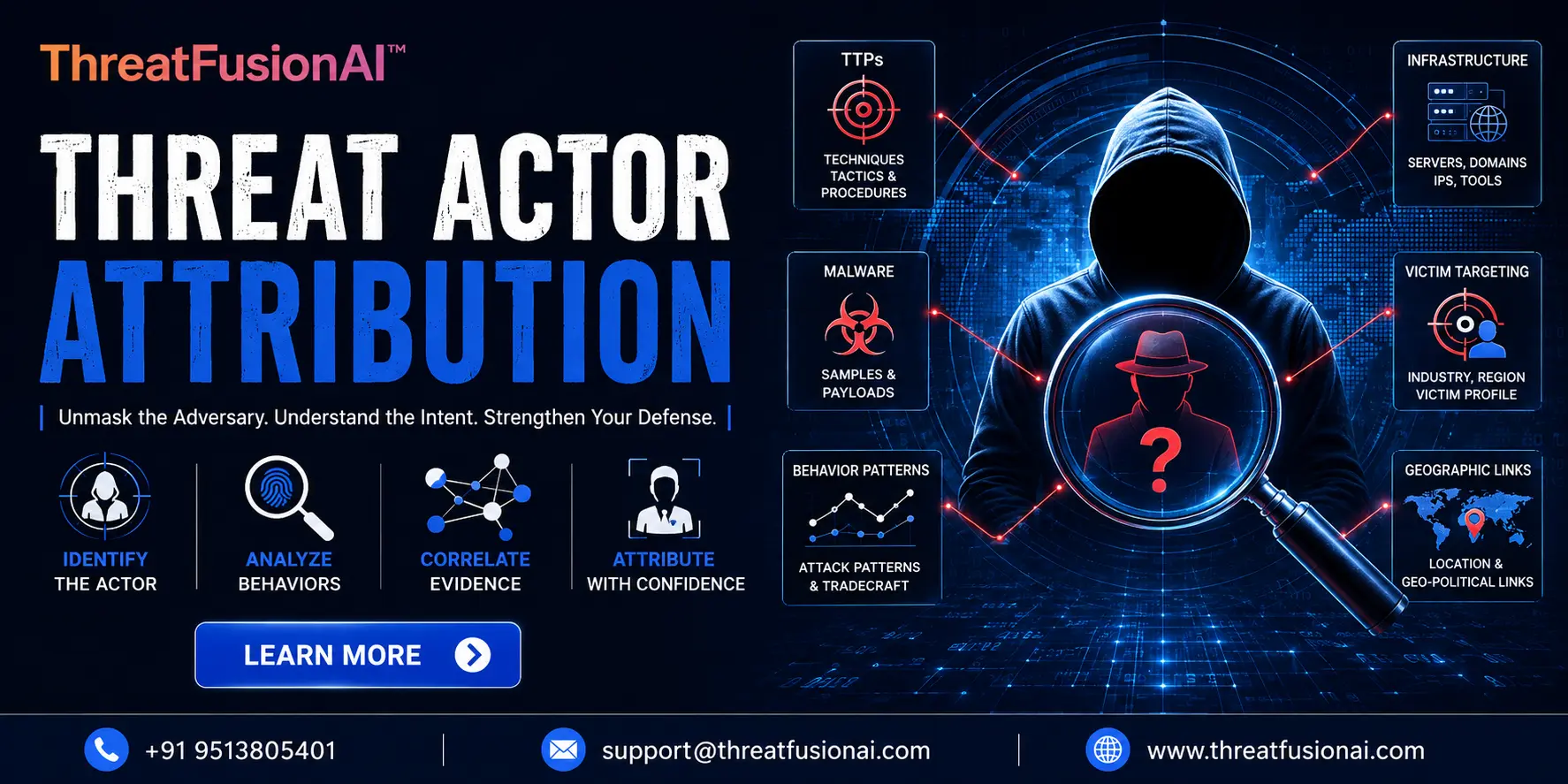
In cybersecurity, threat actor attribution is the methodical process of identifying the precise person, organization, or nation-state responsible for a cyber intrusion by carefully examining technical evidence, attack patterns, digital footprints, and contextual intelligence.
Analysts create a profile of the adversary's identity, operational capabilities, and underlying motivations by comparing tactics, methods, and procedures (TTPs) and indicators of compromise (IOCs) with past threat campaigns.
Accurate attribution helps enterprises to foresee future attacks, implement targeted defenses, and support legal, diplomatic, or regulatory actions, even though reaching complete assurance is still challenging due to IP spoofing and proxy architecture.
Let’s take a look at what threat actor attribution is, its uses, its features, and its benefits for organizations in the IT Industry!
Levels of Attribution: Tactical, Operational, and Strategic
|
S.No. |
Levels |
What? |
|
1. |
Tactical Attribution (Technical Artifacts & IOCs) |
Identifies precise technical signs including IP addresses, file hashes, and malware domains to block urgent threats. |
|
2. |
Operational Attribution (TTPs & Campaign Behaviors) |
Connects discrete episodes into a larger, ongoing threat campaign by mapping adversary strategies, approaches, and technologies. |
|
3. |
Strategic Attribution (Identity, Motive & Geopolitics) |
Reveals the true name, sponsoring nation-state, and underlying financial or geopolitical motivations behind the cyberattack. |
Why Is Threat Actor Attribution Important for Cybersecurity?
Threat actor attribution is important for cybersecurity for the following reasons:
1. Predicts Adversary TTPs and Next Moves: Profiles known threat actor techniques to predict future attack steps.
2. Informs Strategic Risk Management & Resource Allocation: Directs security investment toward defenses that go after the enemies of your particular industry.
3. Accelerates Incident Response and Containment: Uses tried-and-true playbooks customized for the identified attacker to expedite breach remediation.
4. Enables Legal, Regulatory, and Law Enforcement Action: Provides digital evidence that can be used to support criminal charges, penalties, and adherence to regulations.
5. Deters Threat Actors Through Geopolitical & Economic Cost: Increases the cost of launching cyberattacks by imposing financial, political, and punitive repercussions.
How Does Threat Actor Attribution Work?
Threat actor attribution works in the following ways:
● Technical Artifact Collection & Telemetry Gathering: Obtains hard digital evidence directly from impacted systems, such as file hashes, network logs, and malware samples.
● TTP Profiling and Behavior Mapping: Identifies distinctive operational patterns by mapping adversary orders and tactics against frameworks such as MITER ATT&CK.
● Infrastructure Tracking & Domain Pivoting: Identifies the attacker's network by tracking command-and-control servers, SSL certificates, and domain registration trends.
● Threat Intelligence Correlation: Finds matches by cross-referencing individual signs with global threat intelligence and campaign databases from the past.
● Geopolitical & Intent Analysis: Determines financial, strategic, or nation-state motivations by analyzing victim demographics, timing, and types of stolen data.
What Are the Main Methods of Threat Actor Attribution?
|
S.No. |
Methods |
What? |
|
1. |
Malware & Code Reverse Engineering |
Identifies common malware lineages by analyzing distinct code signatures, gathering timestamps, and examining developer artifacts. |
|
2. |
Infrastructure & Network Pivoting |
Maps attacker hosting networks by tracking command-and-control IP clusters, SSL certificates, and domain registration metadata. |
|
3. |
Behavioral & TTP Pattern Mapping |
Finds command-line execution patterns, operational habits, and active hours throughout the MITER ATT&CK framework. |
|
4. |
Victimology & Geopolitical Intent Analysis |
Identifies underlying strategic motivations by analyzing targeted sectors, geographical areas, and exfiltrated data kinds. |
|
5. |
Human Intelligence (HUMINT) & Cyber Counterintelligence |
Uses insider leaks, informant intelligence, and undercover forum monitoring to identify particular danger actors. |
What Technical Indicators Help Identify Threat Actors?
The following technical indicators help identify threat actors:
a) Malware Code & Compile Metadata: Reveals reused code functions, debug routes, compiler timestamps, and unique developer language settings.
b) Network Infrastructure & C2 Indicators: Reveals beaconing intervals, SSL/TLS certificate hashes, domain registration information, and IP addresses possessed by adversaries.
c) Command Line & Tooling Execution Patterns: Highlights the use of living-off-the-land utility syntax, bespoke tool flags, and particular administration scripts during incursion.
d) Persistence & Authentication Mechanisms: Finds stolen API token footprints, compromised service accounts, registry modification keys, and scheduled task names.
e) Exfiltration Telemetry & Encryption Profiles: Identifies outbound staging directories, specific encryption algorithms, compression tools, and target archive formats.
How Does Threat Intelligence Support Threat Actor Attribution?
Threat intelligence supports threat actor attribution in the following ways:
1. Cross-References Historical Campaign Data: Connects isolated intrusions to known threat actor groups by comparing recently detected telemetry with global history databases.
2. Tracks Evolving C2 Infrastructure: Maps an adversary's hosting networks and domain architecture across time using passive DNS, SSL certificate archives, and WHOIS information.
3. Standardizes Behavioral Profiling (TTPs): Highlights the distinct operational habits and tactics of an adversary by mapping unstructured attack records to structured frameworks like MITER ATT&CK.
4. Enriches Context and Victimology: Combines geopolitical knowledge, industry targeting trends, and technical clues to distinguish APTs from financial crooks.
5. Leverages Collective Community Intelligence: Combines vendor research, open-source intelligence (OSINT), and ISAC feeds to identify extensive, multi-organization campaigns.
What Are the Biggest Challenges in Threat Actor Attribution?
|
S.No. |
Challenges |
What? |
|
1. |
Use of False Flags & Deceptive Tactics |
To frame other threat organizations, adversaries purposefully insert false timestamps, stolen code, and deceptive language strings. |
|
2. |
Shared Tooling & Commercial Malware |
Different groups appear to be identical due to the widespread use of ransomware-as-a-service and open-source software. |
|
3. |
Proxy Infrastructure & Anonymization Networks |
Real origin locations are concealed by using Tor, bulletproof hosting, and compromised IoT devices to route C2 communication. |
|
4. |
Evolving TTPs & "Living-off-the-Land" Methods |
There aren't many unique digital traces left behind when using trustworthy system tools (like PowerShell and WMI). |
|
5. |
Geopolitical & Evidentiary Gaps |
Serious evidence dead ends are caused by non-cooperative international legal jurisdictions and a reluctance to share confidential intelligence. |
How Do Threat Actors Use False Flags to Hide Their Identity?
Threat actors use false flags to hide their identity in the following ways:
● Planting Foreign Language Indicators and Timestamps: Inserters misdirect forensic investigation by using keyboard layouts, non-native language texts, and modified compile timestamps.
● Reusing Known Malware Code and Signatures: Copies signature code and open-source exploit modules from other organizations to conceal one's identity.
● Hijacking Rival Command-and-Control (C2) Infrastructure: Routes harmful traffic via well-known enemy servers to provide the impression that competing threat actors are to blame.
● Mimicking Distinct TTPs and Naming Conventions: Copies well-known APT groups' unique file naming conventions, registry keys, and command-line syntax.
● Deploying Decoy Ransomware or Destructive Wipers: Disguises targeted espionage as common cybercrime by using generic ransomware notes or fictitious wiping procedures.
What Common Mistakes Should Organizations Avoid During Attribution?
Organizations should avoid the following types of common mistakes during attribution:
a) Relying Solely on Mutable Technical Indicators (IOCs): Making judgments based only on IP addresses or domain names that are simple for hackers to lease, spoof, or delete.
b) Falling Victim to Confirmation Bias: Disregarding contradictory information and forcing forensic evidence to support a preliminary suspicion about a certain adversary.
c) Ignoring False Flag Indicators: Ignoring clues that have been planted, code that has been cloned, or timestamps that have been altered to deceive investigators.
d) Overlooking "Living-off-the-Land" Context: Treating native administrative tools as distinct attacker signatures rather than assessing their actual usage.
e) Rushing Strategic Attribution Without Sufficient Evidence: Designating a country or group too soon without first verifying operational, technical, and intent-based data.
What Are the Best Practices for Accurate Threat Actor Attribution?
|
S.No. |
Factors |
What? |
|
1. |
Apply Structured Analytic Frameworks |
To objectively arrange complex telemetry, use tried-and-true techniques like the Diamond Model and Cyber Kill Chain. |
|
2. |
Prioritize Long-Term TTP Behavior Over Static Indicators |
Instead of concentrating on readily changed IP addresses or domain hashes, consider enduring operational practices and strategies. |
|
3. |
Enforce Multi-Source Intelligence Corroboration |
Verify internal telemetry using OSINT, commercial threat intelligence, and external ISAC feeds. |
|
4. |
Account for False Flags and Anti-Forensic Deception |
Before completing claims, actively look for borrowed code, modified timestamps, and planted language artifacts. |
|
5. |
Use Phased Confidence Levels and Avoid Premature Claims |
Assign distinct confidence levels (low, medium, and high) and refrain from making public statements until the data is completely solidified. |
Conclusion: Improving Threat Actor Attribution With Actionable Intelligence
Now that we have talked about what Threat Actor Attribution is, you might want to get your hands on a dedicated threat intel solution from a reliable source. For that, you can go for ThreatFusionAI, a dedicated threat intel platform offered by Craw Security.
ThreatFusionAI can help organizations by notifying them about the latest cybersecurity risks and malicious threats so that they can enhance their security measures in time. Thus, you can rely on this amazing platform. What are you waiting for? Contact, Now!
Frequently Asked Questions
About Threat Actor Attribution
1. What is threat actor attribution in cybersecurity?
The process of identifying the precise person, organization, or nation-state responsible for a cyber breach by examining technical evidence, behavioral patterns, and contextual intelligence is known as threat actor attribution.
2. Why is threat actor attribution important?
Threat actor attribution is important for the following reasons:
a) Predicts Adversary Behavior and Next Steps,
b) Informs Strategic Risk and Resource Allocation,
c) Accelerates Incident Response and Containment,
d) Enables Legal, Regulatory, and Law Enforcement Action, and
e) Imposes Financial and Geopolitical Costs on Attackers.
3. How does threat actor attribution work?
Threat actor attribution works in the following ways:
a) Technical Evidence & Telemetry Gathering,
b) TTP Profiling & Behavioral Mapping,
c) Infrastructure Tracking & Network Pivoting,
d) Cross-Campaign Threat Intelligence Correlation, and
e) Victimology & Intent Analysis.
4. What methods are used to identify threat actors?
The following methods are used to identify threat actors:
a) Malware Reverse Engineering & Code Analysis,
b) Infrastructure & Network Pivoting,
c) Behavioral & TTP Profiling,
d) Victimology & Geopolitical Intent Analysis, and
e) Human & Counterintelligence (HUMINT/OSINT).
5. What data is required for threat actor attribution?
The following data is required for threat actor attribution:
a) Technical Indicators (IOCs),
b) Behavioral Telemetry (TTPs),
c) Malware Reverse Engineering Data,
d) Infrastructure & Network Metadata, and
e) Victimology & Contextual Intelligence.
6. How does threat intelligence support threat actor attribution?
Threat intelligence supports threat actor attribution in the following ways:
a) Correlates Telemetry with Historical Campaign Data,
b) Tracks Evolving C2 Infrastructure,
c) Standardizes Behavioral Profiling (TTPs),
d) Provides Victimology and Geopolitical Context, and
e) Aggregates Multi-Source Community Intelligence.
7. What are the biggest challenges in threat actor attribution?
The following are the biggest challenges in threat actor attribution:
a) Use of False Flags & Deceptive Tactics,
b) Shared Tooling & Commercial Malware,
c) Proxy Infrastructure & Anonymization Networks,
d) "Living-off-the-Land" (LotL) Techniques, and
e) Geopolitical & Evidentiary Barriers.
8. How do threat actors use false flags to hide their identity?
Threat actors use false flags to hide their identity in the following ways:
a) Planting Misleading Language Strings and Timestamps,
b) Reusing Known Malware Code and Signatures,
c) Hijacking Rival Infrastructure,
d) Mimicking Distinct TTPs and Naming Conventions, and
e) Deploying Decoy Ransomware or Wipers.
9. How can AI and machine learning improve threat actor attribution?
AI and ML can improve threat actor attribution in the following ways:
a) Automates Stylometric & Author Profiling,
b) Accelerates Large-Scale Malware Clustering,
c) Detects Subtle Behavioral & TTP Anomalies,
d) Correlates Multi-Modal Data Sources, and
e) Filters False Flags and Anti-Forensics.
10. What are the best practices for accurate threat actor attribution?
The following are the best practices for accurate threat actor attribution:
a) Apply Structured Analytic Frameworks,
b) Prioritize Long-Term TTP Behavior Over Static Indicators,
c) Enforce Multi-Source Intelligence Corroboration,
d) Account for False Flags and Anti-Forensic Deception, and
e) Use Phased Confidence Levels and Avoid Premature Claims.