Do you know what Vendor Threat Feed Integration is and how it can help your organization against online threats with ease? If not, then you are at the right place. Here, we will talk about how vendor threat feed integration can benefit organizations in detail.
Moreover, we will introduce you to a reliable threat intelligence solution offered by a reputable VAPT service provider. What are we waiting for? Let’s get straight to the topic!
What Is Vendor Threat Feed Integration?
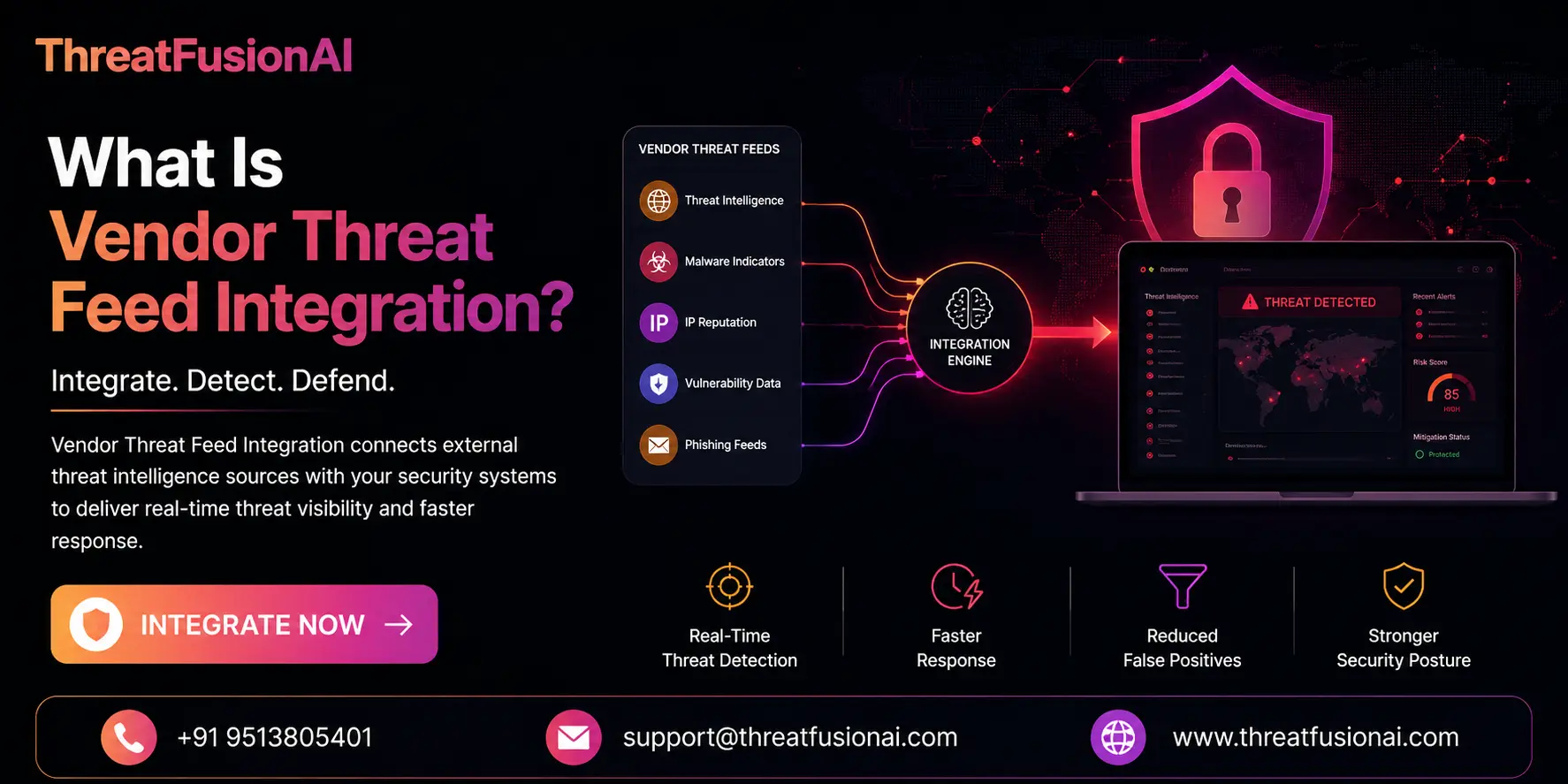
The automated process of integrating external, real-time cyber threat intelligence streams into an organization's current security infrastructure, such as SIEM, SOAR, or firewall systems, is known as vendor threat feed integration.
It reduces human investigation and speeds up threat containment by continuously consuming updated indicators of compromise (IoCs), malicious domains, and IP addresses from reliable third-party providers.
Security operations centers are able to quickly identify, verify, and stop new international cyberthreats before they jeopardize the company's internal network, thanks to this smooth technical pipeline.
Let’s take a look at what Vendor Threat Feed Integration is and how it helps organizations in the IT Industry!
Types of Threat Intelligence Data Provided by Vendors
|
S.No. |
Types |
What? |
|
1. |
Strategic Threat Intelligence |
High-level executive summaries that cover geopolitical risk environments, attacker motivations, and long-term cyber trends. |
|
2. |
Tactical Threat Intelligence |
Attacker approaches, tactics, techniques, and procedures (TTPs) in real time are mapped to frameworks such as MITRE ATT&CK. |
|
3. |
Operational Threat Intelligence |
Actionable information on particular inbound campaigns, such as the nature, timing, and targets of an impending cyberattack. |
|
4. |
Technical Threat Intelligence |
Feeds of particular indicators of compromise (IoCs), such as rogue URLs, file hashes, and malicious IPs, that are tactically machine-readable. |
Key Components of a Vendor Threat Feed Integration Framework
The following are the key components of a vendor threat feed integration framework:
1. Data Ingestion Connectors (APIs): Pipelines for secure communication that automatically import real-time threat information into internal systems from platforms run by third-party vendors.
2. Normalization and Parsing Engine: Software for translating complex, multi-vendor threat data formats into a single, standardized format.
3. Enrichment and Deduplication Layer: Filters that provide important context, such as geographic risk rankings, to the data while removing redundant information.
4. Correlation and Aggregation Module: An analytics engine that finds hidden security issues by comparing internal network records with incoming threat data.
5. Automated Action and Orchestration (SOAR): Playbooks that instantly activate endpoint security tools and firewalls to stop threats without the need for human intervention.
How Vendor Threat Feed Integration Works?
Vendor threat feed integration works in the following ways:
● Automated Data Ingestion (APIs): Real-time threat data streams are continuously pulled from outside vendors by secure APIs.
● Normalization and Format Standardization: A single standardized schema is created by converting raw feeds from several vendor formats.
● Deduplication and Context Enrichment: While adding crucial context, such as risk scores and asset effect, duplicate notifications are eliminated.
● SIEM/SOAR Log Correlation: Internal network traffic records and enriched threat feeds are compared by the centralized security engine.
● Automated Orchestration and Enforcement: Automated playbooks are instantly executed by security tools to stop the identified danger at the perimeter.
Common Use Cases of Vendor Threat Feed Integration
|
S.No. |
Cases |
What? |
|
1. |
Automated Perimeter Defense and Blocking |
In order to dynamically block hostile IPs and domains in real time, firewalls and secure web gateways automatically consume threat feeds. |
|
2. |
Proactive Security Incident Triaging |
SIEM systems prioritize critical warnings and lessen analyst alert fatigue by correlating incoming threat data with internal records. |
|
3. |
Accelerated Vulnerability Management |
To find and fix vulnerabilities that are being actively exploited in the wild, security teams compare internal assets with CVE threat feeds. |
The Role of Vendor Threat Feeds in Security Operations Centers (SOCs)
The following are the roles of vendor threat feeds in SOCs:
a) Accelerating Incident Triage and Investigation: Feeds reduce investigation durations from hours to minutes by providing SOC analysts with immediate context on alerts.
b) Reducing Alert Fatigue through Contextual Filtering: Low-risk data is filtered out by automated filters, allowing analysts to concentrate only on high-priority, verified risks.
c) Powering Proactive Cyber Threat Hunting: Active threat indicators are used by defenders to look for hidden, undetected attackers in internal network data.
d) Enabling Automated Playbook Orchestration: Feeds cause automatic SOAR playbooks to block malicious IPs at the perimeter and immediately isolate compromised endpoints.
e) Mapping Adversary Tactics via Framework Integration: Incoming alarms are directly linked by integrated intelligence to MITRE ATT&CK methods and known attacker profiles.
Benefits of Vendor Threat Feed Integration for Organizations
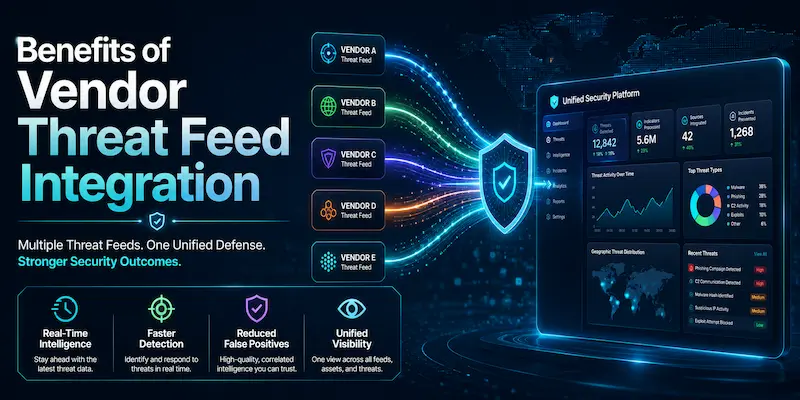
The following are the benefits of vendor threat feed integration for organizations:
1. Real-Time Automated Threat Mitigation: Without the need for human intervention, security technologies immediately stop active worldwide attacks at the perimeter.
2. Significant Reduction in Alert Fatigue: Analysts can concentrate solely on validated, high-risk security incidents after automated filtering removes low-priority data.
3. Accelerated Incident Response Times: Threat investigation and containment cycles are reduced from hours to seconds with the use of enriched situational data.
4. Proactive Vulnerability Prioritization: Software vulnerabilities that threat feeds indicate are being actively exploited in the wild can be quickly identified and fixed by teams.
5. Enhanced Strategic Risk Forecasting: In order to make more intelligent, long-term security expenditures, executive leadership has clear visibility into new industry threat patterns.
How to Evaluate and Choose the Right Threat Feed Vendor?
|
S.No. |
Factors |
How? |
|
1. |
Relevance to Your Industry and Tech Stack |
Choose a vendor that supports your current security solutions natively and actively monitors threats aimed at your particular industry. |
|
2. |
Data Accuracy and Low False-Positive Rates |
Give top priority to suppliers who thoroughly examine data so that your security team doesn't waste time on false alarms. |
|
3. |
Actionability and Contextual Enrichment |
Make sure feeds don't merely provide inexplicable lists but also deep information, such as attacker motivations and mitigation strategies. |
|
4. |
Seamless Integration and Automated Delivery |
For a hassle-free connection to your SIEM or SOAR, pick providers who offer stable APIs and consistent plugin formats. |
|
5. |
Timeliness and Refresh Frequency |
To prevent swift cyberattacks before they reach your network, choose real-time or almost instantaneous updates for your defenses. |
Best Practices for Implementing Vendor Threat Feed Integration
The following are the best practices for implementing vendor threat feed integration:
● Define Specific Threat Intelligence Use Cases: To prevent overloading your systems, match vendor feeds with specific security objectives, such as incident triaging or perimeter blocking.
● Implement Strict De-duplication and Normalization: To keep your database clean, standardize all incoming threat data into a single format and eliminate signs that are repeated.
● Automate Triage with Risk-Based Scoring: To ensure that your security systems only send out alerts for highly verified risks, apply dynamic confidence scores to incoming threats.
● Deploy Phased Automation via Playbooks: Before granting playbooks the power to independently stop vital network traffic, start by automating notifications for low-risk behaviors.
● Establish a Continuous Feed Performance Audit: To eliminate stale feeds, reduce false positives, and guarantee high-value intelligence, regularly assess the accuracy of vendor data.
Future Trends in Vendor Threat Intelligence Integration
The following are the future trends in vendor threat intelligence integration:
a) Transition from Reactive IoCs to Predictive AI Analytics: Systems will shift from monitoring historical signs to employing AI that predicts the next assault location.
b) Hyper-Consolidation via Unified Intelligence Platforms: To do away with disjointed data security screens, siloed vendor feeds will combine into consolidated, cloud-native systems.
c) Continuous, Interconnected Supply Chain Telemetry: Ecosystems will automatically share real-time risk data to monitor threats among partners and third-party vendors.
d) Deep Integration into Zero-Trust Orchestration: When a danger level increases, real-time threat feeds will immediately modify user access rights.
e) Specialized Tracking of Synthetic Threats and GenAI Exploits: Feeds will actively search for corporate deepfakes, automated code exploits, and sophisticated hostile AI activity.
Conclusion: Why Vendor Threat Feed Integration Matters in Modern Cybersecurity?
Now that we have talked about what Vendor Threat Feed Integration is, you might want to get your hands on a dedicated threat intel solution. For that, you can go for Threat Fusion AI, a dedicated threat intel tool offered by Craw Security.
Threat Fusion AI can offer intel about the latest cyber attacks and cyber threats in the IT Industry, so that the organizations can be prepared for unknown threats beforehand. What are you waiting for? Contact, Now!
Frequently Asked Questions
About Vendor Threat Feed Integration
1. What is vendor threat feed integration in cybersecurity?
The automated process of integrating external cyber threat intelligence streams straight into an organization's security systems to quickly detect, verify, and stop new international cyber threats is known as vendor threat feed integration.
2. How does vendor threat feed integration improve threat detection?
Vendor threat feed integration improves threat detection in the following ways:
a) Accelerates Response with Real-Time Data Ingestion,
b) Reduces Alert Fatigue through Automated Filtering,
c) Provides Deep Contextual Enrichment,
d) Enables Proactive Network Correlation, and
e) Powers Automated Playbook Enforcement.
3. What types of threat intelligence data are included in vendor threat feeds?
The following types of threat intelligence data are included in vendor threat feeds:
a) Strategic Threat Intelligence,
b) Tactical Threat Intelligence,
c) Operational Threat Intelligence, and
d) Technical Threat Intelligence.
4. Why is vendor threat feed integration important for Security Operations Centers (SOCs)?
Vendor threat feed integration important for SOCs for the following reasons:
a) Eliminates Critical Blind Spots with Real-Time Global Intel,
b) Accelerates Incident Triage and Cuts Investigation Times,
c) Drastically Reduces Analyst Burnout and Alert Fatigue,
d) Enables Proactive Threat Hunting within the Network, and
e) Seamlessly Drives Automated Response Playbooks.
5. How do organizations integrate vendor threat feeds with SIEM platforms?
Organizations integrate vendor threat feeds with SIEM platforms in the following ways:
a) Connecting via Secure APIs or TAXII Protocols,
b) Normalizing and Standardizing Ingested Formats,
c) Aggregating and Deduplicating Threat Indicators,
d) Executing Real-Time Event Correlation, and
e) Triggering Alerts and Assigning Risk Context.
6. What are the main challenges of implementing vendor threat feed integration?
The following are the main challenges of implementing vendor threat feed integration:
a) High Volume of False Positives and Alert Fatigue,
b) Disparate Data Formats and Interoperability Issues,
c) Lack of Relevant and Actionable Context,
d) Feed Expiration and Data Degradation (Stale Data), and
e) High Total Cost of Ownership (TCO) and Resource Constraints.
7. How can businesses evaluate the quality of a vendor threat feed?
Businesses can evaluate the quality of a vendor threat feed in the following ways:
a) Assess Data Accuracy and False-Positive Rates,
b) Verify Actionability and Contextual Enrichment,
c) Evaluate Relevance to Your Specific Threat Landscape,
d) Measure Timeliness and Refresh Frequency, and
e) Review Technical Delivery and Ease of Integration.
8. What is the difference between commercial and open-source threat feeds?
The primary distinction is that open-source threat feeds are free, community-driven collections that frequently require extensive manual filtering because of higher false-positive rates, while commercial threat feeds provide vetted, high-accuracy intelligence with deep context and vendor support for a premium fee.
9. How does automated threat feed integration enhance incident response?
Automated threat feed integration enhances incident response in the following ways:
a) Drives Instantaneous Perimeter Blocking,
b) Drastically Cuts Mean Time to Investigate (MTTI),
c) Filters Out Noise to Surface Critical Incidents,
d) Accelerates Scope and Blast Radius Analysis, and
e) Enhances Vulnerability Mapping and Patch Prioritization.
10. What are the best practices for managing and optimizing vendor threat feed integrations?
The following are the best practices for managing and optimizing vendor threat feed integrations:
a) Curate and Prioritize Based on Organizational Risk,
b) Implement Automated Deduplication and Multi-Source Normalization,
c) Establish an Indicator Lifespan and Dynamic Aging Policy,
d) Apply Risk-Based Scoring Controls Before Enforcement, and
e) Continuously Audit Feed Performance and Accuracy.