Do you know why a lot of companies are asking for Cyber Threat Intelligence services and why it can be useful against cyber threats? If not, then you are at the right place. Here, we will talk about cyber threat intelligence and related features in detail.
Moreover, we will introduce you to a reliable threat intelligence solution offered by a reputed VAPT service provider. What are we waiting for? Let’s get started!
What Is Cyber Threat Intelligence?
Cyber Threat Intelligence (CTI) refers to knowledge grounded in evidence regarding cyber threats, encompassing the motives, targets, and tactical behaviors of attackers. It enables security teams to proactively predict and thwart cyberattacks before they can breach the network by examining raw security data to reveal harmful patterns.
Ultimately, it transforms the organization's security approach from one of reactive firefighting to a predictive, intelligence-driven defense. Let’s take a look at what Cyber Threat Intelligence is and its related benefits for users!
Why is Cyber Threat Intelligence Important?
|
S.No. |
Factors |
Why? |
|
1. |
Enables Proactive Threat Hunting |
Reveals concealed assailants that are waiting in the network before they can set off security alerts. |
|
2. |
Accelerates Incident Response |
Delivers immediate attacker context to help isolate breaches and reduce system downtime. |
|
3. |
Reduces False Positives and Alert Fatigue |
Excludes non-threatening alerts by comparing network events with confirmed threat indicators. |
|
4. |
Informs Strategic Decision-Making |
Aids leaders in directing security budgets and resources to the most crucial real-world threat vectors. |
|
5. |
Mitigates Third-Party and Supply Chain Risks |
Spot weaknesses and exposed credentials in the networks of external partners before their impact on you. |
The Cyber Threat Intelligence Lifecycle
The following is the cyber threat intelligence lifecycle:
1. Direction and Planning: Specify the security goals, pinpoint the critical assets that require safeguarding, and establish the exact threat intelligence needs.
2. Collection: Collect raw security data from a variety of sources, including internal logs, open-source feeds, commercial databases, and dark web monitoring tools.
3. Processing: Prepare, organize, and convert the bulk of unrefined data into a standardized format suitable for security analysis tools.
4. Analysis and Production: Examine the processed data to reveal harmful patterns, provide context for attacker actions, and convert it into practical security intelligence.
5. Dissemination: Provide the finalized threat intelligence reports, tailored to the roles involved, to the relevant technical teams and those responsible for executive decisions.
6. Feedback: Assess how effective the intelligence provided has been in order to fine-tune operations and enhance the next lifecycle.
The Four Main Types of Cyber Threat Intelligence
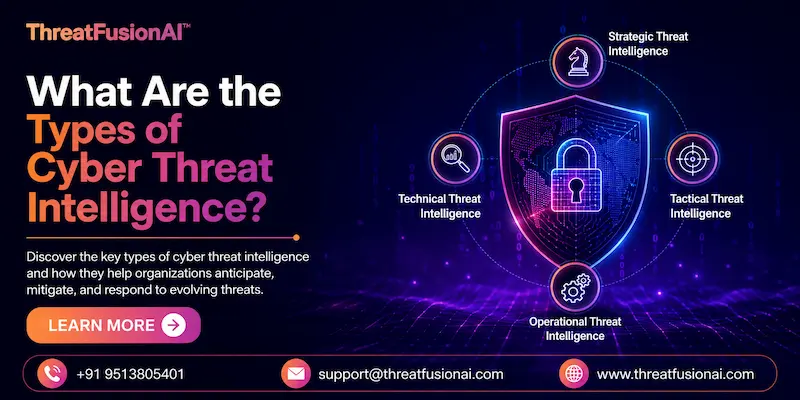
The following are the four main types of cyber threat intelligence:
● Strategic Threat Intelligence: Delivers advanced scrutiny of changing aggressor patterns and reasons for the purpose of steering executive security expenditures.
● Tactical Threat Intelligence: Outlines the particular tactics, techniques, and procedures (TTPs) employed by assailants to assist defenders in constructing improved barriers.
● Operational Threat Intelligence: Provides practical, real-time intelligence on incoming or ongoing cyberattacks targeting the organization.
● Technical Threat Intelligence: Pinpoints particular technical indicators of compromise (IoCs), including harmful URLs, file hashes, and unauthorized IP addresses.
Comparison of Strategic, Tactical, Operational, and Technical Intelligence
|
S.No. |
Topics |
Factors |
What? |
|
1. |
Strategic Intelligence |
Primary Audience & Purpose |
Customized for C-level executives and board members to steer long-term security investments, policy adjustments, and organizational risk management. |
|
Focus & Lifespan |
Concentrates on advanced geopolitical trends, nascent global dangers, and the motivations of assailants, offering insights that hold relevance for months or even years. |
||
|
2. |
Tactical Intelligence |
Primary Audience & Purpose |
Intended for security architects and system administrators to strengthen defenses proactively and create resilient system architectures. |
|
Focus & Lifespan |
Concentrates on the particular Tactics, Techniques, and Procedures (TTPs) employed by threat actors, aiding defenders in comprehending the execution of an attack. |
||
|
3. |
Operational Intelligence |
Primary Audience & Purpose |
Designed for SOC analysts and incident response teams to identify, examine, and reduce the impact of ongoing or upcoming cyberattacks. |
|
Focus & Lifespan |
Concentrates on the "who, what, and when" aspects of a particular campaign, delivering highly contextualized, real-time insights that can be acted upon for days or weeks. |
||
|
4. |
Technical Intelligence |
Primary Audience & Purpose |
Used mainly by automated security systems (such as firewalls, IDS/IPS, and endpoint scanners) to prevent immediate threats at the perimeter. |
|
Focus & Lifespan |
Concentrates on particular, machine-readable Indicators of Compromise (IoCs) like malicious IP addresses, registry keys, and file hashes, which have a brief shelf life due to the rapid changes in attackers' infrastructure. |
Key Sources of Cyber Threat Intelligence
The following are some key sources of cyber threat intelligence:
a) Internal Network Telemetry: Examines your system logs, firewall traffic, and endpoint activities to identify unique threats customized for your network.
b) Open-Source Intelligence (OSINT): Collects public security information from blogs, social media, government advisories, and code repositories to monitor emerging threats.
c) Commercial Threat Feeds: Offer carefully selected, verified, and accurate intelligence from private security providers to ensure dependable threat detection.
d) The Dark Web and Deep Web: Keep an eye on concealed forums and marketplaces to discover leaked corporate credentials, pilfered data, and planned attacks.
e) Community and Industry-Sharing Hubs (ISACs): Utilize collaborative networks that are specific to your industry and where reliable colleagues exchange information about ongoing cyberattacks in a secure manner.
How Do Organizations Use Different Types of Threat Intelligence?
Organizations use different types of threat intelligence in the following ways:
1. Strategic Intelligence Guides Business Strategy: Ensures that executive security budgets and risk management policies are in line with emerging trends of geopolitical threats.
2. Tactical Intelligence Hardens Defenses: It provides guidance to security architects on how to revise system designs to withstand particular attacker techniques.
3. Operational Intelligence Powers Threat Hunting: It enables SOC teams to proactively look for and eliminate active, concealed campaigns within the network.
4. Technical Intelligence Automates Perimeter Blocking: Incorporates real-time signals, such as harmful IP addresses, into firewalls to immediately halt incoming assaults.
Benefits of Using Multiple Types of Threat Intelligence
|
S.No. |
Benefits |
How? |
|
1. |
Builds a Multi-Layered, Defense-in-Depth Posture |
Integrates immediate perimeter defense with long-term fortification of infrastructure to intercept threats at all phases. |
|
2. |
Bridges the Gap Between Executives and Technical Teams |
Brings together corporate leaders and technical defenders around a common comprehension of organizational risk. |
|
3. |
Accelerates Incident Response and Triage Speed |
Combines deep operational context with automated indicator blocking to expedite the neutralization of active breaches. |
|
4. |
Enhances Proactive and Predictive Threat Hunting |
Employs high-level trend analysis in conjunction with detailed attacker techniques to prevent emerging campaigns from launching. |
|
5. |
Optimizes Resource and Security Budget Allocation |
Addresses existing operational deficiencies while guaranteeing that future security expenditures are in line with actual threats. |
Common Challenges in Threat Intelligence
The following are the common challenges in threat intelligence:
● Data Overload and High Noise-to-Signal Ratio: Flood security teams with thousands of raw alerts, leading to extreme fatigue and obscured threats.
● Lack of Context and Actionability: Provides lists of isolated threat indicators lacking the essential context required to prevent an attack.
● Integration and Interoperability Hurdles: Struggles to align various intelligence feeds with legacy security tools, resulting in fragmented defenses.
● The Speed of Evolving AI Threats: Does not manage to keep up with the speed of polymorphic, AI-driven malware, which surpasses conventional threat signatures.
● Severe Cybersecurity Skills Shortage: Results in organizations lacking the specialized analysts needed to interpret complex data and carry out responses.
Best Practices for Building an Effective Threat Intelligence Program
The following are the best practices for building an effective threat intelligence program:
a) Define Clear Stakeholder Requirements First: Concentrate your intelligence-gathering efforts on safeguarding your particular high-value assets and business objectives.
b) Centralize Data and Integrate Security Architecture: Utilize a central platform to effortlessly direct automated threat feeds into your current security stack.
c) Prioritize TTP Tracking Over Fragile Indicators: Concentrate defense strategies on permanent attacker behaviors instead of easily altered IP addresses and file hashes.
d) Leverage AI for Automation and Analytics: Employ AI to quickly eliminate false positives and perform instant cross-referencing of large data streams.
e) Participate Actively in Collective Defense Networks: To establish herd immunity against new campaigns, share anonymized threat data with industry hubs such as ISACs.
How does ThreatFusionAI Enhance Cyber Threat Intelligence?
|
S.No. |
Factors |
What? |
|
1. |
Advanced Multi-Layered Threat Enrichment |
Enhances raw IOCs with profound attacker context by combining OSINT, commercial vendor feeds, and dark web signals. |
|
2. |
Intelligent AI Classification and Threat Scoring |
Utilizes behavioral anomaly detection to immediately rank and prioritize high-risk threats, reducing irrelevant information. |
|
3. |
Real-Time Cross-Platform Correlation |
Combines endpoint, network, and cloud telemetry to create attack timelines for the whole IT environment. |
|
4. |
Immediate Automated Containment (SOAR Integration) |
Instigates immediate playbook reactions such as endpoint isolation and firewall blocking to prevent ongoing breaches. |
|
5. |
Cyber Risk Quantification and Dashboarding |
Translates intricate technical threat indicators into understandable financial impact metrics and executive risk assessments. |
Conclusion
Now that we have talked about what Cyber Threat Intelligence is, you might want to get your hands on a dedicated threat intel solution from a reliable source. For that, you can go for ThreatFusionAI, a dedicated threat detection platform offered by Craw Security.
ThreatFusionAI can help organizations to get notified about the latest cyber threats so that they can prepare better cybersecurity solutions to protect themselves against such threats. What are you waiting for? Contact, Now!
Frequently Asked Questions
About Cyber Threat Intelligence
1. What are the main types of cyber threat intelligence?
The following are the main types of cyber threat intelligence:
a) Strategic Threat Intelligence,
b) Tactical Threat Intelligence,
c) Operational Threat Intelligence, and
d) Technical Threat Intelligence.
2. What is strategic threat intelligence in cybersecurity?
Executives utilize strategic threat intelligence, an analysis of global risk landscapes, threat trends, and attacker motivations that is high-level and non-technical to inform long-term security investments and policies.
3. How does tactical threat intelligence improve security?
Tactical threat intelligence improves security in the following ways:
a) Exposes Attacker Methodologies,
b) Optimizes Firewall and Rule Creation,
c) Accelerates Vulnerability Patching,
d) Powers Proactive Threat Hunting, and
e) Enhances Security Awareness Training.
4. What is operational threat intelligence used for?
Security analysts and incident response teams utilize operational threat intelligence to identify, foresee, and counteract ongoing or impending cyberattacks aimed at their particular organization.
5. What is technical threat intelligence?
Technical threat intelligence includes detailed, machine-readable Indicators of Compromise (IoCs) such as malicious IP addresses, file hashes, and URLs that security systems use to automatically prevent immediate incoming attacks.
6. Which type of threat intelligence is best for SOC teams?
For SOC teams, operational threat intelligence is optimal as it offers the real-time context necessary to identify, prioritize, and counteract ongoing or impending attacks on the network.
7. How do organizations collect cyber threat intelligence?
Organizations collect cyber threat intelligence in the following ways:
a) Analyzing Internal Network Telemetry,
b) Monitoring Open-Source Intelligence (OSINT),
c) Subscribing to Commercial Threat Feeds,
d) Scouring the Dark Web and Deep Web, and
e) Participating in Industry-Sharing Hubs (ISACs).
8. What are the benefits of using multiple types of threat intelligence?
The following are the benefits of using multiple types of threat intelligence:
a) Creates a Multi-Layered, Defense-in-Depth Posture,
b) Bridges the Gap Between Executives and Technical Teams,
c) Accelerates Incident Response and Triage Speed,
d) Enables Proactive and Predictive Threat Hunting, and
e) Optimizes Resource and Security Budget Allocation.
9. How does ThreatFusionAI support cyber threat intelligence?
ThreatFusionAI supports cyber threat intelligence in the following ways:
a) Aggregates and Enriches Multi-Source Intelligence,
b) Automates Scoring with AI Behavioral Analytics,
c) Provides Cross-Platform Telemetry Correlation,
d) Drives Immediate Automated Response (SOAR), and
e) Translates Technical Threats into Business Risk.
10. What is the difference between strategic, tactical, operational, and technical threat intelligence?
Strategic intelligence informs executive risk decisions; tactical outlines attacker methods for fortifying systems; operational reveals ongoing, targeted operations for threat hunters; and technical offers automated machine-readable data for instant perimeter blocking.