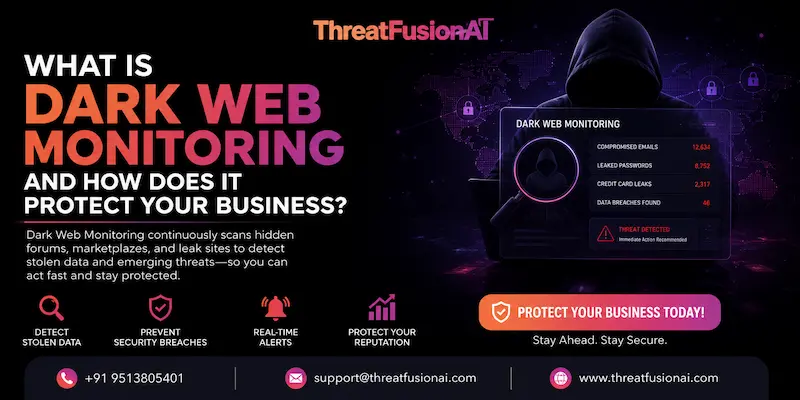
Do you know how Dark Web Monitoring can help you to get prepared for future cyberattacks beforehand with ease? If not, then you are at the right place. Here, we will talk about what Dark Web Monitoring is and its benefits in detail.
Moreover, we will introduce you to a reliable threat intel solution offered by a reputable VAPT service provider. What are we waiting for? Let’s get straight to the topic!
What Is Dark Web Monitoring?
A cybersecurity procedure known as "dark web monitoring" regularly searches the internet's hidden layers for compromised or stolen company data, including credentials and intellectual property.
It searches chat rooms, hacker forums, and illicit marketplaces and instantly notifies companies when their data is discovered to be compromised. By resetting passwords and safeguarding accounts before malevolent actors can take advantage of the stolen data, proactive surveillance enables enterprises to react quickly to possible data breaches.
Let’s find out what Dark Web Monitoring is, its uses, its features, and its benefits for organizations in the IT Industry!
Why the Dark Web Is a Major Cybersecurity Threat?
|
S.No. |
Factors |
Why? |
|
1. |
Hotbed for Stolen Credentials |
It contains enormous, compromised databases of company passwords and usernames that are vulnerable to credential stuffing attacks. |
|
2. |
Anonymity for Cybercriminals |
The identities and whereabouts of threat actors are protected from law enforcement by onion routing and encrypted networks. |
|
3. |
Cybercrime-as-a-Service (CaaS) |
To conduct complex assaults, amateurs can just purchase pre-made ransomware, malware, and phishing kits. |
|
4. |
Trading of Intellectual Property |
Source code, valuable corporate data, and stolen trade secrets are purchased by rivals and state-sponsored hackers. |
|
5. |
Exposure of Customer PII |
Large-scale sales of hacked bank information, emails, and SSNs result in harsh legal repercussions and harm to a company's reputation. |
What Types of Data Can Be Found on the Dark Web?
The following types of data can be found on the dark web:
1. Compromised Corporate Credentials: Passwords, API credentials, and usernames of current employees were compromised by third parties.
2. Personally Identifiable Information (PII): SSNs, phone numbers, residential addresses, and dates of birth for clients and staff.
3. Financial and Payment Data: Digital wallet keys, CVVs, credit card information, and online banking login credentials have all been stolen.
4. Intellectual Property & Trade Secrets: Pre-patent designs, internal strategic documents, blueprints, and proprietary source code.
5. Malignant Cyber Toolkits: Ransomware strains, leased botnet access, sophisticated malware, and unique attacks.
Why Businesses Need Dark Web Monitoring?
Businesses need dark web monitoring for the following reasons:
● Early Detection of Data Breaches: It reveals company data that has been taken right away, weeks or months before a typical security audit would discover it.
● Protection of Corporate Reputation: Early leak detection avoids public exposures, protecting consumer confidence and brand integrity.
● Mitigation of Financial Losses: The enormous expenses of ransomware payouts, system outages, and legal fees are reduced when active credential abuse is stopped.
● Compliance and Regulatory Alignment: Regular scanning guarantees compliance with stringent data protection regulations such as GDPR, HIPAA, and PCI-DSS.
● Prevention of Supply Chain Attacks: Before hackers can use compromised vendor credentials to access your main network, it warns them.
How Dark Web Monitoring Works?
|
S.No. |
Factors |
How? |
|
1. |
Automated Data Scraping |
AI-powered bots are constantly scouring the dark web, collecting information from invitation-only chat rooms, hidden forums, and encrypted networks. |
|
2. |
Information Extraction |
To find text, code, and file dumps, natural language processing (NLP) techniques extract and organize the disorganized, unstructured material. |
|
3. |
Database Matching |
The retrieved data is cross-referenced with the particular "watchlists," such as IP addresses, domain names, and staff emails, that your business maintains. |
|
4. |
Immediate Alerting |
The system immediately notifies the user of what was disclosed and where, if a match is discovered (for example, an employee's password for sale). |
|
5. |
Remediation and Triage |
In order to mitigate the risk, security teams are provided with actionable threat intelligence, such as requiring password changes or preventing compromised API credentials. |
How AI and Automation Improve Dark Web Monitoring?
AI and automation improve dark web monitoring in the following ways:
a) 24/7 Automated Scalability: Large, secret networks are regularly crawled by AI bots at a speed and scale that is unmatched by human experts.
b) Bypassing CAPTCHAs and Paywalls: In order to gain entry to exclusive cybercriminal forums, clever automation solves CAPTCHA and manages intricate anti-bot protections.
c) Natural Language Processing (NLP): Hacker jargon, dark web slang, and several foreign languages are automatically translated and analyzed using sophisticated algorithms.
d) False Positive Reduction: To only notify teams about distinct, actionable dangers, machine learning eliminates duplicate leaks and previous data dumps.
e) Predictive Threat Modeling: In order to predict which assets hackers would target next before an attack takes place, AI examines emerging pattern trends.
Essential Features to Look for in a Dark Web Monitoring Solution
The following are some essential features to look for in a dark web monitoring solution:
1. Real-Time Automated Alerting: Reduces attacker stay time by instantly alerting your security team when exposed company data is discovered.
2. Comprehensive Network Coverage: Scans underground paste websites, I2P, Freenet, Tor networks, and encrypted communication apps like Telegram.
3. Identity and Asset Watchlists: Enables the tracking of particular company assets, such as source code, IP addresses, domain names, and CEO correspondence.
4. Low False-Positive Rates: Prevents alert fatigue for security personnel by using sophisticated filtering to guarantee notifications are validated and actionable.
5. Integration and Remediation Capabilities: Interacts easily with your current SIEM/SOAR systems and offers precise instructions for eliminating the threat that has been identified.
Common Challenges and Limitations of Dark Web Monitoring
|
S.No. |
Factors |
What? |
|
1. |
Access Restrictions to Private Channels |
Vet-only forums that demand human contact, cryptocurrency deposits, or criminal proof are difficult for automated bots to access. |
|
2. |
The Whack-a-Mole Reality of Marketplaces |
Dark websites are difficult to follow since they often change domains, exit scams, or are confiscated by law enforcement. |
|
3. |
Data Volume and Noise |
To identify real risks, human analysts must go through terabytes of redundant, out-of-date, or simply fraudulent data dumps. |
|
4. |
Encryption and Obfuscation |
In order to conceal data origins and buyer identities, hackers employ multi-layered routing and strongly encrypt their connections. |
|
5. |
Reactive Nature of Detection |
It only discovers data after a breach has happened, so rather than preventing the initial hack, it lessens the continuing consequences. |
How ShieldXDR Strengthens Business Security with Dark Web Monitoring?
ShieldXDR strengthens business security with dark web monitoring in the following ways:
● Unified Threat Visibility: ShieldXDR creates a single security dashboard by combining your network, endpoint, and cloud telemetry with dark web leak data.
● Proactive Automated Remediation: As soon as a leak is discovered, it immediately initiates planned reactions, such as requiring password changes or deactivating compromised accounts.
● Human-Vetted Intelligence: Cyber threat specialists verify automated dark web alerts to remove noise and provide extremely precise, useful information.
● Context-Aware Alerts: It prioritizes the most dangerous vulnerabilities by precisely mapping stolen passwords to your vital company assets.
● Continuous Supply Chain Auditing: In order to prevent incoming third-party dangers, it constantly scans underground forums for vendor and partner data leaks.
Best Practices for Maximizing the Effectiveness of Dark Web Monitoring
The following are the best practices for maximizing the effectiveness of dark web monitoring:
a) Define Clear Asset Watchlists: Identify and monitor your most valuable assets, such as core IP addresses, executive emails, and intellectual property.
b) Integrate with Existing Security Infrastructure: For consolidated, quick threat management, integrate dark web feeds straight into your SIEM, SOAR, or XDR platform.
c) Establish an Incident Response Playbook: Establish precise, systematic, step-by-step processes to isolate accounts and immediately revoke credentials in the event of a breach.
d) Combine Automation with Human Triage: While depending on threat experts to confirm the intricate concerns, use AI bots to swiftly search through enormous data dumps.
e) Enforce Multi-Factor Authentication (MFA): Implement stringent multi-factor authentication (MFA) on all business accounts to prevent hackers from gaining access to your network through password leaks alone.
Final Thoughts: Why Dark Web Monitoring Is Essential for Modern Businesses?
Now that we have talked about what Dark Web Monitoring is, you might want to get your hands on a dedicated threat intel solution. For that, you can go for Threat Fusion AI, a dedicated threat intel platform offered by Craw Security.
Threat Fusion AI can update the latest cyber attack and cyber threat events on it to give the users the knowledge of current various heinous and malicious risks. Thus, you can feel safer in the future against cyber threats. What are you waiting for? Contact, Now!
Frequently Asked Questions
About Dark Web Monitoring
1. What is dark web monitoring, and how does it work?
Dark web monitoring is a cybersecurity procedure that uses automated tools to continuously search secret networks for corporate data that has been stolen. It notifies companies as soon as their assets or credentials are discovered to be compromised.
2. Why is dark web monitoring important for businesses?
Dark web monitoring is important for businesses for the following reasons:
a) Early Breach Detection,
b) Reputation & Trust Protection,
c) Financial Loss Mitigation,
d) Strict Regulatory Compliance, and
e) Supply Chain Security.
3. What types of sensitive information can dark web monitoring detect?
The following types of sensitive information can be detected by dark web monitoring:
a) Compromised Employee Credentials,
b) Personally Identifiable Information (PII),
c) Financial and Payment Data,
d) Intellectual Property and Trade Secrets, and
e) Proprietary Infrastructure Data.
4. How does dark web monitoring help prevent cyberattacks?
Dark web monitoring helps prevent cyberattacks in the following ways:
a) Thwarts Credential Stuffing Attacks,
b) Interrupts Targeted Phishing Campaigns,
c) Preempts Ransomware Deployments,
d) Secures Misconfigured Cloud Assets, and
e) Blocks Vendor-Driven Breaches.
5. Can dark web monitoring detect stolen employee credentials?
Yes, dark web monitoring constantly searches subterranean networks for employee credentials that have been stolen, including usernames, passwords, and API keys, and notifies security teams before hackers can take advantage of them.
6. What is the difference between dark web monitoring and threat intelligence?
While threat intelligence is a more comprehensive security discipline that examines global cyber dangers, attacker strategies, and emerging trends to proactively defend the entire corporate infrastructure, dark web monitoring particularly searches secret networks for a company's already-stolen data.
7. Which industries benefit the most from dark web monitoring?
The following industries benefit the most from dark web monitoring:
a) Financial Services and Banking,
b) Healthcare and Pharmaceuticals,
c) E-commerce and Retail,
d) Government and Defense Contractors, and
e) Technology and Software Providers.
8. How often should businesses perform dark web monitoring?
Because cybercriminals buy and sell stolen data around-the-clock, businesses should monitor the dark web continually and in real time. Periodic or monthly scans are too slow to stop a breach.
9. What should a business do if its data is found on the dark web?
A business should do the following tasks if its data is found on the dark web:
a) Initiate Password Resets and Revoke Sessions,
b) Enable or Enforce Multi-Factor Authentication (MFA),
c) Isolate and Audit Affected Systems,
d) Notify Impacted Stakeholders and Legal Counsel, and
e) Monitor for Targeted Phishing and Social Engineering.
10. How can ShieldXDR help protect businesses with dark web monitoring?
ShieldXDR helps protect businesses with dark web monitoring in the following ways:
a) Continuous Endpoint and Cloud Remediation,
b) Unified Threat Telemetry,
c) Reduction of Alert Fatigue,
d) Context-Driven Prioritization, and