Do you know how helpful Alert Correlation in Cybersecurity Monitoring can be for businesses? If not, then you are at the right place. Here, we will talk about what Alert correlation is and its related benefits in detail!
Moreover, we will introduce you to a reliable threat intel platform offered by a reputable VAPT service provider. What are we waiting for? Let’s get straight to the topic!
What is Alert Correlation in Cybersecurity Monitoring?
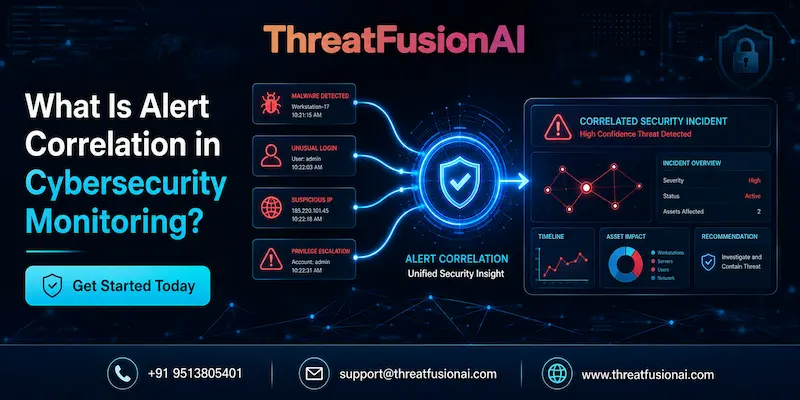
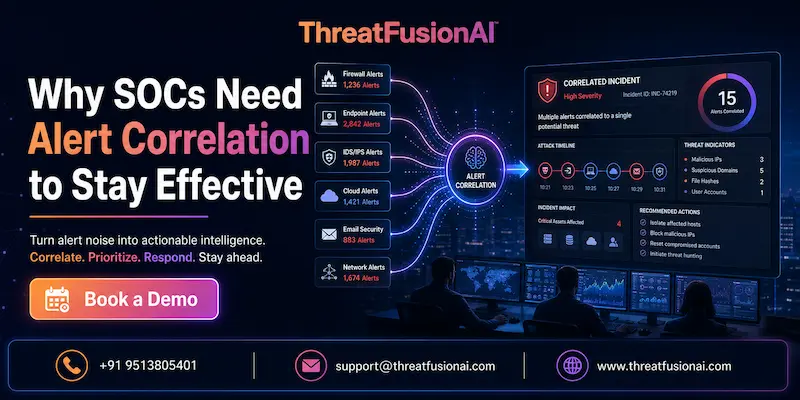
Massive amounts of raw security data from various systems within a business network are ingested, filtered, and analyzed via alert correlation, an automated cybersecurity procedure. It combines disparate, low-level warning indicators into a unified, chronological timeline of an ongoing attack by using machine learning and preset logical rules.
This significantly lowers background noise and false positives, enabling Security Operations Center (SOC) teams to quickly grasp the entire context of a high-priority incident and take action before harm is done.
Let’s take a look at what Alert Correlation is in Cybersecurity Monitoring and how it helps businesses to improve security measures!
Key Components of an Alert Correlation System
|
S.No. |
Factors |
What? |
|
1. |
Data Ingestion and Normalization Engine |
Gathers unprocessed logs from various sources and transforms them into a common format for consistent analysis. |
|
2. |
Centralized Rule and Policy Database |
Contains the correlation rules, compliance standards, and baseline logic that are used to find known attack patterns. |
|
3. |
Analytics and Machine Learning Engine |
Real-time data stream analysis to identify hidden anomalies and connect disparate occurrences. |
|
4. |
Threat Intelligence Integration |
Identifies known dangerous IPs, domains, and file hashes by enhancing incoming alarms with external global data feeds. |
|
5. |
Prioritization and Incident Scoring System |
Highlights the most serious risks first by assessing the severity and business impact of associated events. |
How Does Alert Correlation Work?
Alert Correlation works in the following ways:
1. Step 1: Data Collection and Normalization: Combines unprocessed logs from clouds, networks, and endpoints and transforms them into a common format for consistent analysis.
2. Step 2: Event Filtering and Deduplication: Eliminates background noise and, in order to avoid clutter, combines repeated, identical events into a single entry.
3. Step 3: Relationship and Pattern Matching: Uses AI and pre-established algorithms to link distinct events based on shared characteristics like time, source IP, or user identification.
4. Step 4: Threat Context Enrichment: Identifies known harmful signs by incorporating internal asset data and external threat intelligence into the related events.
5. Step 5: Incident Consolidation and Scoring: Combines the confirmed sequence of events into a single incident and gives it a risk score so that analysts can prioritize it.
Why Alert Correlation Is Important for Security Operations Centers (SOCs)?
Alert correlation is important for SOCs for the following reasons:
● Mitigates Critical Alert Fatigue: Saves analysts from experiencing sensory saturation by condensing thousands of repetitive, low-priority signals into a small number of structured situations.
● Uncovers Advanced Multi-Stage Attacks: Connects seemingly unconnected network irregularities between many departments to reveal sophisticated, slow-moving cyberthreats.
● Drastically Speeds Up Incident Response: Reduces investigative times from days to minutes by providing an instantaneous, pre-assembled chronological history of the breach.
● Reduces Costly False Positives: Ensures that security teams only pursue genuine, verified threats by filtering out benign background noise and common software irregularities.
● Optimizes Scarce Security Talent: Allows tier-one analysts to concentrate on high-level threat hunting and strategic protection by automating the time-consuming process of manual log sorting.
Benefits of Alert Correlation in Cybersecurity Monitoring
|
S.No. |
Benefits |
How? |
|
1. |
Full-Spectrum Visibility |
Creates a single, cross-domain security picture by integrating endpoint, network, identity, and cloud telemetry, therefore dismantling organizational silos. |
|
2. |
Rapid Root-Cause Identification |
Shows experts how a breach began and which assets were impacted first by tracking an assault back to its first entry point. |
|
3. |
Minimized Mean Time to Detect (MTTD) |
By identifying dangerous patterns that traditional point solutions overlook, you can quickly identify sophisticated, low-and-slow attack strategies. |
|
4. |
Consistent Compliance Audit Trails |
Creates the clear, unchangeable forensic timelines required by data privacy laws by automatically recording and organizing security incidents. |
|
5. |
Lower Operational Overhead |
Eliminates raw data noise before it overwhelms the primary security information repository, which lowers storage expenses and manual review times. |
How SIEM Platforms Use Alert Correlation?
SIEM platforms use alert correlation in the following ways:
a) Applying Cross-Domain Rules: Connects disparate signs from identity systems, firewalls, and endpoints to reveal common attack behaviors.
b) Tracking Time and Sequence Windows: Keeps an eye on particular time periods to identify gradual adversary advancements that, when considered separately, appear innocuous.
c) Enforcing Threshold Aggregation: When a certain incident, such as a failed login, exceeds a safe frequency limit, accounts or systems are flagged.
d) Executing Behavioral Anomaly Mapping: Instantly identifies unpredictable, dangerous deviations by comparing real-time network information with predetermined user baselines.
e) Automating Incident Triage and Lifecycle: Instantly generates, fills out, and directs structured incident cases to the appropriate analysts for prompt resolution.
Mapping Correlated Alerts to Threat Frameworks (MITRE ATT&CK)
By comparing linked warnings to known real-world adversary tactics, methods, and procedures (TTPs), the MITRE ATT&CK methodology contextualizes solitary security occurrences. By giving defenders a systematic blueprint of the attacker's current phase, such as lateral movement or data exfiltration, this alignment enables teams to anticipate the enemy's next move and implement accurate, focused responses.
AI and Machine Learning in Alert Correlation
By switching security from static, rule-based filtering to dynamic behavioral analysis that examines millions of events every second, AI and machine learning revolutionize alarm correlation.
These solutions neutralize sophisticated threats with little human interaction by exposing stealthy, zero-day abnormalities and automatically piecing together complex attack chains by establishing user and network baselines.
Challenges and Limitations of Alert Correlation
The following are some challenges and limitations of alert correlation:
1. High Implementation Complexity: Requires extensive knowledge to integrate several multi-vendor security systems and correctly calibrate complex correlation rules.
2. Garbage In, Garbage Out Vulnerability: Becomes useless if upstream logs lack important contextual information, are fragmentary, or have poor formatting.
3. Evolving Attacker Evasion Techniques: It is difficult to apprehend sophisticated attackers who purposefully imitate typical network behavior and spread out their acts across several months.
4. High Operational Resource Strain: Requires costly data storage infrastructure and enormous processing capacity to handle and analyze large-scale real-time feeds.
5. Persistent False Positives: If the system's baseline rules are unable to adapt to genuine, atypical developer or administrator actions, it will produce false events.
Best Practices for Implementing Alert Correlation
The following are the best practices for implementing alert correlation:
● Standardize Log Formatting Early: To guarantee smooth, consistent analysis, enforce stringent data standardization across all ingestion sources.
● Map Rules to Threat Frameworks: To guarantee thorough coverage of known attacker approaches, align correlation logic directly with the MITRE ATT&CK matrix.
● Establish Legitimate Behavioral Baselines: Before implementing stringent anomaly-detection procedures, thoroughly profile typical network and user activities.
● Prune and Tune Rules Continuously: To get rid of out-of-date rules and stop fresh false positives, evaluate and improve alerting policies on a regular basis.
● Integrate High-Fidelity Threat Intelligence: To immediately validate harmful signs, enhance correlation pipelines with dependable, real-time external threat feeds.
Future Trends in Alert Correlation Technology
|
S.No. |
Factors |
What? |
|
1. |
Transition to Autonomous Agentic AI Integration |
Transitions from passive filters to autonomous AI agents that look into and contain dangers on their own. |
|
2. |
Continuous Exposure Management (CEM) Convergence |
Combines real-time attack surface and vulnerability data with active event telemetry to forecast exploitability. |
|
3. |
Identity-First and Zero-Trust Correlation |
Focuses a lot of analysis on privilege changes across cloud systems, access irregularities, and user activity. |
|
4. |
Decentralized Security Data Lakes and Edge Analytics |
Reduces cloud bandwidth expenses by immediately correlating and filtering telemetry at the data source. |
|
5. |
Predictive Threat Forecasting |
Projects and blocks the expected next tactical maneuver of an adversary using previous assault route mapping. |
Conclusion: Strengthening Cybersecurity with Alert Correlation
Now that we have talked about what Alert Correlation is in Cybersecurity Monitoring, you might want to consider a dedicated solution to prepare for better security measures against unknown cyberthreats. For that, you can go for Threat Fusion AI, a dedicated threat intel platform offered by Craw Security.
Threat Fusion AI can help organizations by notifying them about current threats and giving them the time to prepare for future threats beforehand. What are you waiting for? Contact, Now!
Frequently Asked Questions
About Alert Correlation in Cybersecurity Monitoring
1. What is alert correlation in cybersecurity monitoring?
Alert correlation is an automated procedure that creates a single, contextualized danger chronology by aggregating, normalizing, and analyzing vast amounts of disparate security records.
2. Why is alert correlation important for Security Operations Centers (SOCs)?
Alert correlation is important for SOCs for the following reasons:
a) Conquers Alert Fatigue,
b) Exposes Advanced Multi-Stage Attacks,
c) Drastically Accelerates Incident Response,
d) Cuts Costly False Positives, and
e) Maximizes Scarce Security Talent.
3. How does alert correlation help reduce alert fatigue?
Alert correlation helps reduce alert fatigue in the following ways:
a) Collapses Repetitive Data,
b) Weaves Siloed Data Together,
c) Suppresses Harmless Background Noise,
d) Prioritizes Threats via Risk Scoring, and
e) Automates the Initial Sorting Phase.
4. What types of security events can be correlated?
The following types of security events can be correlated:
a) Authentication Anomalies and Privilege Shifts,
b) Network Traffic Irregularities and External Communication,
c) Endpoint File and Process Discrepancies,
d) Cloud Infrastructure and API Changes, and
e) Data Access and Exfiltration Signals.
5. What is the difference between alert correlation and alert aggregation?
Alert correlation connects entirely unrelated events across several domains to reveal intricate attack patterns, whereas alert aggregation gathers identical occurrences to decrease volume.
6. How do SIEM platforms use alert correlation to detect threats?
SIEM platforms use alert correlation to detect threats in the following ways:
a) Applying Cross-Domain Rules,
b) Tracking Time and Sequence Windows,
c) Enforcing Threshold Rules,
d) Mapping Behavioral Anomalies, and
e) Enriching Events with Threat Intelligence.
7. Can artificial intelligence improve alert correlation accuracy?
Yes, by substituting dynamic behavioral baselines that can identify unknown zero-day patterns and lower false positives for strict restrictions, artificial intelligence significantly increases accuracy.
8. What are the main challenges of implementing alert correlation?
The following are the main challenges of implementing alert correlation:
a) Data Normalization Hurdles,
b) The "Garbage In, Garbage Out" Trap,
c) High Administrative Overhead,
d) Persistent False Positive Risks, and
e) Sophisticated Evasion Tactics.
9. How does alert correlation enhance incident response and threat detection?
By automatically assembling disparate security events into a single, coherent attack chronology, alert correlation improves incident response and threat detection. This enables analysts to quickly assess the complete extent of a breach and prevent it from spreading.
10. What are the best practices for effective alert correlation in cybersecurity environments?
The following are the best practices for effective alert correlation in cybersecurity environments:
a) Standardize and Normalize Log Data Early,
b) Map Correlation Logic to the MITRE ATT&CK Matrix,
c) Establish Clear Behavioral Baselines,
d) Prune and Tune Rules Continuously, and
e) Integrate Reliable, Real-Time Threat Intelligence.
Read More: