MITRE ATT&CK mapping

Map Malware Behaviour to the MITRE ATT&CK Framework

Observed malware behaviour placed on the ATT&CK Enterprise matrix, then carried outward to the threat actors, malware families and campaigns that share those techniques -- including the ransomware tradecraft the framework describes best.

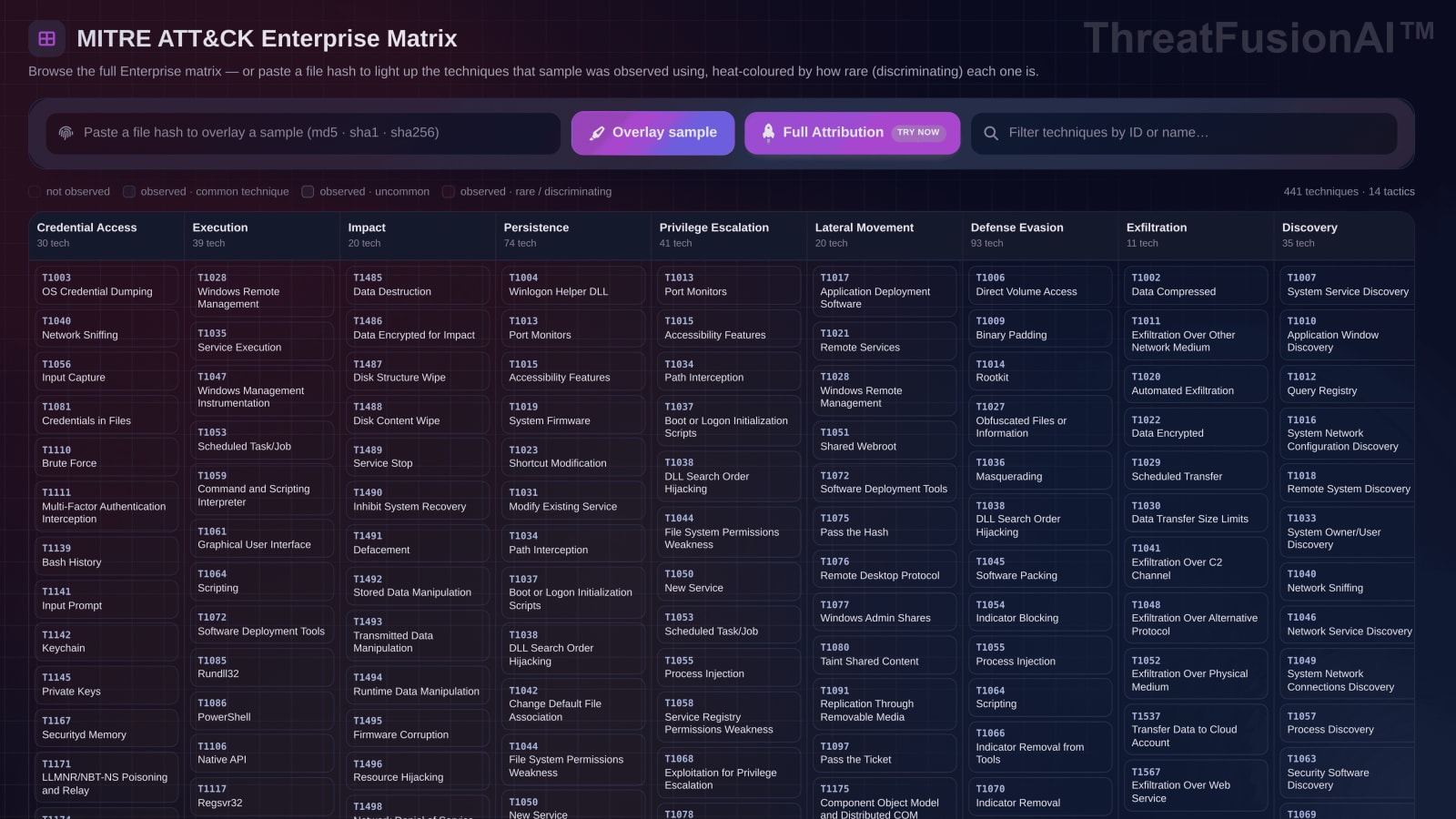
The full ATT&CK Enterprise matrix, 441 techniques across 14 tactics, with a hash overlay box and technique filter
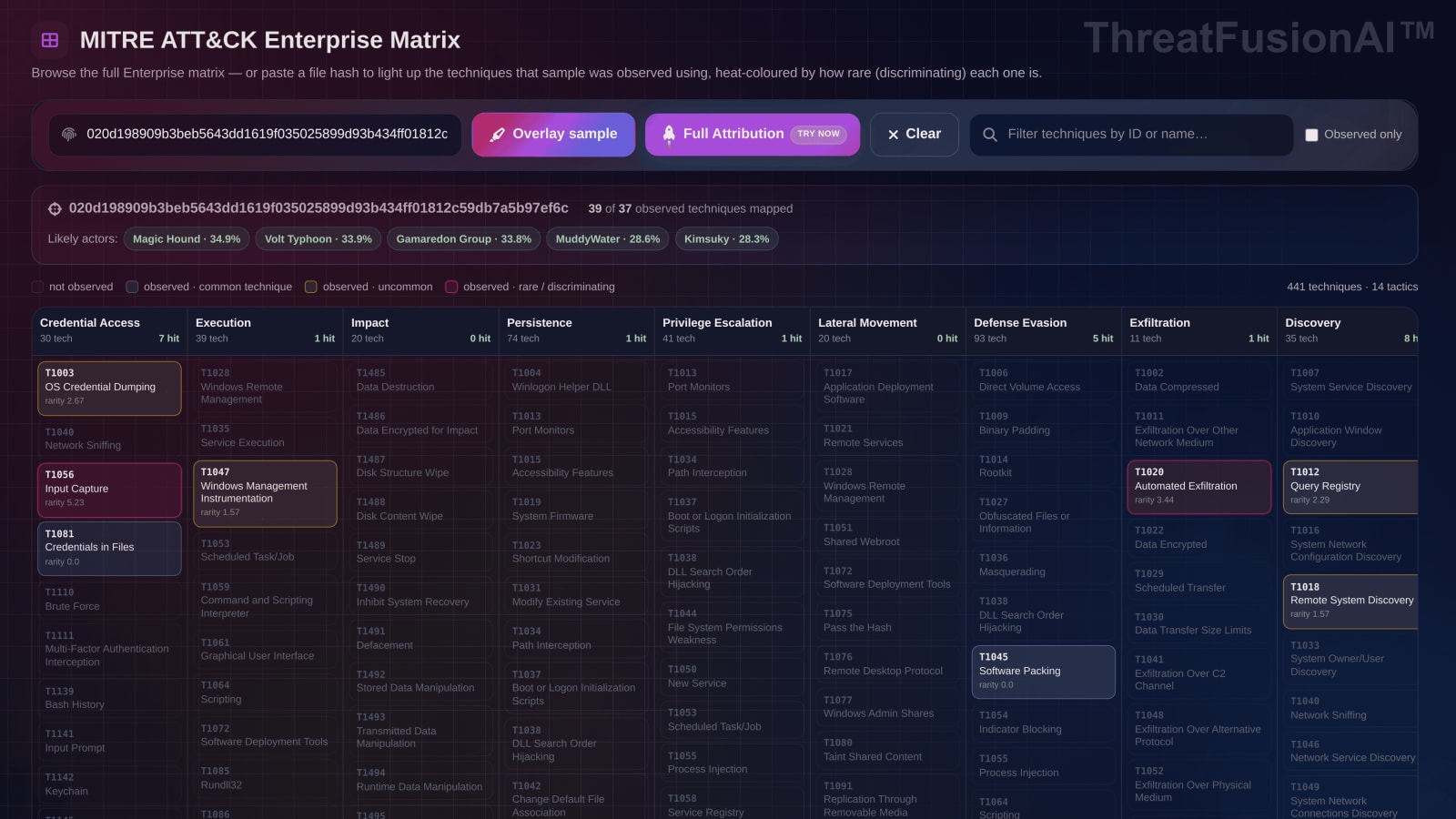
The matrix with a file hash overlaid: observed techniques heat-coloured by rarity, per-tactic hit counts and likely actor chips
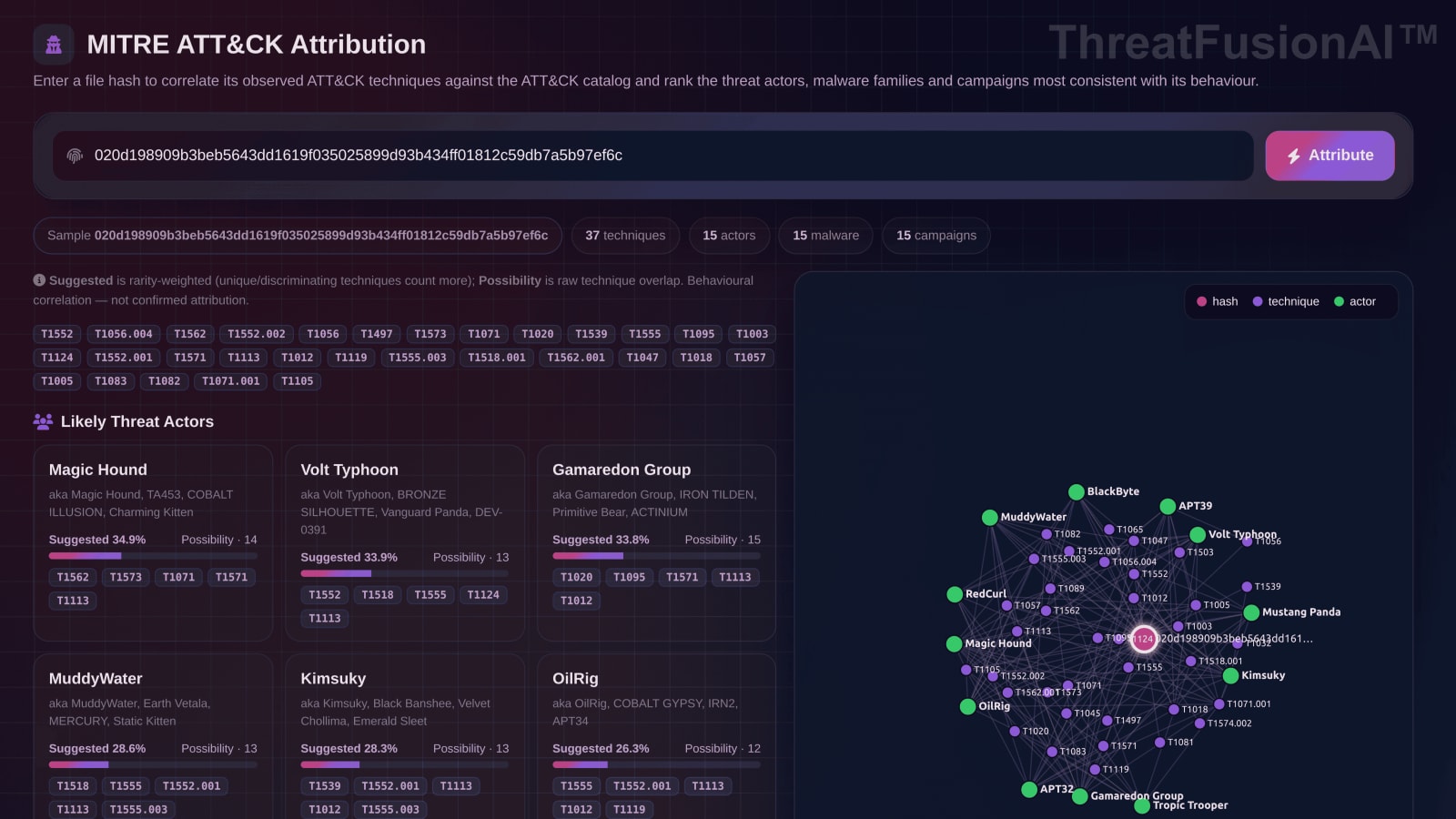
Likely threat actor cards with aliases, suggested match percentages and shared techniques, beside a hash to technique to actor graph
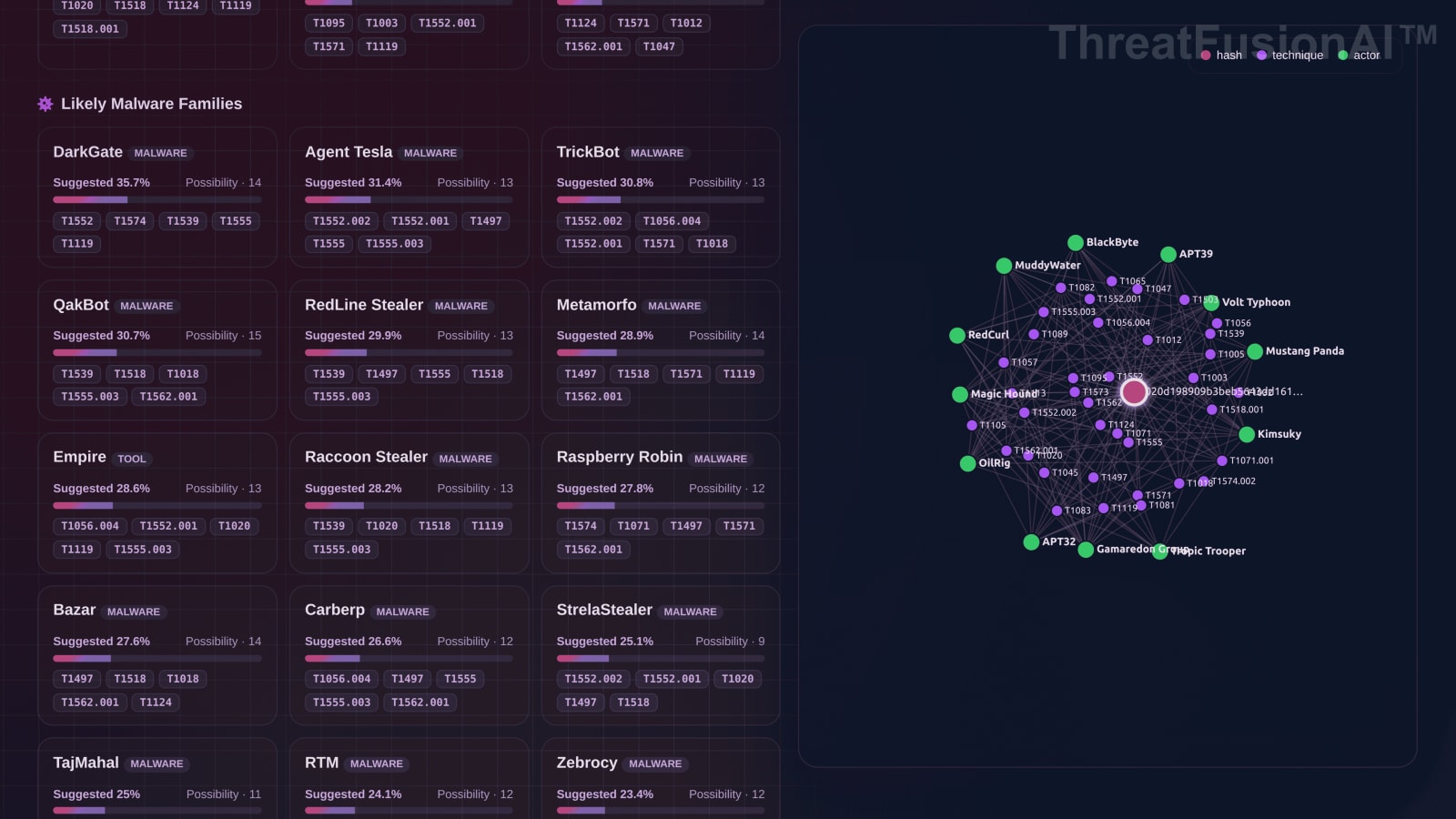
Likely malware families ranked for the sample, including DarkGate, Agent Tesla, TrickBot and QakBot
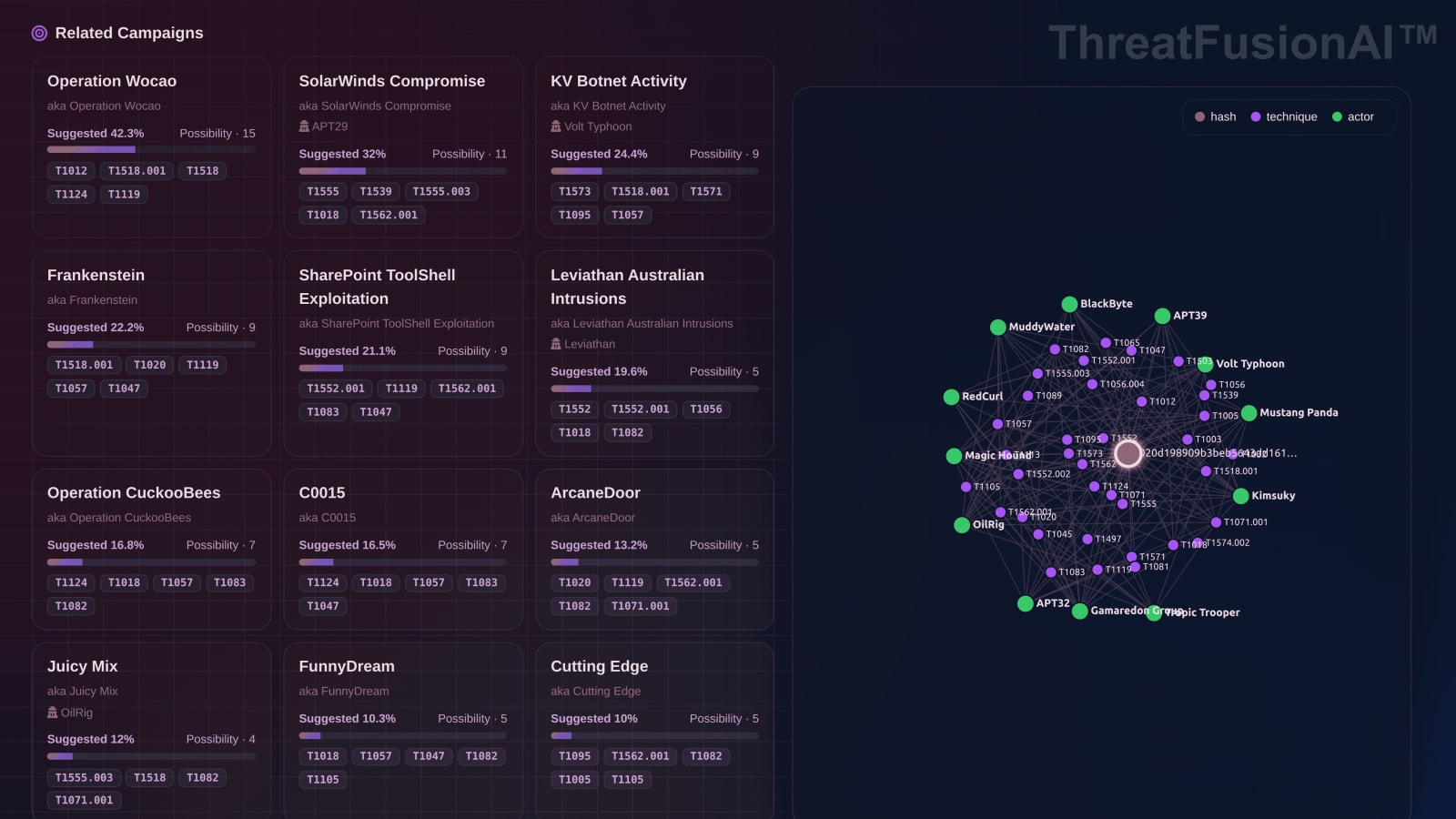
Related campaigns matched to the sample, such as Operation Wocao, SolarWinds Compromise and KV Botnet Activity
MITRE ATT&CK mapping

From Observed Behaviour to Tactics, Techniques and Actors

ThreatFusionAI helps analysts comprehend how a malware sample functions by integrating attacker behavior with the MITRE ATT&CK framework, Instead of seeing only a malicious verdict, analysts can examine which MITRE ATT&CK techniques were associated with the observed behavior.

Step 01
Explore the ATT&CK matrix

View Enterprise ATT&CK techniques across the familiar ATT&CK matrix structure, Search and investigate techniques by ID or name and understand how they fit within attacker tactics.

Step 02
Map Malware Behavior

Submit a malware hash and identify ATT&CK techniques associated with the sample's observed behavior, heat-coloured by how rare — and therefore how discriminating — each technique is.

Step 03
Compare threat actors

ThreatFusionAI compares observed techniques with documented activity from tracked threat groups. Rare or distinctive combinations can provide stronger investigative clues than techniques commonly used by many attackers.

Step 04
Identify possible malware families

Observed behaviour is compared against known malware and tools including DarkGate, Agent Tesla, TrickBot and QakBot, ranked by how much of the sample's behaviour each one explains.

Step 05
Connect activity to campaigns

Investigate known campaigns and their associated threat actors where supporting relationships exist — Operation Wocao, SolarWinds Compromise, KV Botnet Activity — each arriving with its attributed actor attached.

MITRE Security Framework for Threat Investigation

Security teams can use the MITRE security framework and ATT&CK knowledge base to describe attacker behavior consistently across investigations, ThreatFusionAI helps analysts connect malware activity with:

TacticsTechniquesMalwareThreat actorsCampaigns

Threat intelligence teams, SOC analysts, incident responders, and security leadership can all communicate better as a result.

Ransomware

Ransomware and MITRE ATT&CK Analysis

Ransomware investigations often involve much more than the encryption event itself. Attackers employ techniques across multiple lifecycle stages, including initial access, credential access, discovery, lateral movement, command and control, defence evasion, exfiltration and impact.

Initial access
The phishing attachment, the exposed service, the stolen VPN credential
Credential access
Dumping and reusing whatever logins the first machine gives up
Discovery
Mapping the network, the shares, the backups worth destroying
Lateral movement
Spreading from the first host to the ones that matter
Command and control
The channel back to the operator, usually hiding in normal traffic
Defense evasion
Killing the agent, clearing the logs, blending into the noise
Exfiltration
The data leaves before it's encrypted — that's the real leverage
Impact
Encryption, and the note. The only stage most people ever see

What the platform provides.ThreatFusionAI helps investigators compare observed malware behavior with these techniques and investigate related threat activity, Using ransomware MITRE ATT&CK mapping allows analysts to describe this behavior using standardized ATT&CK tactics and techniques.