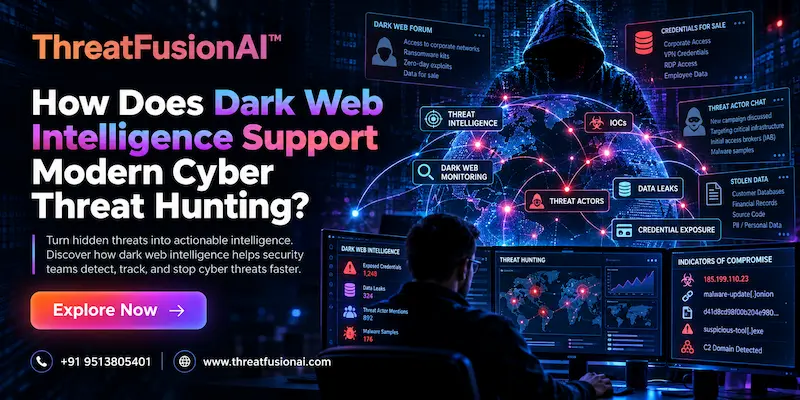
Do you know what Dark Web Intelligence is, how it works, and how it can help modern cyber threat hunting for better security against cyber threats? If not, then you are in the right place. Here, we will take a look at what it is and related benefits in detail.
Moreover, we will introduce you to a reliable threat intel solution offered by a reputable VAPT service provider. What are we waiting for? Let’s get straight to the topic!
What Is Dark Web Intelligence?
Dark web intelligence involves systematically monitoring encrypted networks, underground cybercrime forums, illicit marketplaces, and closed messaging channels (like Telegram) to uncover stolen corporate credentials, proprietary data leaks, and targeted attack discussions.
By tracking adversary activity directly within these hidden spaces, organizations can identify early indicators of compromise, assess brand exposure, and proactively mitigate threats before an actual intrusion occurs.
It transforms passive defense into proactive threat hunting by providing visibility into the supply, demand, and strategies of active cybercriminals. Wondering what Dark Web Intelligence is? Let’s explore what it is, how it works, and what the benefits are for users!
Why Does Dark Web Intelligence Matter in Modern Cybersecurity?
|
S.No. |
Factors |
Why? |
|
1. |
Early Threat Warning & Pre-Breach Visibility |
Detects early access broker advertisements and initial breach preparation before an actual intrusion starts. |
|
2. |
Credential & Identity Theft Mitigation |
Detects corporate login credentials that have been disclosed and sold on forums in order to stop automated credential stuffing and account takeover. |
|
3. |
Brand & Executive Protection |
Monitors threats of VIP extortion, spoof domain sales, and targeted phishing kits directed at business executives. |
|
4. |
Third-Party & Supply Chain Risk Monitoring |
Spots released partner data that was distributed through illegal underground channels and compromised vendor access keys. |
|
5. |
Anticipation of Ransomware & RaaS Operations |
Identifies target victim lists, leak site staging, and active ransomware affiliate recruitment prior to encryption payload deployment. |
How Does Dark Web Intelligence Support Cyber Threat Hunting?
Dark web intelligence supports cyber threat hunting in the following ways:
1. Identifies Target-Specific TTPs: Identifies the precise enemy strategies that are debated underground in order to customize particular internal hunt theories.
2. Uncovers Compromised Credentials for Baseline Anomalies: Targeted searches for illicit user session behavior are triggered by flagging employee logins that have been leaked.
3. Reveals Active C2 Infrastructure & Payloads: Finds bespoke malware samples and recently deployed domain networks before they are reported by public sources.
4. Provides Early Warning on Initial Access Vectors: Reveals zero-day vulnerabilities that target particular enterprise software models and sold VPN access credentials.
5. Guides Custom Detection Signature Development: Provides special forum IOCs for creating high-fidelity hunting queries for YARA, SIGMA, and SIEM.
Key Types of Threats Found Through Dark Web Intelligence
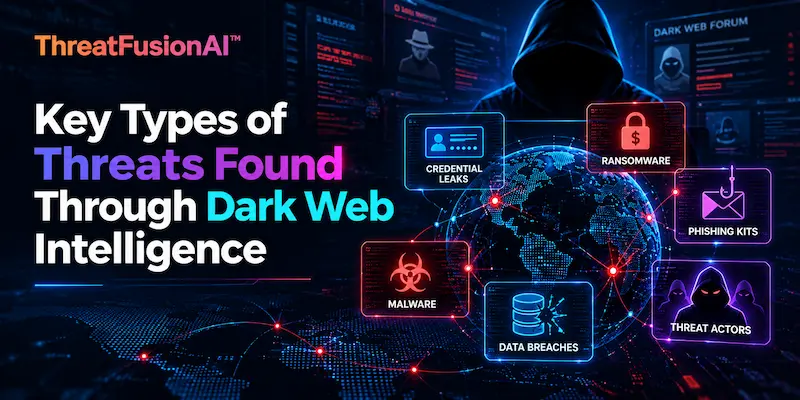
The following are some key types of threats found through dark web intelligence:
● Compromised Credentials & Session Hijacking Tokens: Infostealers collect stolen login pairs and active browser cookie logs, which they then auction off to get around MFA.
● Broker Listings for Corporate Network Access: Initial access brokers (IABs) are companies that offer pre-configured entry points into cloud environments, RDPs, and enterprise VPNs.
● Exfiltrated Corporate Data & Intellectual Property: Financial records, customer PII, and proprietary source code that are released on leak sites to compel double-extortion ransomware demands.
● Malware-as-a-Service (MaaS) & Exploits: Low-level threat actors exchange proprietary obfuscation tools, commercial ransomware kits, and zero-day exploit payloads.
● Malicious Insider & Extortion Activity: Disgruntled workers are selling business data or access to internal systems on underground forums.
How Does Dark Web Intelligence Help Detect Stolen Credentials?
|
S.No. |
Factors |
How? |
|
1. |
Monitors Infostealer Logs |
Ingests raw stealer log dumps that contain stored login credentials, active cookies, and stolen browser autofill data. |
|
2. |
Scans Underground Marketplaces |
Finds recently listed corporate account access pairs by searching automated illegal marketplaces, such as Russian Market and Genesis. |
|
3. |
Infiltrates Closed Forums & Messaging Channels |
Keeps an eye on Telegram channels and invite-only hacking boards where threat actors exchange bulk combo lists. |
|
4. |
Triggers Automated MFA & Password Resets |
Allows for the quick revocation of credentials by feeding newly found credential leaks straight into IAM/SIEM systems. |
|
5. |
Identifies Credential Stuffing Risk |
In order to prevent automated brute-force attack operations, compromised employee passwords were cross-referenced with public login portals. |
How Do Threat Hunters Collect Dark Web Intelligence?
Threat hunters collect dark web intelligence in the following ways:
a) Automated Crawler & Forum Scraping Infrastructure: Uses robust, TOR-routed web scrapers to methodically consume forum threads, market listings, and public posts.
b) Persona Management & Human Intelligence (HUMINT): Keeps secret, verified sock-puppet identities in order to enter invite-only, restricted cybercrime communities.
c) Infostealer Log & Telegram Channel Monitoring: Sets up automated API bots to compile real-time chat feeds and malware log dumps from underground Telegram groups.
d) Commercial Threat Feeds & Specialized OSINT: Allows users to safely query pre-indexed dark web datasets by subscribing to specific CTI vendor feeds (such as Recorded Future and Flashpoint).
e) Decoy Assets & Canary Tokens: To track unauthorized opponent exfiltration, post papers with beacon embeddings or trackable false credentials on public forums.
Integrating Dark Web Intelligence Into a Threat Hunting Workflow
By providing external signs like compromised credentials, new C2 domains, and ongoing exploit talks straight into SIEM and EDR platforms as hunt hypotheses, dark web intelligence combines with threat hunting.
In order to quickly verify whether external enemy activity has infiltrated internal networks, hunters transform these underground discoveries into unique YARA, SIGMA, or KQL rules to sweep business logs.
Transforming Dark Web Telemetry Into Actionable Indicators of Compromise (IOCs)
Using automated parsing, normalization, and STIX/TAXII enrichment to extract file hashes, C2 IPs, and compromised credentials, raw dark web telemetry is converted into actionable IOCs.
In order to promptly stop active attacks and promote proactive detection, these indicators are structured into YARA/SIGMA rules and transmitted to SIEM/EDR systems after being verified against enterprise asset context.
Best Practices for Using Dark Web Intelligence in Threat Hunting
The following are the best practices for using dark web intelligence in threat hunting:
1. Maintain Rigorous Operational Security (OpSec): Use well-managed identities, non-attributable networks, and specialized isolated environments to carry out all underground reconnaissance.
2. Validate and Filter Signal-to-Noise: To eliminate unsupported hacker chatter and false positives, cross-check raw dark web claims against internal telemetry.
3. Convert Raw Data into Standardized Formats: Convert extracted threat indicators into actionable detection rules such as YARA, SIGMA, or KQL, as well as STIX/TAXII objects.
4. Focus on Pre-Breach Indicators: Give priority to early warning indicators including targeted exploit talk, compromised employee credentials, and initial access broker listings.
5. Automate Ingestion and SIEM/ EDR Integration: Enriched threat intelligence can be streamed straight into company SOC solutions for quick threat hunting sweeps and automated blocking.
How Can ThreatFusionAI Support Dark Web Intelligence and Threat Hunting?
ThreatFusionAI can support dark web intelligence and threat hunting in the following ways:
● Automated Dark Web Exposure Monitoring: Detects corporate credential exposures and initial access broker listings by continuously scanning underground forums, leak sites, and illegal channels.
● AI-Driven IOC Correlation & Infrastructure Graphing: Automatically maps broader adversary attack infrastructure by connecting discrete signs such as hashes, IPs, and domains.
● MITRE ATT&CK & Threat Actor Attribution: Connects campaigns to recognized threat actor profiles and ranks extracted behaviors against typical TTP strategies.
● Indicator-Driven Threat Hunting Workflows: Enables analysts to start proactive sweeps using certain threat group methodologies, hashes, or C2 domains.
● AI-Assisted Investigation & Triaging: Simplifies IOC interactions and intricate malware telemetry in order to expedite investigative judgments.
Conclusion: Strengthening Threat Hunting With Dark Web Intelligence
Now that we have talked about what Dark Web Intelligence is, you might want to get your hands on a dedicated threat intelligence solution from a reliable source. For that, you can go for ThreatFusionAI, a dedicated threat intel platform offered by Craw Security.
ThreatFusionAI can help businesses by notifying them about the latest security vulnerabilities and cyber threats so that they can enhance their security measures in time. What are you waiting for? Contact, Now!
Frequently Asked Questions
About Dark Web Intelligence
1. How does the dark web contribute to cybercrime?
The dark web contributes to cybercrime in the following ways:
a) Commercializes Attack Capabilities (Cybercrime-as-a-Service),
b) Facilitates Data & Credential Monetization,
c) Enables Initial Access Arbitrage,
d) Provides Anonymous Communication & Coordination, and
e) Serves as an Extortion Platform.
2. What is dark web intelligence?
The process of gathering, evaluating, and turning raw threat data from hidden forums, encrypted channels, and underground markets into useful insights to stop cyberattacks is known as "dark web intelligence."
3. What is the purpose of threat intelligence in cybersecurity?
Threat intelligence's goal is to transform unprocessed threat data into useful insights so that businesses can foresee, stop, and react quickly to cyberattacks before they do harm.
4. What are the top 10 dark web monitoring tools?
The following are the top 10 dark web monitoring tools:
a) Recorded Future,
b) SpyCloud,
c) Flare,
d) DarkOwl,
e) SOCRadar,
f) ZeroFox,
g) CrowdStrike Falcon Intelligence Recon,
h) Cyble Vision,
i) KELA (DeXpose), and
j) Hudson Rock (Cavalier).
5. Is the dark web illegal in India?
No, it is not unlawful to access or browse the dark web in India; but using it for illegal purposes, such as buying illicit items, handling stolen data, or hacking, is prohibited by both the Indian Penal Code and the Information Technology Act.
6. Which country uses the dark web the most?
Approximately 15–20% of all daily Tor network traffic originates from the United States, which has the largest number of dark web users worldwide.
7. How many Indians use the dark web?
India has the fifth-largest user base in the world, accounting for about 4.3% of all traffic, with an average of 135,000 daily active users connecting directly to the Tor network, according to Tor Project stats.
8. Can the FBI track the dark web?
Yes, the FBI often uses sophisticated techniques like blockchain analysis, server seizures, undercover operations, operational security (OpSec) slip-up tracking, and malicious software injections to track and deanonymize dark web activity.
9. Which is deeper, the dark web or deep web?
Although the Dark Web is "deeper" in terms of accessibility, encryption, and deliberate concealment, the Deep Web is significantly "deeper" in terms of scale, making up between 90% and 95% of the whole internet as opposed to the Dark Web's less than 0.01%.