Do you know what SOC Analyst Tools are, their uses, and why organizations need such tools for their protection against online threats? If not, then you are in the right place. Here, we will talk about what SOC Analyst Tools are and related benefits in detail.
Moreover, we will introduce you to a reliable threat intel solution offered by a reputable VAPT service provider. What are we waiting for? Let’s get started!
What Are SOC Analyst Tools?
Security Operations Center personnel employ SOC analyst tools, which are specialist cybersecurity software solutions, to monitor, identify, evaluate, and address cyber threats in various organizational environments.
These systems allow real-time visibility and quick incident triage by centralizing security telemetry, such as logs, network traffic, host activity, and identity measurements, into unified dashboards.
They enable analysts to effectively analyze anomalies, contain breaches, and mitigate risks by utilizing capabilities like SIEM log aggregation, XDR endpoint tracking, SOAR playbook automation, and threat intelligence feeds.
Let’s explore what SOC Analyst Tools are, their uses, their features, and related benefits for organizations in the IT Industry!
Why Are SOC Analyst Tools Important in Cybersecurity?
SOC analyst tools are important in cybersecurity for the following reasons:
Accelerated Threat Detection and Incident Response:
Reduces detection and dwell times from days to minutes by centralizing and correlating real-time security events.
Reduction of Alert Fatigue and Analyst Burnout:
Presents analysts with high-priority occurrences by filtering out benign network noise and correlating low-level information.
Complete Cross-Surface Visibility:
Combines telemetry from endpoints, networks, identities, and multi-cloud environments to eliminate organizational blind spots.
Automated Containment and Remediation:
Uses automated playbooks to block malicious IPs, immediately isolate affected hosts, and revoke compromised access keys.
Continuous Compliance and Regulatory Readiness:
Maintains smooth compliance with frameworks like GDPR, HIPAA, and PCI DSS by automatically recording security incidents and auditing posture metrics.
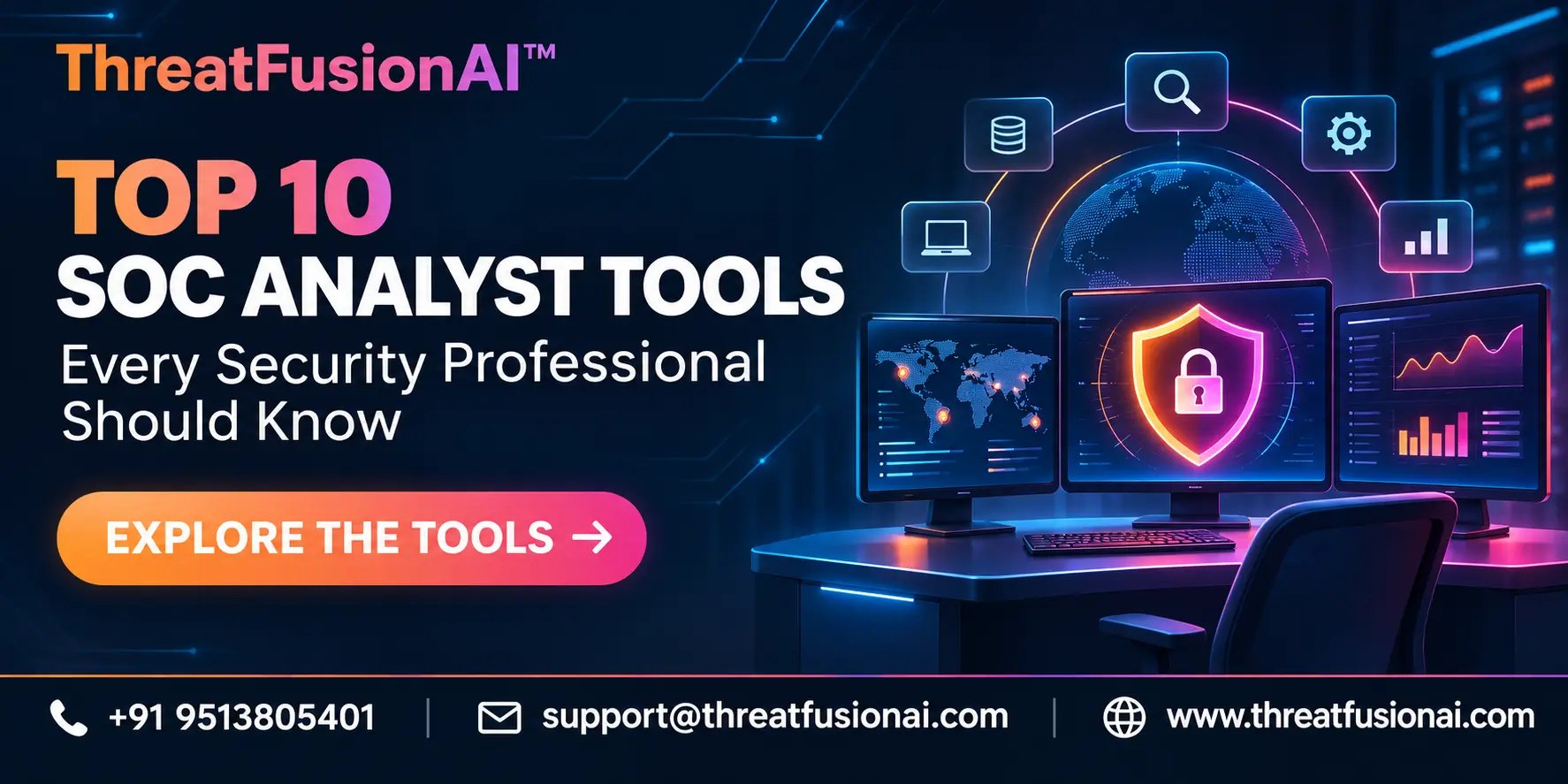
Top 10 SOC Analyst Tools Every Security Professional Should Know in 2026
|
S.No. |
Tools |
What? |
|
1. |
SIEM Tools for Security Information and Event Management |
To carry out unified security event analysis, rule-based threat detection, and real-time correlation, and centralize multi-source log telemetry. |
|
2. |
EDR Tools for Endpoint Detection and Response |
On host endpoints, offer quick automated containment, behavioral anomaly tracking, and ongoing process monitoring. |
|
3. |
SOAR Tools for Security Orchestration, Automation, and Response |
To speed up threat containment and get rid of tedious manual triage, organize incident response workflows and run automated playbooks. |
|
4. |
Network Traffic Analysis Tools for Threat Detection |
To find covert command-and-control channels and stealthy lateral movement, continuously examine deep network packet flows and protocol information. |
|
5. |
Intrusion Detection and Prevention System (IDS/ IPS) Tools |
To detect or actively discard malicious packets, keep an eye on perimeter and internal network traffic streams against signature databases and behavioral patterns. |
|
6. |
Vulnerability Assessment and Management Tools |
To find and fix system vulnerabilities before they are exploited, automate asset discovery, vulnerability scanning, and risk prioritization. |
|
7. |
Threat Intelligence Tools for Identifying Cyber Threats |
To add external attacker attribution to internal security warnings, ingest, standardize, and contextualize global IOC inputs. |
|
8. |
Log Management and Monitoring Tools for Security Operations |
To provide quick forensic searching and real-time visualization, aggregate, index, and interpret enormous amounts of operational event logs. |
|
9. |
Digital Forensics and Incident Response (DFIR) Tools |
Investigate the underlying causes of breaches and uphold the legal chain of custody by extracting, analyzing, and preserving volatile memory, disk images, and system artifacts. |
|
10. |
Malware Analysis and Reverse Engineering Tools |
Use static and dynamic analysis to break down binary executables to find hidden TTPs, malicious payloads, and command signatures. |
How SOC Analyst Tools Work Together in a Security Operations Center?
SOC analyst tools work together in a security operations center in the following ways:
Centralized Ingestion via SIEM and Log Management:
Creates a single, searchable, correlated stream by combining and standardizing telemetry from multiple sources.
Endpoint and Network Detection Enrichment:
Covers raw log data with real-time process, packet, and memory telemetry.
Contextualization via Threat Intelligence Platforms (TIP):
Verifies threat severity by cross-referencing real-time telemetry with external threat feeds.
Orchestration and Automated Playbook Execution:
Initiates automated security tool workflows to quickly contain verified attacks.
Deep Forensic Triage and Malware Analysis:
Examines hacked binaries and artifacts to identify the impact and underlying cause.
How to Choose the Best SOC Analyst Tools for Your Security Team?
You can choose the best SOC analyst tools for your security teams in the following ways:
Assess Ecosystem Integration and Scalability:
Give preference to products that have native APIs so that networks, endpoints, and multi-cloud environments can be smoothly unified without forming data silos.
Evaluate AI Accuracy and Explainability:
Make sure machine learning models provide high-confidence alert context, unambiguous decision paths, and minimal false-positive rates.
Measure Time-to-Value and Playbook Automation:
Choose platforms that automatically automate triage and speed up issue response times by using pre-built SOAR playbooks.
Run a Data-Driven Proof of Concept (PoC):
To verify detection rates, ingestion speeds, and general analyst usability, test products against actual company traffic.
Analyze Total Cost of Ownership and Licensing:
Choose predictable pricing structures that combine several point security systems to save on operational expense.
Free vs. Paid SOC Analyst Tools: Which Is Better?
|
S.No. |
Topics |
Factors |
What? |
|
1. |
Free/ Open-Source SOC Tools |
Cost & Customizability |
Allows security engineers to thoroughly examine, alter, and customize the source code to meet certain operational needs without having to pay upfront license fees. |
|
Community-Driven Flexibility |
Benefits from rapid community patches and active community detection rules (like Sigma and YARA), but maintaining, integrating, and scaling it involves a large amount of manual labor. |
||
|
2. |
Paid Enterprise SOC Tools |
Out-of-the-Box Automation & SLA Support |
Provides guaranteed uptime/patching, ongoing vendor support, and pre-packaged SOAR playbooks without taxing internal engineering teams. |
|
Seamless Scalability & Advanced AI |
Provides native ecosystem connectors, scalable multi-cloud ingestion, and unique machine-learning models that are immediately tailored for low false-positive rates. |
Essential Skills Every SOC Analyst Needs to Use Security Tools Effectively
The following are some essential skills every SOC analyst needs to use security tools effectively:
Deep Network Protocol & OS Telemetry Mastery:
Recognize hidden irregularities quickly by comprehending packet flows, system logs, and OS functions.
SIEM & Query Language Proficiency:
Learn query syntaxes such as Lucene, SPL, or KQL to effectively hunt threats and filter noise.
Threat Intelligence & Framework Alignment:
To comprehend opponent TTPs, map real-time warnings directly to threat feeds and MITER ATT&CK methods.
Scripting & Workflow Automation:
To automate repetitive chores and expedite triage procedures, write scripts in Python, PowerShell, or Bash.
Incident Response & Forensic Triage:
To identify breaches and identify the underlying reasons, examine memory dumps, disk artifacts, and network captures.
Final Thoughts: Building an Effective SOC Toolkit for Cybersecurity Professionals
Now that we have talked about what SOC Analyst Tools are, you might want to get your hands on a dedicated threat intel solution from a reliable source. For that, you can go for ThreatFusionAI, a dedicated threat intelligence platform offered by Craw Security.
ThreatFusionAI can help organizations by notifying them about the latest cyber threats and malicious risks so that they can enhance their security measures. What are you waiting for? Contact, Now!
Frequently Asked Questions
About SOC Analyst Tools
1. What are the top 10 SOC analyst tools every security professional should know?
The following are the top 10 SOC analyst tools every security professional should know:
a) SIEM Tools for Security Information and Event Management,
b) EDR Tools for Endpoint Detection and Response,
c) SOAR Tools for Security Orchestration, Automation, and Response,
d) Network Traffic Analysis Tools for Threat Detection,
e) Intrusion Detection and Prevention System (IDS/IPS) Tools,
f) Vulnerability Assessment and Management Tools,
g) Threat Intelligence Tools for Identifying Cyber Threats,
h) Log Management and Monitoring Tools for Security Operations,
i) Digital Forensics and Incident Response (DFIR) Tools, and
j) Malware Analysis and Reverse Engineering Tools.
2. Which tools are most commonly used by SOC analysts?
The following tools are most commonly used by SOC analysts:
a) Security Information and Event Management (SIEM) Platforms (e.g., Microsoft Sentinel, Splunk ES),
b) Endpoint Detection and Response (EDR / XDR) Platforms (e.g., CrowdStrike Falcon, SentinelOne),
c) Security Orchestration, Automation, and Response (SOAR) Platforms (e.g., Palo Alto Cortex XSOAR, Torq, Tines),
d) Network Detection and Response (NDR) & Packet Analyzers (e.g., Corelight/Zeek, Wireshark), and
e) Threat Intelligence Platforms (TIP) & DFIR Tools (e.g., Anomali, MISP, Volatility, Autopsy).
3. What is the best SIEM tool for SOC analysts?
Depending on whether an organization values cloud-native scalability and affordable ecosystem integration (Sentinel) or raw search speed with extensive customisation (Splunk), Splunk Enterprise Security and Microsoft Sentinel are generally regarded as the top SIEM tools for SOC analysts.
4. Which SOC analyst tools are best for beginners?
The following SOC analyst tools are best for beginners:
a) Wireshark (Network Packet Analysis),
b) Wazuh / Elastic Security (SIEM & EDR),
c) VirusTotal & AlienVault OTX (Threat Intelligence),
d) TheHive (SOC Case Management), and
e) NetworkMiner & Autopsy (DFIR Fundamentals).
5. Are there any free SOC analyst tools available?
Wazuh (SIEM/EDR), Security Onion (Network Monitoring), TheHive (Incident Response), MISP (Threat Intelligence), and Wireshark (Packet Analysis) are just a few of the many potent free and open-source SOC analyst tools available in important categories.
6. What is the difference between SIEM, EDR, and SOAR tools?
EDR continually monitors and defends host endpoints at the system level, SIEM aggregates and correlates log telemetry across the entire company network for centralized visibility, and SOAR coordinates and automates response activities across both to immediately contain threats.
7. Which tools are used for threat detection and incident response?
The following tools are used for threat detection and incident response:
a) Extended Detection and Response (XDR) Platforms (e.g., CrowdStrike Falcon, Microsoft Defender XDR),
b) Security Information and Event Management (SIEM) (e.g., Splunk ES, Microsoft Sentinel),
c) Network Detection and Response (NDR) Platforms (e.g., Darktrace, Corelight, Vectra AI),
d) Security Orchestration, Automation, and Response (SOAR) (e.g., Palo Alto Cortex XSOAR, Splunk SOAR), and
e) Identity Threat Detection and Response (ITDR) & Identity Security (e.g., Okta ThreatInsight, CrowdStrike Falcon Identity).
8. Do SOC analysts need to know programming to use security tools?
No, proficiency with query languages and rudimentary scripting in Python, PowerShell, or Bash is necessary for specialized threat hunting, log parsing, and playbook automation, but deep software development skills are not necessarily necessary for basic SOC analyst jobs to use GUI-based security products.
9. How can I practice using SOC analyst tools at home?
You can practice using SOC analyst tools at home in the following ways:
a) Set up a Local Virtualized Security Lab,
b) Practice on Interactive Cyber Range Platforms,
c) Master Packet Analysis with Wireshark,
d) Deploy a Free Cloud-Native SIEM Trial, and
e) Build an Open-Source Threat Hunting Environment.
10. What are the most important skills required to become a SOC analyst?
The following are the most important skills required to become a SOC analyst:
a) Log Analysis & Query Language Mastery,
b) Network & OS Telemetry Fundamentals,
c) Threat Framework & Intelligence Alignment,
d) Scripting & Automation Competency, and
e) Incident Response & Forensic Triage.