Do you know what Lateral Movement is, its uses, its impacts, and how you can protect yourself against such threats? If not, then you are in the right place. Here, we will talk about what Lateral Movement is and related benefits in detail.
Moreover, we will introduce you to a reliable threat intel solution offered by a reputable VAPT service provider. What are we waiting for? Let’s get started!
What Is Lateral Movement in Cybersecurity?
Lateral movement is a cyberattack tactic where an attacker, after acquiring initial access to a single endpoint or account inside a network, systematically navigates deeper through the environment to elevate privileges and reach high-value targets.
Attackers can travel stealthily across devices without setting off boundary security alerts by using methods including stolen credentials, remote administration protocols, and unpatched internal vulnerabilities.
Threat actors can establish persistence, map the network structure, and find sensitive company data before exfiltration or ransomware deployment by imitating legitimate administrative activities through lateral movement.
Initial Access vs Lateral Movement
|
S.No. |
Topics |
Factors |
What? |
|
1. |
Initial Access |
Focus & Gateway |
The main point of entry via which an attacker initially penetrates the perimeter (e.g., via phishing, unpatched external vulnerabilities, or stolen edge credentials). |
|
Objective |
Creates an initial foothold on a single machine or user account and leaves a trace inside the target network. |
||
|
2. |
Lateral Movement |
Focus & Navigation |
Internal traversal across machines and network segments using methods like SSH, RDP, or Pass-the-Hash takes place solely after first access. |
|
Objective |
Escalates privileges, maps the environment, and finds critical databases or high-value targets for ransomware or data exfiltration. |
Why Do Cybercriminals Use Lateral Movement Attacks?
Cybercriminals use lateral movement attacks for the following reasons:
To Reach High-Value Targets:
Go from initial low-security endpoints to essential IP assets, domain controllers, and core databases.
To Evade Detection and Perimeter Security:
To get beyond perimeter security measures, blend in with authorized internal traffic and administrative procedures.
To Escalate System Privileges:
Elevate rights from regular user to domain administrator by using internal exploits and credentials that have been stolen.
To Establish Persistence and Redundancy:
To keep control in the event that initial access is revoked, plant compromised service accounts and backdoors on several nodes.
To Maximize Ransomware Impact and Data Exfiltration:
To carry out synchronized system encryption and stage enterprise-wide data theft, map the whole infrastructure.
What Are the Different Stages of a Lateral Movement Attack?
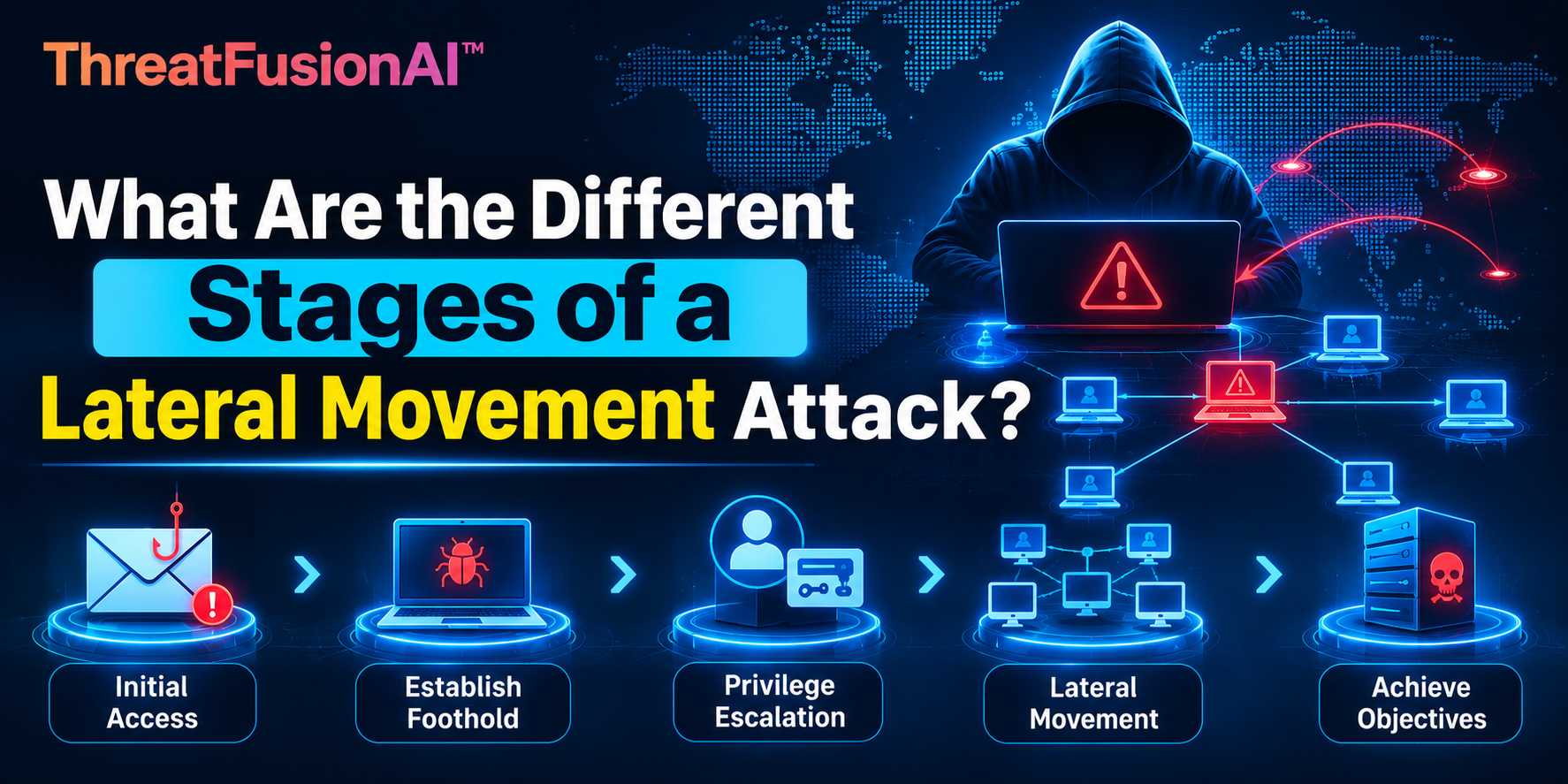
The following are the different stages of a lateral movement attack:
Reconnaissance & Network Mapping:
To find high-value targets and susceptible endpoints, scan internal subnets, ports, and Active Directory structures.
Credential Harvesting & Privilege Escalation:
To increase rights to administrator access, retrieve tokens, dump local password hashes, and take advantage of vulnerabilities.
Internal Exploitation & Traversal:
To switch between network segments without setting off perimeter alarms, use trustworthy protocols like SSH, RDP, or PsExec.
Establishing Persistence:
To sustain long-term access, plant backdoors, rogue service accounts, or web shells on several compromised hosts.
Reaching the Target & Objective Execution:
To carry out data exfiltration, service interruption, or enterprise-wide ransomware, locate important databases or domain controllers.
How Does Lateral Movement Work in Cyberattacks?
|
S.No. |
Factors |
How? |
|
1. |
Internal Reconnaissance |
Attackers map linked systems, administrative shares, and open ports by querying Active Directory and scanning local subnets. |
|
2. |
Credential Harvesting |
Threat actors retrieve plain-text credentials, Kerberos tickets, and password hashes from local caches or system memory. |
|
3. |
Privilege Escalation |
Attackers can increase access from a regular user to a domain administrator by taking advantage of internal OS flaws and misconfigurations. |
|
4. |
System-to-System Traversal |
Using built-in administration tools like SSH, RDP, WMI, or PsExec, attackers switch between endpoints to imitate legitimate communications. |
|
5. |
Establishing Remote Persistence |
Unauthorized scheduled processes, rogue service accounts, and planted web shells guarantee uninterrupted access even after individual endpoints are fixed. |
What Are the Common Lateral Movement Techniques?
The following are the common lateral movement techniques:
Pass-the-Hash (PtH) & Pass-the-Ticket (PtT):
Use Kerberos tickets or intercepted NTLM hashes to authenticate directly to distant servers without needing to crack passwords.
Exploiting Administrative Protocols (RDP, SSH, WinRM):
To gain direct access to the targeted internal machines, use proper credentials and legitimate remote access protocols.
Abuse of Built-in Living-off-the-Land Tools (WMI, PsExec):
To avoid detection, use native OS administration tools to carry out malicious commands across host systems.
SSH Key Hijacking & Agent Forwarding:
To switch between Linux and Unix computers with ease, steal unprotected private SSH keys or take advantage of misdirected agent sockets.
Internal Phishing & Session Hijacking:
To deceive coworkers and get around multi-factor authentication, compromise active browser tokens or internal email accounts.
Real-World Examples of Lateral Movement Attacks
The following are some real-world examples of lateral movement attacks:
NotPetya Cyberattack (2017):
Automatically propagated throughout internal networks utilizing Mimikatz-harvested credentials in conjunction with EternalBlue and EternalRomance SMB attacks.
Target Data Breach (2013):
Accessed Point-of-Sale (POS) systems by switching from a hacked third-party HVAC vendor account to internal network segments.
SolarWinds Supply Chain Attack (2020):
Obtained initial access through hacked Orion software upgrades, then moved laterally into Microsoft 365 cloud environments by forging SAML tokens.
What Are the Warning Signs of Lateral Movement in a Network?
|
S.No. |
Factors |
What? |
|
1. |
Unusual Internal Authentication Spikes |
Logins made after hours, several unsuccessful attempts at authentication, or quick logins made by a single account across non-standard systems. |
|
2. |
Abnormal Use of Remote Access & Management Protocols |
Unexpected internal RDP, WinRM, WMI, or SSH communication that passes through non-administrative network regions. |
|
3. |
Credential Scraping & Dump Tool Execution |
LSASS memory access attempts, Mimikatz, and unverified password hash extractions are examples of security alarms. |
|
4. |
Internal Network Scanning Activity |
Active Directory queries, host-to-host port scans, or SMB sweeps coming from a typical user workstation. |
|
5. |
Creation of Rogue Accounts and Persistence Mechanisms |
Unanticipated scheduled tasks, new persistent system services, or the unauthorized establishment of local admin accounts. |
How to Detect Lateral Movement in Cybersecurity?
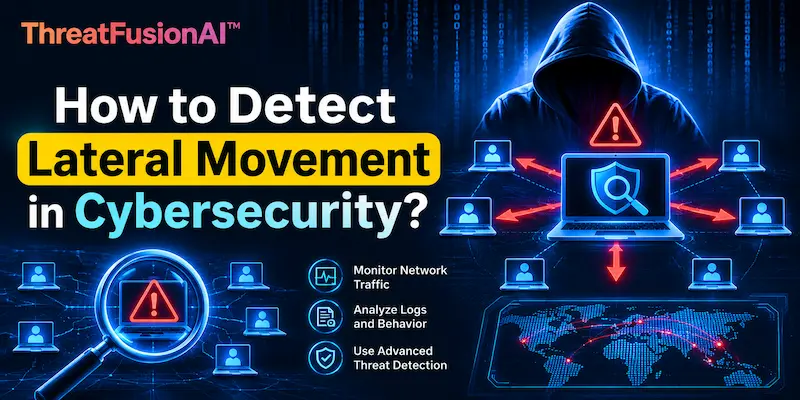
You can detect lateral movement in cybersecurity in the following ways:
Deploy Endpoint Detection and Response (EDR):
Keep an eye on questionable system command usage, credential dumping attempts, and process executions in real time.
Analyze Network Traffic with NDR/NTA:
Check for unapproved SSH, RDP, SMB sweeps, and non-standard protocols in internal east-west communication.
Enforce User and Entity Behavior Analytics (UEBA):
Establish baseline user behavior so that alarms about odd access patterns or logins made after hours can be automatically triggered.
Audit Centralized Authentication & Active Directory Logs:
Keep an eye out for multi-host logins, Kerberoasting, and unusual privilege escalation on domain controllers and SIEM feeds.
Deploy Canary Tokens and Cyber Deception:
Use decoy services, bait files, and fictitious credentials to quickly identify illegal lateral exploration.
What Tools Are Used to Detect Lateral Movement Attacks?
The following tools are used to detect lateral movement attacks:
Endpoint Detection and Response (EDR / XDR):
Prevents local privilege escalation by examining memory dumps, endpoint process executions, and suspicious command-line activities.
Network Detection and Response (NDR / NTA):
Examines internal east-west network traffic to identify covert lateral channels, port scans, and illicit protocol usage.
Security Information and Event Management (SIEM):
Combines and connects system logs and multi-source authentication to identify anomalies in cross-host access.
User and Entity Behavior Analytics (UEBA):
Uses baseline behavior profiling to automatically identify privilege abuse, unusual user logins, and access during off-peak hours.
Deception Technology & Canary Tokens:
Uses decoy assets, honeypots, and fictitious credentials to instantly send out high-fidelity notifications in the event of illegal activity.
How to Prevent Lateral Movement Attacks in Cybersecurity?
|
S.No. |
Factors |
How? |
|
1. |
Implement Zero Trust & Strict Network Microsegmentation |
To strictly limit east-west traffic and prevent lateral traversal, divide networks into discrete subnets. |
|
2. |
Enforce Least Privilege & Privileged Access Management (PAM) |
Limit user access, remove shared local administrator accounts, and store admin credentials. |
|
3. |
Mandate Hardware-Based Multi-Factor Authentication (MFA) |
To stop token theft and pass-the-ticket authentication, require FIDO2/WebAuthn security keys. |
|
4. |
Harden Remote Access & Disable Unnecessary Management Protocols |
Secure active management channels while disabling unused RDP, WinRM, and SMBv1 services. |
|
5. |
Protect LSA Caches & Enforce Credential Safeguards |
To prevent memory scraping programs like Mimikatz, activate Credential Guard and restricted admin modes. |
Incident Response for Lateral Movement
The following is the incident response for lateral movement:
Isolate Compromised Hosts Immediately:
To immediately stop active east-west lateral traversal, disconnect compromised endpoints from the network.
Revoke and Reset Compromised Credentials:
For all impacted, elevated, and domain-level accounts, force credential resets and end open sessions.
Identify the Initial Entry Point and Traversal Path:
Examine network traffic and endpoint logs to determine the attacker's movement path and weaponized access point.
Block Malicious Infrastructure and Protocols:
To cut off unwanted protocols and command-and-control channels, update network access restrictions, DNS sinks, and firewall rules.
Eradicate Persistence Mechanisms and Audit Systems:
Before restoring confirmed clean system backups, eliminate rogue scheduled jobs, web shells, and unauthorized accounts.
Conclusion
Now that we have talked about what Lateral Movement is, you might want to get your hands on a dedicated threat intel solution for future threats. For that, you can go for ThreatFusionAI, a dedicated threat intelligence platform offered by Craw Security.
ThreatFusionAI can help businesses by notifying them about the latest cyber threats and vulnerabilities so that they can enhance their security measures for future threats. What are you waiting for? Contact, Now!
Frequently Asked Questions
About Lateral Movement
1. What is lateral movement in cybersecurity?
The post-exploitation technique known as "lateral movement" allows an attacker to gain access to high-value assets and raise privileges by surreptitiously traversing an internal network from an initial entry point.
2. How does lateral movement work in a cyberattack?
Lateral movement works in a cyberattack in the following ways:
a) Internal Reconnaissance,
b) Credential Harvesting,
c) Privilege Escalation,
d) System-to-System Traversal, and
e) Establishing Remote Persistence.
3. Why do hackers use lateral movement techniques?
Hackers use lateral movement techniques for the following reasons:
a) To Access High-Value Target Assets,
b) To Evade Perimeter and Network Controls,
c) To Elevate System and Domain Privileges,
d) To Build Network-Wide Persistence, and
e) To Maximize Ransomware and Data Theft Impact.
4. What are the most common lateral movement techniques?
The following are the most common lateral movement techniques:
a) Pass-the-Hash (PtH) and Pass-the-Ticket (PtT),
b) Abuse of Remote Services (RDP, SSH, WinRM),
c) Execution via Living-off-the-Land (LotL) Tools,
d) Exploitation of Internal Remote Services, and
e) Internal Spear Phishing and Session Hijacking.
5. How can you detect lateral movement in a network?
You can detect lateral movement in a network in the following ways:
a) Analyze Internal East-West Traffic (NDR/NTA),
b) Monitor Endpoint Process & Memory Activity (EDR),
c) Correlate Logs with User Behavior Analytics (UEBA/SIEM),
d) Audit Active Directory & Authentication Logs, and
e) Deploy Cyber Deception & Canary Tokens.
6. What tools are used to detect lateral movement attacks?
The following tools are used to detect lateral movement attacks:
a) Endpoint Detection and Response (EDR / XDR),
b) Network Detection and Response (NDR / NTA),
c) Security Information and Event Management (SIEM),
d) User and Entity Behavior Analytics (UEBA), and
e) Cyber Deception Technology & Canary Tokens.
7. How can organizations prevent lateral movement attacks?
Organizations can prevent lateral movement attacks in the following ways:
a) Implement Microsegmentation & Zero Trust Architecture,
b) Enforce Least Privilege & Privileged Access Management (PAM),
c) Mandate Hardware-Based Multi-Factor Authentication (MFA),
d) Harden Remote Access & Native Management Protocols, and
e) Protect System Memory & LSA Caches.
8. What is the difference between lateral movement and privilege escalation?
While lateral movement disperses an attacker's power laterally across a network from one computer to another, privilege escalation increases an attacker's authority vertically on a single system (e.g., standard user to administrator).
9. How does network segmentation help prevent lateral movement?
Network segmentation helps prevent lateral movement in the following ways:
a) Restricts East-West Traffic,
b) Isolates Critical Assets,
c) Contains Security Breaches,
d) Reduces the Internal Attack Surface, and
e) Enhances Threat Visibility.
10. Is lateral movement part of the MITRE ATT&CK framework?
Yes, Lateral Movement is a core primary tactic (ID: TA0008) in the MITRE ATT&CK framework, representing 9 distinct techniques used by threat actors to navigate an internal network.