Do you know what SIEM and SOAR Platforms are and their benefits for users working in the IT Industry? If not, then you are in the right place. Here, we will talk about both & related benefits in detail.
Moreover, we will introduce you to a reliable threat intel solution offered by a reputable VAPT service provider. What are we waiting for? Let’s get straight to the topic!
What is Threat Intelligence?
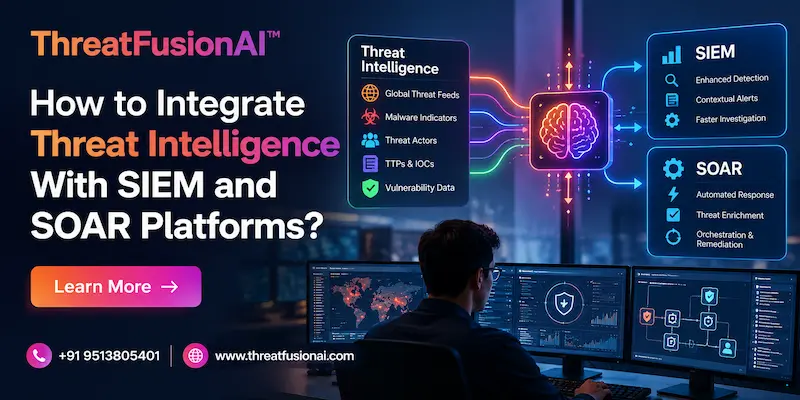
Information regarding current or potential cyberthreats, attacker tactics, methods, and procedures (TTPs), and indicators of compromise (IOCs) is studied as part of threat intelligence. Organizations can proactively identify security threats, prioritize vulnerabilities, and bolster defensive mechanisms by collecting and processing data from various sources.
In the end, it transforms unprocessed threat data into useful security insights to speed up incident response and safeguard vital assets. Let’s explore what SIEM and SOAR Platforms are and how you can protect your confidential data against future cyber threats!
What is SIEM?
A security solution called Security Information and Event Management (SIEM) gathers, compiles, and evaluates log data from all of an organization's IT infrastructure in real time. It helps SOC teams identify threats, expedite incident response, and maintain ongoing compliance logging by correlating events across servers, networks, and apps.
What is SOAR?
A software program called Security Orchestration, Automation, and Response (SOAR) links several security systems and uses standardized playbooks to automate incident response procedures.
It speeds up threat mitigation and lessens analyst burnout by automatically prioritizing alarms and carrying out response activities without human participation.
Benefits of Integrating Threat Intelligence With SIEM and SOAR
|
S.No. |
Benefits |
How? |
|
1. |
Contextualized Alert Enrichment |
Automatically adds real-time threat information to raw logs to show the intensity and intent of the assault. |
|
2. |
Accelerated Automated Incident Response |
Immediately isolates compromised endpoints and blocks malicious IPs by triggering SOAR playbooks with verified IOCs. |
|
3. |
Reduced False Positives & Analyst Fatigue |
Correlates SIEM events with verified threat intelligence feeds to filter out innocuous noise. |
|
4. |
Proactive Threat Hunting & Risk Mitigation |
Reveals zero-day IOCs and new attack strategies before they take advantage of internal flaws. |
|
5. |
Streamlined Compliance & Audit Evidence |
Generates automated, enriched event logs that prove continuous threat monitoring and active mitigation. |
Prerequisites for Threat Intelligence Integration
The following are some prerequisites for threat intelligence integration:
1. Defined Priority Intelligence Requirements (PIRs): Ensures that only pertinent threat inputs are included by clearly defining organizational focus areas.
2. API & Interoperability Architecture: Guarantees safe, scalable RESTful APIs or STIX/TAXII interfaces between feeds, SIEM, and SOAR.
3. Data Normalization & Mapping Standards: Standardizes diverse threat data into unified forms (like MITRE ATT&CK or CEF) for accurate SIEM correlation.
4. Valid Infrastructure & Feed Quality: Guarantees that threat feeds are precise, low-noise, and compatible with the processing and storage capabilities of the SIEM/ SOAR.
5. Role-Based Governance & Automated Playbooks: Defines explicit approval thresholds, access controls, and automated workflows before executing response actions.
Steps to Integrate Threat Intelligence With SIEM and SOAR Platforms
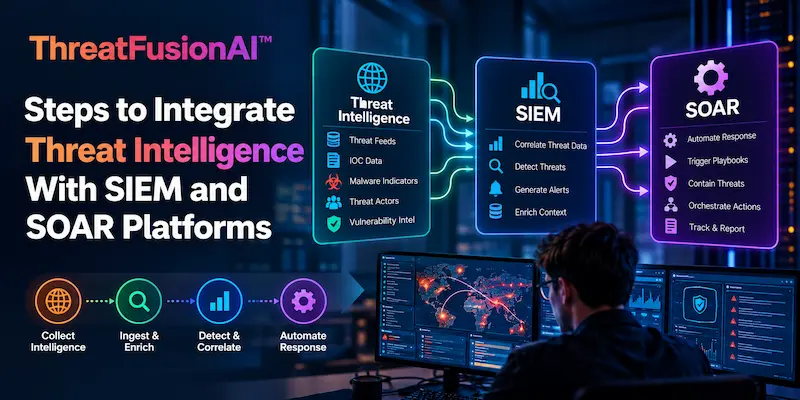
The following are the steps to integrate threat intelligence with SIEM and SOAR platforms:
● Ingest and Normalize Feeds via STIX/TAXII: Connect high-fidelity threat feeds to standard parsing formats for seamless SIEM ingestion.
● Configure Automated Alert Enrichment: At ingestion, automatically match threat intelligence indications with incoming raw SIEM logs.
● Develop & Tune Orchestration Playbooks: Create SOAR processes to isolate compromised hosts and automatically block validated IOCs.
● Establish Bi-Directional Feedback Loops: To continuously improve detection criteria, feed internal SOC detection data back into threat intelligence tools.
● Validate, Benchmark & Audit Workflows: To guarantee response correctness and maintain audit preparedness, conduct automated testing and regular audits.
Defining Automated vs. Manual Response Protocols (SOAR Playbooks)
|
S.No. |
Topics |
Factors |
What? |
|
1. |
Automated Response Protocols |
Low-Risk, High-Confidence Triage |
When threat intelligence confidence scores reach predetermined criteria, it automatically carries out immediate containment steps, such as revoking compromised tokens or blocking hostile IPs at the firewall. |
|
Zero-Latency Threat Isolation |
Reduces Mean Time to Remediate (MTTR) significantly by instantly isolating affected endpoints or disabling compromised user accounts through API integration without requiring human intervention. |
||
|
2. |
Manual Response Protocols |
Human-in-the-Loop Verification |
Before starting disruptive operations like shutting down production servers or erasing active user devices, automated playbooks are paused at crucial stages to obtain SOC analyst clearance. |
|
Complex & Ambiguous Escalations |
Allows human judgment to oversee delicate business activities by sending low-confidence, high-impact alerts to tier-2 and tier-3 analysts using pre-enriched contextual threat intelligence. |
Common Use Cases of Threat Intelligence Integration
The following are some common use cases of threat intelligence integration:
a) Automated Phishing & Credential Harvest Triage: Analyzes reported emails instantly, parses dubious URLs, and removes lures that match from all inboxes.
b) Dynamic Endpoint Containment & Quarantine: Detects high-confidence host-based indicators of compromise (IOCs) and automatically isolates affected hosts.
c) Automated Perimeter IP & Domain Blocking: Malicious C2 IPs and domain blocklists are dynamically pushed to firewalls and edge gateways.
d) Vulnerability Prioritization & Exposure Patching: Automatically prioritizes critical security fixes by cross-referencing current CVE exploit data with internal resources.
e) Suspicious Login & Account Takeover (ATO) Mitigation: Prevents login attempts in real time from hostile proxies, compromised credential databases, and known TOR nodes.
Best Practices for Effective Threat Intelligence Integration
The following are some of the best practices for effective threat intelligence integration:
1. Define Strict Priority Intelligence Requirements (PIRs): Focus all intelligence gathering on threats that directly affect your sector, tech stack, and valuable assets.
2. Prioritize High-Fidelity, Curated Data Feeds: To avoid overloading SIEM storage and false positives, choose validated, low-noise threat sources.
3. Implement Phase-Based SOAR Automation: Before fully automating low-risk actions, start with automated enrichment and manual approvals.
4. Standardize and Normalize Data Formats: To guarantee smooth log correlation, enforce consistent parsing (STIX/TAXII, MITER ATT&CK) across all tools.
5. Establish Continuous Feedback and Tuning Loops: Continually improve playbook logic and detection rules based on incident metrics and feedback from SOC analysts.
Challenges of Integrating Threat Intelligence With SIEM and SOAR
|
S.No. |
Challenges |
What? |
|
1. |
Data Overload & High False Positive Rates |
Uncurated feed ingestion overloads SIEMs with noise, hiding actual dangers and leading to alert fatigue. |
|
2. |
Parsing & Schema Inconsistencies |
Seamless ingestion, normalization, and correlation are hampered by inconsistent data formats among threat sources. |
|
3. |
Over-Automation & Operational Disruption |
Critical business services may unintentionally be shut down by triggering aggressive SOAR playbooks on false positives. |
|
4. |
Stale Data & Indicator Decay |
Misallocated SOC response resources and redundant blocklists are caused by outdated IP or domain IOCs. |
|
5. |
API Rate Limits & Architectural Bottlenecks |
Real-time enrichment is delayed when API query restrictions or bandwidth are exceeded during high-volume alert spikes. |
Future Trends in Threat Intelligence, SIEM, and SOAR
The following are some future trends in threat intelligence, SIEM, and SOAR:
● Shift to Hyperautomation & Agentic AI: Complex multi-step investigation, threat hunting, and remediation tasks are self-executed by autonomous AI agents.
● Convergence into Unified Exposure Management: Combines attack surface management, SIEM, SOAR, and threat intelligence for comprehensive risk visibility.
● Adoption of Open Data Standards (OCSF): Eliminates the need for bespoke parsing and speeds up data correlation by standardizing log schemas across manufacturers.
● Identity & GenAI Threat Telemetry: Increases the scope of detection algorithms to keep an eye on LLM prompt injections, AI-driven phishing, and synthetic identity assaults.
● Human-In-The-Loop Governance: Requires professional verification for high-risk autonomous reactions in order to strike a balance between operational safety and speed.
Conclusion
Now that we have talked about what SIEM and SOAR Platforms are, you might want to get your hands on a dedicated threat intel solution from a reliable source. For that, you can go with ThreatFusionAI, a dedicated threat intel platform offered by Craw Security.
ThreatFusionAI can help businesses by notifying them about the latest cyber threats and malicious risks, so that businesses can improve their security measures for future threats. What are you waiting for? Contact, Now!
Frequently Asked Questions
About SIEM and SOAR Platforms
1. What is threat intelligence integration with SIEM and SOAR?
The practice of combining real-time threat data with internal event logs and automatic reaction playbooks to quickly identify, enhance, and address cyberattacks is known as threat intelligence integration with SIEM and SOAR.
2. How does threat intelligence improve SIEM threat detection?
Threat intelligence improves SIEM threat detection in the following ways:
a) Reduces False Positives via Contextual Enrichment,
b) Accelerates Threat Identification Speed,
c) Maps Alerts to Threat Actor TTPs,
d) Uncovers Hidden Zero-Day & Advanced Threats, and
e) Prioritizes Critical Incident Escalations.
3. What is the role of SOAR in threat intelligence integration?
The following are the roles of SOAR in threat intelligence integration:
a) Automates Dynamic Alert Enrichment,
b) Executes Zero-Latency Active Response,
c) Streamlines Orchestration Across Tools,
d) Filters Noise and Enforces Decision Logic, and
e) Maintains Incident Records and Metrics.
4. What are the key benefits of integrating threat intelligence with SIEM and SOAR?
The following are the key benefits of integrating threat intelligence with SIEM and SOAR:
a) Accelerated Mean Time to Detect and Respond (MTTD/MTTR),
b) Reduced False Positives and Alert Fatigue,
c) Automated Triage and Contextual Enrichment,
d) Proactive Threat Hunting and Defense, and
e) Optimized Resource Allocation and Compliance.
5. Which threat intelligence sources can be integrated with SIEM platforms?
The following threat intelligence sources can be integrated with SIEM platforms:
a) Commercial & Vendor Threat Intelligence Feeds,
b) Open-Source Threat Intelligence (OSINT),
c) Information Sharing and Analysis Centers (ISACs/ISAOs),
d) Government & National Cyber Security Feeds, and
e) Internal Telemetry & Historical Incident Data.
6. How do SIEM and SOAR platforms exchange threat intelligence data?
SIEM and SOAR platforms exchange threat intelligence data in the following ways:
a) Standardized API Integration (REST & STIX/TAXII),
b) Automated Log Correlation & Data Encoding,
c) Contextual Enrichment Query Loops,
d) Bi-Directional Feedback & Rule Updating, and
e) Shared Database & Message Broker Pipelines.
7. What are the common challenges of threat intelligence integration?
The following are the common challenges of threat intelligence integration:
a) Data Overload and High Alert Volume,
b) High False Positive Rates,
c) Data Normalization and Schema Mismatches,
d) Indicator Decay and Stale Data, and
e) API Rate Limits and Performance Bottlenecks.
8. How can threat intelligence help reduce false positives in SIEM alerts?
Threat intelligence helps reduce false positives in SIEM alerts in the following ways:
a) Automated Indicator Validation & De-Duplication,
b) Contextual Risk Scoring,
c) Whitelisting Known-Good Infrastructure,
d) Behavioral & TTP Alignment, and
e) Dynamic Rule & Signature Tuning.
9. Can SOAR automate incident response using threat intelligence?
Yes, SOAR may completely automate incident response utilizing threat intelligence by continuously assessing incoming threat indicators to initiate automatic playbooks that instantly and without human intervention block hostile IPs, quarantine compromised endpoints, and revoke compromised user credentials.
10. What are the best practices for implementing threat intelligence integration with SIEM and SOAR?
The following are the best practices for implementing threat intelligence integration with SIEM and SOAR:
a) Define Explicit Priority Intelligence Requirements (PIRs),
b) Prioritize High-Fidelity Data & Standardize Formats,
c) Adopt Phased Playbook Automation,
d) Continuously Tune Rules & Filter Baseline Alerts, and
e) Establish Bi-Directional Feedback Loops.