Do you know what IOC Enrichment is, its uses, its features, and why cyber forensics investigators need it? If not, then you are in the right place. Here, we will talk about what IOC enrichment is and related benefits in detail.
Moreover, we will introduce you to a reliable threat intelligence solution offered by a reputable VAPT service provider. What are we waiting for? Let’s get started!
What Are Indicators of Compromise (IOCs)?
A piece of digital forensic evidence that suggests a system or network has probably been compromised, such as a malicious IP address, an unknown hash value, a suspicious file path, or an odd network traffic pattern, is known as an Indicator of Compromise (IOC).
These artifacts are used by security analysts to track intruder activities, identify current attacks, and stop additional compromise throughout the company architecture. Organizations can automatically identify and stop known attack vectors before serious harm is done by recording and disseminating IOCs using threat intelligence platforms.
Let’s explore what IOC Enrichment is, its uses, its features, and related benefits for organizations in the IT Industry!
What Is IOC Enrichment?
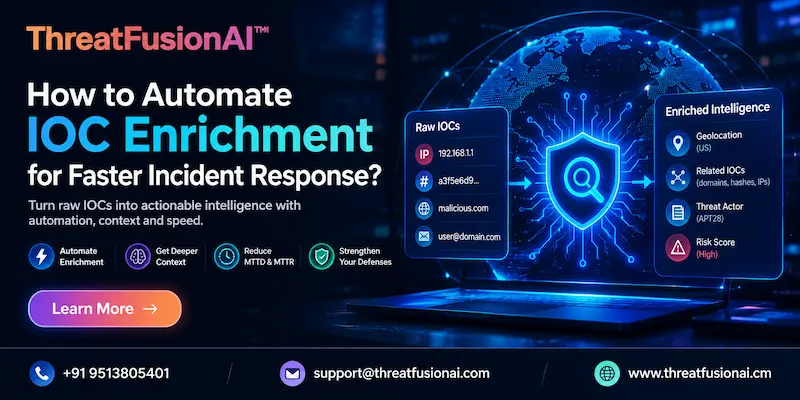
The practice of automatically obtaining contextual information for raw indications of compromise, like IP addresses, file hashes, or URLs, such as threat actor attribution, geolocation, risk scores, and domain registration history, is known as IOC enrichment.
By converting discrete security artifacts into actionable insights, this extra intelligence enables security analysts to assess threats and react to situations much more quickly.
Why Does IOC Enrichment Matter in Cybersecurity?
|
S.No. |
Factors |
Why? |
|
1. |
Reduces Mean Time to Detect and Respond (MTTD/ MTTR) |
Provides instant context for quicker alarm resolution, which expedites investigations. |
|
2. |
Cuts Through Alert Fatigue |
Eliminates low-priority noise and false positives so that analysts can concentrate on actual threats. |
|
3. |
Enables Decisive Threat Prioritization |
Uses real-time threat intelligence and severity scores to automatically rank security warnings. |
|
4. |
Powers Security Automation (SOAR) |
Provides automated playbooks with extensive threat data so they may take immediate containment measures. |
|
5. |
Uncovers the Full Scope of an Attack |
Reveals malware families, hidden infrastructure, and incident-related signs. |
What Are the Challenges of Manual IOC Enrichment?
The following are the challenges of manual IOC enrichment:
Slow Investigation Speed:
Incident response is significantly delayed when individual IP addresses, file hashes, and domain information are manually retrieved from various threat sources.
Severe Analyst Fatigue:
Burnout and an increase in human error during important alerts result from repeatedly copying and pasting indicators into different search portals.
Lack of Scalability:
The enormous volume of high-speed security warnings produced by contemporary enterprise setups is too much for manual enrichment to handle.
Inconsistent Data Standards:
Different analysts use different methods to collect varying amounts of context, which leads to inconsistent event reporting and documentation.
Delayed Threat Containment:
Active attackers have a large window of opportunity to move laterally via the network due to the time spent manually obtaining context.
How Does Automated IOC Enrichment Work?
Automated IOC enrichment works in the following ways:
Trigger & Ingestion:
Automatically ingests raw IOCs upon arrival from SIEM, EDR, or email alerts.
API Query Orchestration:
Uses automated API calls to query several threat intelligence feeds simultaneously.
Context Aggregation & Normalization:
Combines information about external threats and translates it to a single, common format.
Risk Scoring & Correlation:
Correlates internal log data with external intelligence to assign threat risk levels.
Alert Enrichment & Action Routing:
Initiates automated SOAR response workflows and directly adds rich context to security tickets.
What Types of Indicators of Compromise Can Be Enriched Automatically?
|
S.No. |
Types |
What? |
|
1. |
Network Indicators (IPs, ASN, & Geolocation) |
Add ISP ownership, geographic origin, WHOIS information, and past threat reputations to network addresses. |
|
2. |
Domain Names & Infrastructure (FQDNs) |
Obtain SSL/TLS certificates, DNS records, registrar information, domain age, and associated malicious infrastructure. |
|
3. |
File Hashes (MD5, SHA-1, SHA-256) |
To obtain file metadata, sandbox behavioral reports, and VirusTotal detection ratios, query malware databases. |
|
4. |
URLs & Web Artifacts |
Examine hosting hosts, HTTP response codes, live online screenshots, and signs of phishing kits without clicking on dangerous links. |
|
5. |
Email Artifacts (Headers, Senders, & Domains) |
Extract header routing jumps, suspicious attachment hashes, sender domain health, and SPF/DKIM validation status. |
Which Threat Intelligence Sources Are Best for IOC Enrichment?
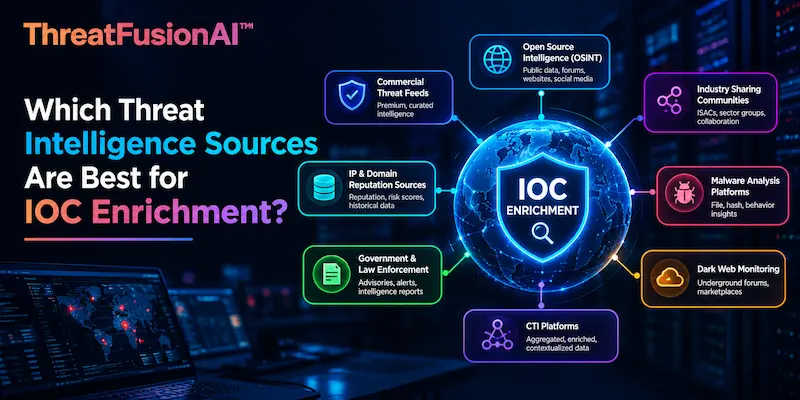
The following are the best threat intelligence sources for IOC enrichment:
Multi-Scanner Aggregators:
To confirm the reputation of files and URLs, platforms such as VirusTotal and Hybrid Analysis simultaneously query hundreds of antivirus engines and sandboxes.
Commercial Threat Intelligence Feeds:
Real-time threat scores and curated, high-confidence actor attribution are provided by services such as Mandiant, Recorded Future, and CrowdStrike.
Community-Driven OSINT Platforms:
Crowdsourced threat alerts are used by open-source programs like URLhaus, AbuseIPDB, and AlienVault OTX to facilitate rapid community verification.
Domain & Network Telemetry Providers:
SSL certificates, active open ports, and specialized databases such as DomainTools, Shodan, Censys, and WHOIS query hosting infrastructure.
Internet Noise & Scan Filters:
To prevent analysts from pursuing untargeted alarms, platforms such as GreyNoise block out innocuous, mass-internet background scanner traffic.
What Are the Key Steps in an Automated IOC Enrichment Workflow?
The following are the key steps in an automated IOC enrichment workflow:
Alert Ingestion & Parsing:
When incoming SIEM, EDR, or email security alerts are triggered, automatically extract raw IOCs.
Parallel API Query Orchestration:
To retrieve reputation data without bottlenecking, send concurrent API calls to external threat intelligence platforms.
Data Normalization & Threat Scoring:
Assign a consolidated risk score and standardize raw vendor responses into a single schema.
Context Injection & Ticket Update:
Automatically add comprehensive, organized threat context to SIEM dashboards and security ticketing systems.
Automated Triage & Action Routing:
Use SOAR response playbooks to isolate compromised hosts depending on the final threat score or to automatically close benign alarms.
Which Tools Can Automate IOC Enrichment?
|
S.No. |
Tools |
Why? |
|
1. |
Dedicated SOAR Platforms |
Automated enrichment playbooks are executed across several security stacks by tools such as Palo Alto Cortex XSOAR, Splunk SOAR, and Swimlane. |
|
2. |
Open-Source Intelligence Frameworks |
Threat intelligence aggregation and open-source process automation are provided by programs like Shuffle, OpenCTI, and IntelOwl. |
|
3. |
SIEM-Native Enrichment Engines |
Using integrated threat intelligence feeds, enterprise SIEMs such as Microsoft Sentinel, Datadog, and Elastic SIEM automatically enhance incoming logs. |
|
4. |
Custom Python Automation Frameworks |
To automate enrichment logic, custom scripts that use vendor SDKs and libraries like requests access threat APIs directly. |
|
5. |
Threat Intelligence Management Platforms |
Enriched intelligence is gathered, correlated, and sent to security products by platforms such as Anomali ThreatStream, ThreatConnect, and ThreatQuotient. |
How to Integrate IOC Enrichment With SIEM, SOAR, and EDR Tools?
You can integrate IOC enrichment with SIEM, SOAR, and EDR tools in the following ways:
Establish Webhook & API Connections Across the Triad:
For real-time, bidirectional data flow, link SIEM, SOAR, and EDR systems via secure REST APIs and webhooks.
Trigger SOAR Automation via SIEM Alert Ingestion:
Upon discovery, automatically transfer raw IOCs and high-priority SIEM alarms straight into SOAR enrichment playbooks.
Execute Automated Multi-Source Enrichment Playbooks:
To quickly collect context and reputation information, run concurrent API searches across external threat intelligence providers.
Enrich Alert Context and Query EDR Telemetry:
While searching EDR tools for host processes and file artifacts that match, inject augmented threat data back into the SIEM.
Orchestrate Automated Containment & Closed-Loop Feedback:
Use SOAR to initiate automated EDR host isolation or network blocks, after which SIEM incident tickets and threat lists are immediately updated.
What Are the Real-World Use Cases of Automated IOC Enrichment?
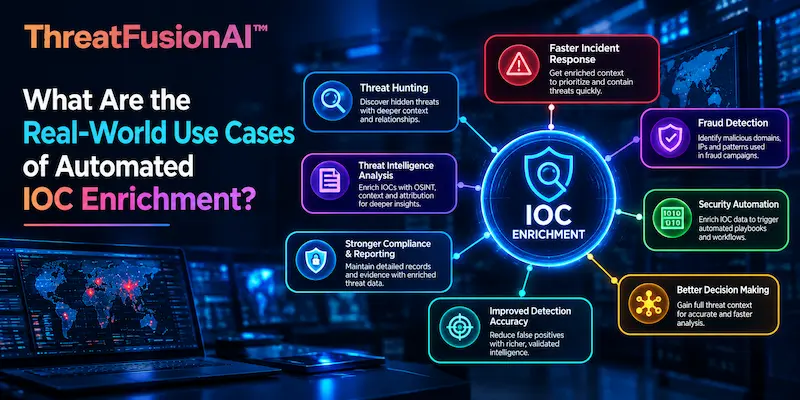
The following are the real-world use cases of automated IOC enrichment:
Phishing & Email Threat Triage:
Analyzes headers, scans embedded URLs, and explodes attachments in sandboxes by parsing user-reported emails.
SOC Alert Enrichment & Prioritization:
Enables analysts to concentrate on important true positives by attaching threat context and risk scores to incoming SIEM alarms.
Automated Threat Hunting & Sweeping:
Searches the enterprise's network traffic and historical endpoint records for recently discovered signs of compromise.
Ransomware & Malware Containment:
Instantly initiates automated host isolation via EDR by correlating file hashes and C2 IPs with threat intelligence.
Vulnerability & Exposure Management:
Prioritizes updates for vulnerabilities that are actively exploited in the wild by cross-referencing current system vulnerabilities with real-time threat feeds.
What Are the Key Best Practices and Pitfalls of Automated IOC Enrichment?
|
S.No. |
Topics |
Factors |
What? |
|
1. |
Best Practices |
Implement API Rate Limit and Caching Strategies |
To avoid API quota exhaustion and save money on paid threat intelligence feeds, save recent lookup results in local databases or caching layers (like Redis). |
|
Establish Clear Risk-Scoring Thresholds |
To avoid false-positive interruptions, establish stringent rationale and minimal confidence scores across several sources prior to implementing high-impact automated actions (such as isolating crucial servers). |
||
|
2. |
Pitfalls |
Over-Relying on Single-Source Intelligence |
Relying on a single threat intelligence stream raises the possibility of taking action based on out-of-date or erroneous reputation rankings, which could result in missed threats or incorrect triage choices. |
|
Overwhelming SOC Infrastructure with Uncached Queries |
API throttles and delayed alert response can result from ingesting raw IOCs into automated playbooks without simple deduplication or whitelist filtering. |
What Is the Future of IOC Enrichment Automation in Cybersecurity?
Autonomous AI agents that carry out proactive retroactive sweeps across data, real-time predictive threat rating, and generative reasoning are key components of the future of IOC enrichment automation.
Security platforms will automatically synthesize multi-vector context, anticipate attacker intent, and carry out precise containment operations with little human oversight by switching from static lookup scripts to adaptive, intent-driven SOAR playbooks.
Conclusion: How to Accelerate Incident Response With Automated IOC Enrichment?
Now that we have talked about what IOC Enrichment is, you might want to get your hands on a dedicated security solution from a reliable source. For that, you can go for ThreatFusionAI, a dedicated threat intel platform offered by Craw Security.
ThreatFusionAI helps businesses by notifying them about the latest cyber threats and vulnerabilities so that they can enhance their security measures before future cyberattacks. What are you waiting for? Contact, Now!
Frequently Asked Questions
About IOC Enrichment Automation
1. What is IOC enrichment automation in cybersecurity?
In order to expedite incident triage and response without requiring human labor, IOC enrichment automation is the programmatic collection, normalization, and scoring of threat intelligence context for raw digital artifacts like IP addresses, file hashes, and domain names.
2. How does automated IOC enrichment improve incident response?
Automated IOC enrichment improves incident response in the following ways:
a) Dramatically Reduces MTTD and MTTR,
b) Eliminates False-Positive Alert Fatigue,
c) Provides Immediate Context and Threat Attribution,
d) Enables Scalable SOAR Orchestration, and
e) Exposes the Full Scope of the Attack.
3. What are the benefits of automating IOC enrichment?
The following are the benefits of automating IOC enrichment:
a) Maximizes SOC Analyst Productivity,
b) Ensures Consistent and Standardized Triage,
c) Accelerates Threat Containment,
d) Optimizes Threat Intelligence ROI, and
e) Delivers Enterprise-Wide Scalability.
4. Which tools are best for automating IOC enrichment?
The following tools are best for automating IOC enrichment:
a) Palo Alto Cortex XSOAR,
b) Shuffle,
c) OpenCTI,
d) Splunk SOAR (formerly Phantom), and
e) Custom Python Automation Frameworks.
5. How does IOC enrichment automation work?
IOC enrichment automation works in the following ways:
a) Alert Ingestion & Artifact Parsing,
b) Parallel API Query Orchestration,
c) Data Normalization & Threat Scoring,
d) Context Injection & Ticket Enrichment, and
e) Automated Action Routing.
6. What types of IOCs can be enriched automatically?
The following types of IOCs can be enriched automatically:
a) IP Addresses & Network Indicators,
b) Domain Names & FQDNs,
c) File Hashes (MD5, SHA-1, SHA-256),
d) URLs & Web Artifacts, and
e) Email Artifacts.
7. How can IOC enrichment be integrated with SIEM and SOAR platforms?
IOC enrichment can be integrated with SIEM and SOAR platforms in the following ways:
a) Bi-Directional API & Webhook Connectivity,
b) Automated Alert Forwarding Rules,
c) Orchestrated Parallel Enrichment Playbooks,
d) Contextual Ticket Ingestion & SIEM Invalidation, and
e) Closed-Loop Automated Containment.
8. How does automated IOC enrichment reduce incident response time?
Automated IOC enrichment reduces incident response time in the following ways:
a) Eliminates Manual API Lookups,
b) Streamlines Context Aggregation,
c) Accelerates Triage & Prioritization,
d) Triggers Instant Containment Playbooks, and
e) Automates False-Positive Filtering.
9. What are the challenges of implementing IOC enrichment automation?
The following are the challenges of implementing IOC enrichment automation:
a) API Rate Limits and Cost Management,
b) False Positives and Operational Disruption,
c) Data Normalization and Schema Mismatches,
d) Stale or Short-Lived Intelligence, and
e) Tool Integration and API Maintenance.
10. What are the best practices for automating IOC enrichment?
The following are the best practices for automating IOC enrichment:
a) Implement Aggressive Caching & Deduplication,
b) Normalize Scoring Across Sources,
c) Establish Safe Confidence Thresholds,
d) Maintain Strict Whitelists & Allowlists, and
e) Audit Playbooks & Refresh Intelligence Regularly.