Do you know what Cyber Threat Intelligence and Malware Detection are and their benefits for organizations in the IT Industry? If not, then you are in the right place. Here we will talk about what these things are and related benefits in detail.
Moreover, we will introduce you to a reliable threat intel solution offered by a reputable VAPT service provider. What are we waiting for? Let’s get started!
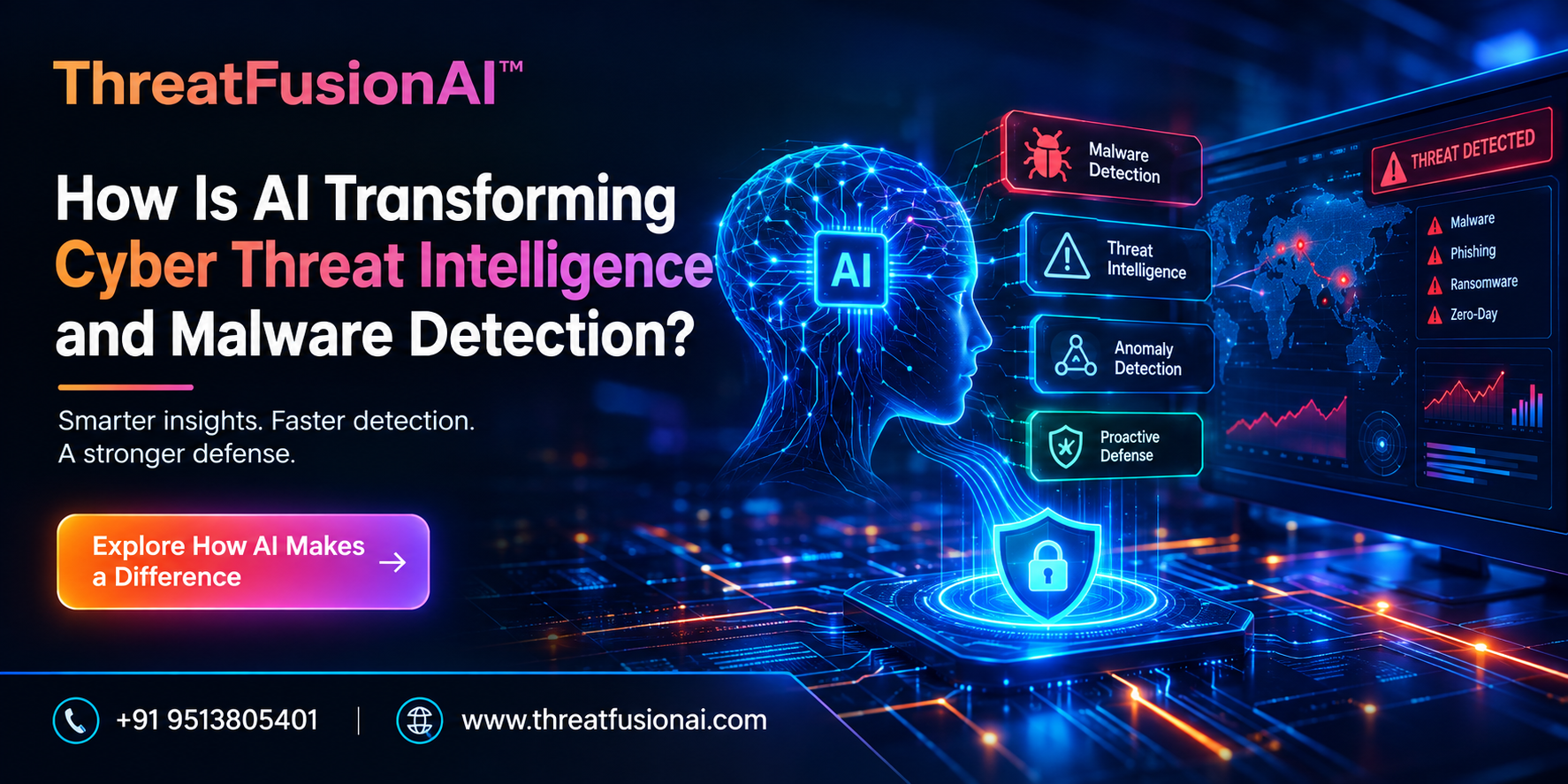
How Is AI Transforming Cyber Threat Intelligence?
|
S.No. |
Factors |
How? |
|
1. |
Automated Threat Data Processing & Aggregation |
Consumes and correlates OSINT feeds, unstructured dark web telemetry, and structured logs at the petabyte scale in real time. |
|
2. |
Predictive Adversary Profiling |
Uses past behavioral patterns to predict future attack pathways, adversary TTP alterations, and campaign targets. |
|
3. |
Real-Time Behavioral Anomaly Mapping |
In multi-cloud systems, baselines of standard system and identity operations can quickly reveal subtle differences. |
|
4. |
Hyper-Automated IOC Extraction & Enrichment |
Automatically extracts, verifies, and contextualizes compromise indications from unprocessed threat reports and forums using natural language processing (NLP). |
|
5. |
AI-Assisted Natural Language Querying |
Expedites threat investigations by converting simple-text analyst searches into intricate cross-domain hunting queries. |
The Role of AI in Modern Malware Detection
The following are the roles of AI in modern malware detection:
1. Zero-Day & Variant Detection: Identifies hidden dangers using machine learning models based on intent and structure rather than static markers.
2. Real-Time Behavioral Sandbox Analysis: In virtualized situations, suspicious payloads are detonated to dynamically monitor system calls, API calls, and process execution.
3. De-Obfuscation & Anti-Evasion Countermeasures: Removes runtime packing, decrypts code, and thwarts sandbox detection techniques using neural networks.
4. Heuristic File & Binary Profiling: Detects dangerous anomalies instantaneously by analyzing code entropy, import tables, PE headers, and static metadata.
5. Automated Triage & Remediation Guidance: Gives high-risk malware warnings priority and provides analysts with practical root-cause containment actions.
Key AI Technologies Used in Cyber Threat Intelligence and Malware Detection
The following are some key AI technologies used in cyber threat intelligence and malware detection:
● Machine & Deep Learning (ML/DL): Uses vast telemetry to train prediction algorithms that identify baseline irregularities, categorize zero-day malware, and find structural patterns.
● Natural Language Processing (NLP): Extracts, correlates, and enhances actionable threat indicators by parsing unstructured threat intelligence streams, forums, and security blogs.
● Large Language Models (LLMs) & Generative AI: Powers interactive AI copilots that create investigation scripts, convert plain text into hunting questions, and summarize intricate attack chains.
● User & Entity Behavior Analytics (UEBA): Uses behavioral models and statistical baselining to monitor identity activities and identify compromised credentials or insider threats.
● Graph Neural Networks (GNNs): To reveal lateral movement and multi-stage campaign topologies, map intricate relationships between hosts, network flows, and API execution trees.
AI vs. Traditional Cyber Threat Intelligence and Malware Detection
|
S.No. |
Topics |
Factors |
What? |
|
1. |
Traditional Cyber Threat Intelligence & Malware Detection |
Static & Rule-Based Detection |
Depends on static file hashes, pre-written YARA or Snort rules, and known indicators of compromise (IOCs), making it useless against new malware and zero-day vulnerabilities. |
|
Reactive & Manual Operations |
Requires security analysts to create correlation rules, manually compile threat feeds, and carry out time-consuming triage following an alert. |
||
|
2. |
AI-Driven Cyber Threat Intelligence & Malware Detection |
Dynamic Behavioral & Heuristic Analysis |
Detects undiscovered zero-days, polymorphic malware, and fileless attacks based on operational intent using machine learning models and structural profiling. |
|
Proactive & Autonomous Orchestration |
Correlates cross-domain telemetry continuously, automatically gathers threat intelligence, and performs machine-speed containment operations in real time. |
Benefits of AI in Cyber Threat Intelligence and Malware Detection
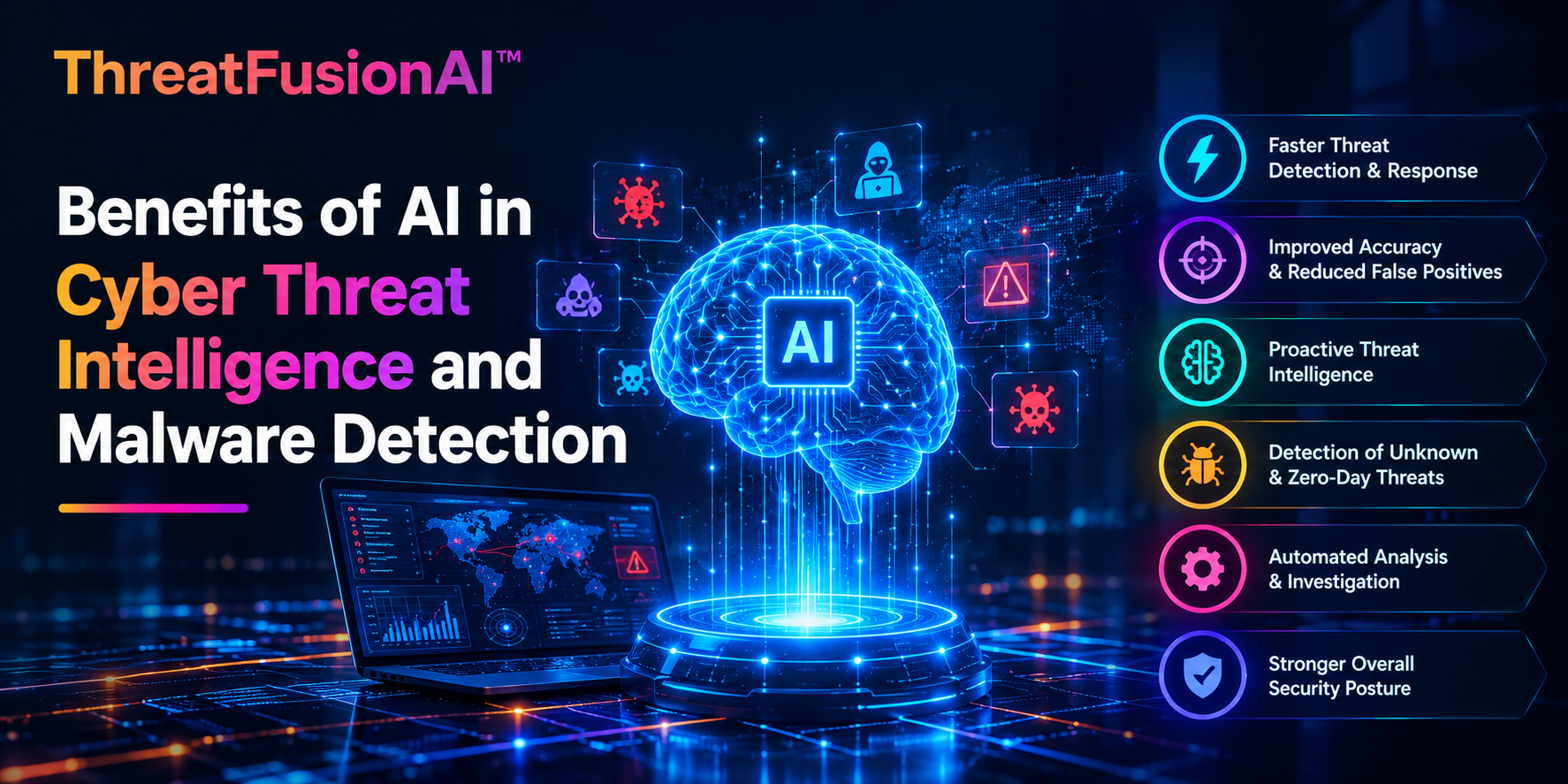
The following are the benefits of AI in cyber threat intelligence and malware detection:
a) Real-Time Speed & Automation: Detects, isolates, and contains harmful activity in seconds by continuously scanning petabyte-scale telemetry.
b) Proactive Zero-Day & Variant Protection: Evaluates behavioral and structural intent to detect polymorphic attacks and unknown exploits without using static signatures.
c) Drastic Noise & False Positive Reduction: Reduces alert fatigue and highlights high-confidence, actionable threats by filtering out trivial baseline abnormalities.
d) Automated Context & Threat Enrichment: Automatically maps raw indicators to particular adversary TTPs and attack chains by correlating multi-source feeds using natural language processing.
e) Scalable Threat Hunting & Investigation: Gives SOC analysts the ability to dynamically carry out intricate cross-domain searches as organizational footprints grow.
Real-World Applications of AI in Cybersecurity
The following are some real-world applications of AI in cybersecurity:
1. Autonomous Endpoint & Cloud XDR Triage: Gathers alarms and assesses risk severity without human involvement by correlating telemetry across hosts, containers, and cloud workloads.
2. Automated SOAR Incident Response & Quarantine: Initiates pre-approved playbooks to immediately block hostile IPs, revoke compromised credentials, and isolate vulnerable endpoints.
3. Dark Web & OSINT Predictive Threat Profiling: Uses natural language processing (NLP) to scrape illegal forums, paste sites, and open-source intelligence in order to characterize current enemies and forecast future campaigns.
Challenges and Limitations of AI in Cybersecurity
|
S.No. |
Factors |
What? |
|
1. |
Adversarial Machine Learning & Evasion Attacks |
To trick models and get around classification, adversaries create minute input perturbations. |
|
2. |
Training Data Poisoning & Drift |
Over time, data drift causes false negatives, and corrupting training data reduces model accuracy. |
|
3. |
Black-Box "Black Box" & Lack of Explainability |
Forensic validation, regulatory compliance, and root-cause analysis are all hampered by opaque neural decisions. |
|
4. |
High Operational & Compute Overhead |
Complex machine learning systems demand large investments in data storage, computing power, and infrastructure. |
|
5. |
Risk of Over-Reliance & Alert Fatigue |
Analyst fatigue is caused by high false-positive rates, and security teams may become blind to model flaws due to over-reliance. |
Ethical, Privacy, and Regulatory Considerations in AI-Driven Defense
The following are some ethical, privacy, and regulatory considerations in AI-driven defense:
● Data Privacy & Telemetry Ingestion Compliance: Strict data minimization, redaction, and adherence to international privacy laws (such as the CCPA and GDPR) are necessary when ingesting cross-domain logs.
● Regulatory Compliance & Mandatory Assessments: Implementing AI detection technologies necessitates ongoing risk assessments and adherence to AI guidelines (such as the EU AI Act and NIST AI RMF).
● Algorithmic Bias & False-Positive Discrimination: Skewed detections that unfairly limit valid user groups, local IP addresses, or vital systems must be avoided during model training.
● Human-in-the-Loop & Autonomous Accountability: To ensure human accountability for automated disruptions, critical containment measures need clear escalation pathways.
● Model Explainability & Forensic Auditability: For post-incident audits, AI-driven choices must have comprehensive execution logs and interpretable feature weights.
Best Practices for Implementing AI in Cyber Threat Intelligence
The following are the best practices for implementing AI in cyber threat intelligence:
a) Establish Rigorous Data Governance & Pipeline Integrity: To avoid model drift and data poisoning, clean, redact, and regularly evaluate training and inference telemetry.
b) Enforce Human-in-the-Loop Validation: Make it mandatory for analysts to examine and approve high-impact automated actions, such as account revocation or network containment.
c) Adopt Secure-by-Design & Zero-Trust Frameworks: Use stringent telemetry verification and zero-trust access restrictions to safeguard AI model artifacts, prompt interfaces, and pipeline APIs.
d) Conduct Continuous Red-Teaming & Adversarial Testing: To ensure resilience, regularly test AI detection models against evasion assaults, data disturbances, and quick injections.
e) Integrate Cross-Domain Telemetry into XDR/SOAR: To optimize detection coverage and response time, provide orchestration engines with unified network, identity, cloud, and endpoint feeds.
The Future of AI in Cyber Threat Intelligence and Malware Detection
Self-defending, autonomous ecosystems that use behavioral biometrics, predictive analytics, and multi-agent coordination to identify and eliminate threats in real time are the key to the future of AI in threat intelligence and malware detection.
To remain ahead of machine-speed zero-day attacks, corporate defense will depend on quantum-resistant models, generative scenario simulations, and automated, human-in-the-loop orchestrations as hostile AI develops.
Conclusion
Now that we have talked about what Cyber Threat Intelligence and Malware Detection are, you might want to get your hands on a dedicated threat intel solution. For that, you can go for ThreatFusionAI, a dedicated threat intelligence platform offered by Craw Security.
Organizations can secure their networks, systems, and databases against online threats with the help of ThreatFusionAI so that they can enhance their security measures for the future. What are you waiting for? Contact, Now!
Frequently Asked Questions
About Cyber Threat Intelligence and Malware Detection
1. What Is AI in Cyber Threat Intelligence?
The use of machine learning, natural language processing, and predictive analytics to automatically ingest, correlate, and analyze massive security data streams to identify, anticipate, and counteract cyber threats in real time is known as artificial intelligence (AI) in cyber threat intelligence.
2. How Does AI Improve Malware Detection?
AI improves malware detection in the following ways:
a) Detects Unknown Zero-Day Threats,
b) Analyzes Real-Time Behavioral Telemetry,
c) Defeats Obfuscation & Evasion Tactics,
d) Accelerates Automated Triage & Containment, and
e) Reduces Alert Fatigue & False Positives.
3. Can AI Detect Unknown and Zero-Day Malware?
Yes, instead of depending on static signatures, AI analyzes runtime behavioral intent, code structure, and execution patterns to identify undiscovered and zero-day malware.
4. What AI Technologies Are Used in Cyber Threat Intelligence?
The following AI technologies are used in cyber threat intelligence:
a) Machine Learning & Deep Learning (ML/DL),
b) Natural Language Processing (NLP),
c) Large Language Models (LLMs) & Generative AI,
d) User & Entity Behavior Analytics (UEBA), and
e) Graph Neural Networks (GNNs).
5. How Does Machine Learning Help Identify Cyber Threats?
ML helps identify cyber threats in the following ways:
a) Anomalous Behavioral Baselining,
b) Supervised Pattern Classification,
c) Clustering & Campaign Aggregation,
d) Predictive Risk Scoring, and
e) Time-Series Sequence Analysis.
6. What Are the Benefits of AI-Powered Malware Detection?
The following are the benefits of AI-powered malware detection:
a) Instant Zero-Day & Variant Identification,
b) Autonomous Real-Time Containment,
c) Significant Noise & Alert Fatigue Reduction,
d) Proactive Evasion & Obfuscation Stripping, and
e) Reduced Mean Time to Detect & Respond (MTTD/MTTR).
7. Can AI Detect and Prevent Ransomware Attacks?
Yes, AI continuously monitors endpoint behavior to find and stop unauthorized encryption routines, shadow copy deletions, and real-time command-and-control connections in order to detect and prevent ransomware attacks.
8. What Are the Challenges of Using AI in Cybersecurity?
The following are the challenges of using AI in cybersecurity:
a) Adversarial Exploitation & Poisoning,
b) Black-Box Explainability Issues,
c) High Operational & Resource Costs,
d) Concept Drift & False Positives, and
e) Excessive Autonomy & Identity Risks.
9. Can AI Replace Human Cybersecurity Analysts?
Because AI lacks the strategic context, intuition, ethical reasoning, and key decision-making skills necessary to validate complex threats and manage commercial risks, it cannot take the role of human cybersecurity experts.
10. What Is the Future of AI in Cyber Threat Intelligence and Malware Detection?
Autonomous, self-defending security ecosystems that use behavioral biometrics, multi-agent coordination, and predictive analytics to proactively neutralize threats at machine speed are the key to the future of AI in cyber threat intelligence and malware detection.