Do you know what Threat Intelligence Feed Quality is, its uses, its features, and how you can evaluate such a thing for better security? If not, then you are in the right place. Here, we will talk about what threat intelligence feed quality offers and related benefits in detail.
Moreover, we will introduce you to a reliable threat intel solution offered by a reputable VAPT service provider. What are we waiting for? Let’s get started!
What Is Threat Intelligence Feed Quality?
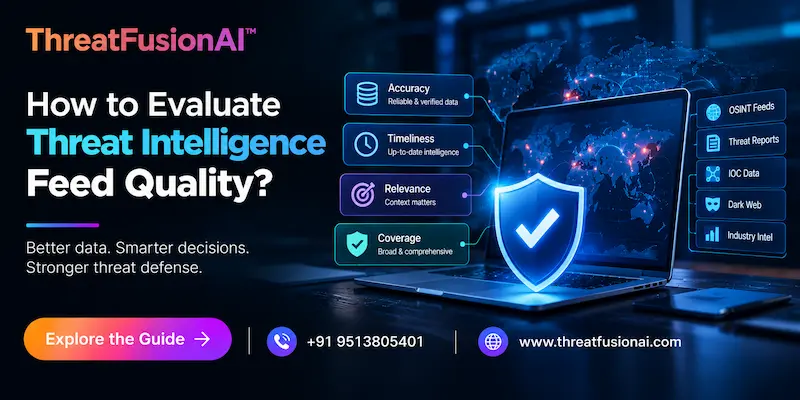
The accuracy, timeliness, and relevance of external cyber threat data that a business consumes in order to avert possible assaults are measured by the threat intelligence feed quality. By providing actionable, contextual indicator data (IoCs) that are especially suited to an enterprise's industry and tech stack, high-quality feeds reduce false positives.
By assessing feed quality, security teams may prioritize high-risk vulnerabilities and automate threat detection without overburdening analysts with pointless security noise. Let’s find out how you can test Threat Intelligence Feed Quality for better security!
Why Is Feed Quality Important?
|
S.No. |
Factors |
Why? |
|
1. |
Reduces False Positives and Alert Fatigue |
Removes unnecessary danger warnings, freeing up security professionals to concentrate on real, serious cyber threats. |
|
2. |
Accelerates Incident Response Times |
Enables automated security systems to immediately stop active assaults by providing timely, context-rich indicator data. |
|
3. |
Optimizes Resource Allocation |
Keeps security teams from squandering vital time and funds looking into redundant, erroneous, or out-of-date threat intelligence. |
|
4. |
Enhances Threat Detection Precision |
Provides customized intelligence based on an organization's industry, attack surface, and technological stack. |
|
5. |
Improves Security ROI |
Provides dependable, high-fidelity data to current security assets, such as SIEM and SOAR platforms, to maximize their performance. |
Key Indicators of Feed Quality
The following are some key indicators of feed quality:
1. Timeliness and Freshness: Provides low-latency real-time threat data to identify and stop zero-day threats before they are exploited.
2. Accuracy and Low False-Positive Rate: Offers certified, high-fidelity indicators (IoCs) to avoid analyst fatigue and pointless security alarms.
3. Context and Actionability: Includes suggested remedial actions, attack lineage, threat actor motive, and comprehensive threat metadata.
4. Relevance to Organizational Stack: Directly corresponds with the location, internal technology infrastructure, and industry sector of an organization.
5. Completeness and Interoperability: Provides extensive coverage across attack vectors and easily integrates using standardized formats (STIX/TAXII) with current SIEM, SOAR, and firewall technologies.
How to Verify Feed Source Credibility?
You can verify feed source credibility in the following ways:
● Evaluate Provider Reputation and Track Record: Examine the vendor's background, reputation in the market, publications on threat research, and peer reviews from the community.
● Assess Primary vs. Secondary Data Sourced: Find out if the source simply compiles public, second-hand information or produces unique, direct danger telemetry.
● Verify Historical Accuracy and Low False-Positive Rates: Examine the accuracy of previous threat detection to make sure the feed regularly provides trustworthy, validated indication data.
● Inspect Data Provenance and Contextual Detail: Verify that indications have unambiguous attack chain attribution, detailed technical metadata, and signature origins.
● Test Against Known Internal Telemetry: Verify the significance of real-world detection by cross-referencing feed data with historical incident reports and internal SIEM logs.
How to Assess Data Relevance and Timeliness?
|
S.No. |
Factors |
How? |
|
1. |
Evaluate Time-to-Ingest Latency |
To guarantee real-time security, track the period from threat detection to feed delivery. |
|
2. |
Correlate with Active Technology Stack |
Filter indications to solely match the hardware, software, and cloud assets unique to your company. |
|
3. |
Filter Out Expired Indicators (IoCs) |
Use specified TTL (time-to-live) criteria to automatically remove outdated IP addresses and hashes. |
|
4. |
Analyze Threat Actor Recency |
Give information about ongoing campaigns more weight than information about past or inactive enemy activity. |
|
5. |
Assess Contextual Depth |
Make sure indicators don't just contain strings but also useful information like attack vectors and kill-chain mapping. |
How to Measure Feed Accuracy?
You can measure feed accuracy in the following ways:
a) Calculate False Positive and True Positive Rates: Keep track of the percentage of benign traffic that is mistakenly marked compared to actual threats.
b) Correlate Indicators with Historical Incident Logs: Verify real-world malicious activity match rates by cross-referencing feed data with internal SIEM logs.
c) Audit Source Intelligence Verification Processes: To make sure indicators are fully validated before distribution, assess provider screening procedures.
d) Track Indicator Stale Rates and TTL Accuracy: To avoid active warnings on out-of-date or reassigned IPs, keep an eye on how rapidly indicators expire.
e) Benchmark Feed Alerts Against Ground-Truth Security Data: Check feed outputs against results from internal sandboxes and validated external threat databases.
How to Check Feed Coverage and Completeness?
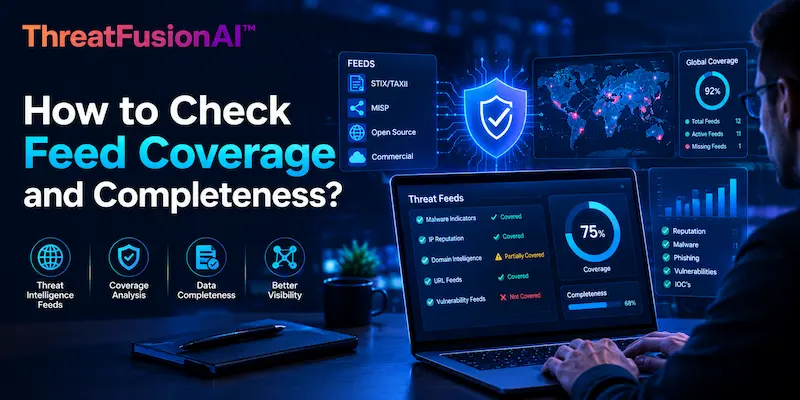
You can check feed coverage and completeness in the following ways:
1. Map Feed Data to the MITRE ATT&CK Framework: Find weaknesses in the strategies, methods, and processes used by covered adversaries throughout the kill chain.
2. Audit Asset and Technology Stack Alignment: Make that your particular operating systems, apps, and infrastructure are covered by the indicators.
3. Benchmark Against External Ground-Truth Sources: To find missing danger information, compare feed indications to extensive public sources.
4. Analyze Threat Vector Diversification: Make sure that all entry points such as email, endpoints, networks, and cloud domains are covered.
5. Evaluate Geographic and Industry Specificity: Verify that threat actors targeting the area and industry of your company are reflected in the intelligence.
How to Identify False Positives and Negatives?
|
S.No. |
Factors |
How? |
|
1. |
Correlate Feed Alerts with Internal SIEM/ EDR Telemetry |
To confirm execution, compare alarms to real endpoint activity and network logs. |
|
2. |
Execute Automated Sandbox and Detonation Analysis |
Run dubious payloads in separate sandboxes to watch behavior in real time and verify intent. |
|
3. |
Audit Expired Indicators and Infrastructure Reuse |
Eliminate outdated IoCs and confirm whether IP addresses that have been flagged have been transferred to valid services. |
|
4. |
Perform Historical Log Backtesting |
To find compromises or false matches that were previously overlooked, query prior SIEM logs against new indicators. |
|
5. |
Benchmark Feed Output Against Peer Datasets |
For consensus, compare feed warnings with commercial threat feeds and reliable third-party sources. |
How to Evaluate Data Context and Actionability?
You can evaluate data context and actionability in the following ways:
● Inspect MITRE ATT&CK Mapping: For a clear threat framing, confirm that indicators are mapped to particular adversary tactics, techniques, and procedures (TTPs).
● Audit Attack Lineage and Provenance: Make sure the feed data includes known threat actor attribution, related malware families, and complete execution routes.
● Validate Recommended Remediation Steps: Instead of using raw strings, confirm intelligence offers specific mitigation recommendations, firewall rules, or detection signatures.
● Assess Indicator Confidence Scores: Prioritize high-confidence threats above noisy telemetry by looking for transparent risk rating and validation criteria.
● Evaluate Operational Tool Compatibility: Make that contextual data is organized in standard forms (STIX/TAXII) so that SIEM and SOAR playbooks are automatically filled in.
How to Assess Feed Integration and Compatibility?
You can assess feed integration and compatibility in the following ways:
a) Audit Format Standards and Protocol Support: For smooth ingestion, make sure feeds embrace open standards like STIX, TAXII, JSON, and CSV.
b) Test SIEM, SOAR, and Firewall Interoperability: Check for direct, built-in native connections with your primary security control systems.
c) Evaluate Automated Parser and Schema Mapping: Verify indicators don't need manual parsing scripts because they automatically translate to internal data formats.
d) Assess API Rate Limits and Throughput Capacity: To make sure the feed can manage high-volume indicator ingestion without throttling, test endpoint limitations.
e) Validate Playbook and Workflow Automation Readiness: Verify that feed metadata instantly initiates automated SOAR enrichment, blocking, and alert workflows.
Free vs. Paid Threat Intelligence Feeds
|
S.No. |
Topics |
Factors |
What? |
|
1. |
Free Threat Intelligence Feeds |
Cost-Effective Baseline Coverage |
It is perfect for simple perimeter defense because it offers free, open-source, community-driven threat data (such as Abuse.ch and CISA). |
|
Higher Noise and Maintenance |
Frequently lacks dedicated validation, which results in duplicate data, greater false-positive rates, and more operational cost for manual filtering. |
||
|
2. |
Paid Threat Intelligence Feeds |
High-Fidelity and Custom Context |
Provides verified, low-latency information that is mapped to particular tech stacks and industries, along with thorough adversary attribution and remediation advice. |
|
Turnkey Integration and SLA Guarantees |
Includes automated parsing, constant updates, direct native interface with SIEM/SOAR platforms, and committed vendor support. |
Common Challenges in Feed Quality Assessment
The following are the common challenges in feed quality assessment:
1. Data Volume and Signal-to-Noise Ratio: It is challenging to separate high-fidelity threat data from background noise while processing millions of raw indications per day.
2. Establishing Reliable Ground Truth: Without independent sandbox execution or internal telemetry cross-referencing, it is difficult to verify the accuracy of external threat data.
3. High Indicator Decay Rates: Attackers' quick dynamic IP and domain reallocation produces stale indicators that cause false positives.
4. Lack of Contextual Metadata: Many feeds provide isolated strings without obvious threat actor attribution, TTPs, or related attack paths.
5. Format Heterogeneity and Parser Friction: Security automation systems are strained when unstructured, proprietary, or inconsistently formed feed schemas are normalized.
How to Conduct Threat Intelligence Feed Scoring and Benchmarking?
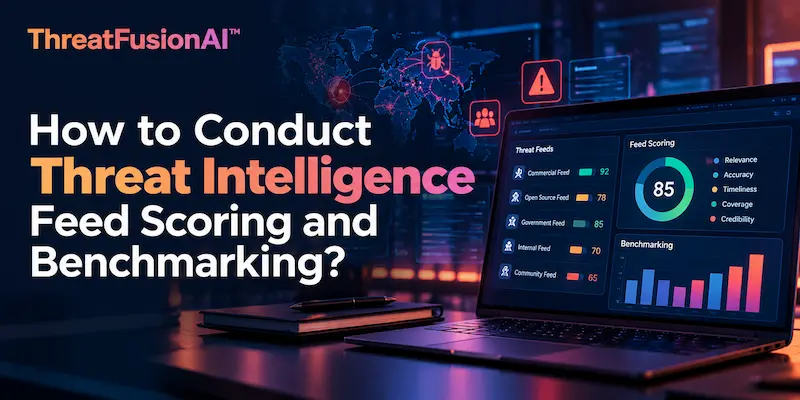
You can conduct threat intelligence feed scoring and benchmarking in the following ways:
● Define Weighted Evaluation Metrics: Based on organizational requirements, give important elements like timeliness, accuracy, context, and relevance unique score weights.
● Ingest Feeds into a Controlled Staging Environment: Before production deployment, safely assess live indicator streams in a separate sandbox.
● Correlate Feed Outputs Against Ground-Truth Security Data: Verify feed performance using findings from sandbox analyzes and confirmed internal incident reports.
● Benchmark True-Positive and False-Positive Ratios: Determine the best-performing intelligence sources by calculating accuracy scores across competing feeds.
● Perform Periodic Feed ROI and Cost-Benefit Audits: To justify continuing spending, regularly compare feed costs against analyst time saved and incident prevention value.
Best Practices for Evaluating Feed Quality
|
S.No. |
Factors |
What? |
|
1. |
Conduct Pre-Purchase Proof-of-Concept (PoC) Testing |
Before allocating funds, assess potential feeds in a real-world setting to gauge actual performance. |
|
2. |
Automate Dynamic IoC Expiration and Deduplication |
Use automated rules based on stringent TTL limits to remove stale indicators and duplicate entries. |
|
3. |
Enrich Indicators with Contextual Metadata |
Attach threat actor attribution, attack vectors, and MITER ATT&CK mappings to incoming indicators automatically. |
|
4. |
Cross-Correlate Feed Telemetry with SIEM/ EDR Logs |
To find active internal compromises, compare feed signs to internal security telemetry. |
|
5. |
Establish Continuous Feed Scorecards |
To inform decisions about renewal and optimization, check vendor feeds on a regular basis using quantitative performance measures. |
How to Choose the Right Threat Intelligence Feed?
You can choose the right threat intelligence feed in the following ways:
a) Align Feeds with Strategic and Technical Architecture: Choose sources that fit your industry sector, threat profile, and particular tech stack.
b) Prioritize High-Fidelity and Context-Rich Data: Select feeds that provide actionable TTPs, a clear attack lineage, and low false-positive rates.
c) Verify Native Integration and Automation Capabilities: Use standard protocols to guarantee direct compatibility with current SIEM, SOAR, and firewall technologies.
d) Demand Transparent Sourcing and PoC Validation: Before making a purchase, verify the origin and authenticity of vendor data in a live staging environment.
e) Balance Cost Against Analyst Workload and ROI: Compare the impact of incident prevention and saved analyst hours with subscription fees.
Conclusion: Improving Threat Intelligence Feed Quality
Now that we have talked about what Threat Intelligence Feed Quality is, you might want to get your hands on a dedicated security solution from a reliable source. For that, you can go for ThreatFusionAI, a dedicated threat intelligence platform offered by Craw Security.
ThreatFusionAI can help businesses by notifying them about the latest cyber threats and vulnerabilities that can attract malware, so that they can enhance their security measures before any cyberattacks. What are you waiting for? Contact, Now!
Frequently Asked Questions
About Threat Intelligence Feed Quality
1. What Is Threat Intelligence Feed Quality?
The accuracy, timeliness, relevance, and contextuality of external cyber threat data for an organization's particular security environment is measured by the quality of the threat intelligence feed.
2. Why Is Threat Intelligence Feed Quality Important?
Threat intelligence feed quality is important for the following reasons:
a) Prevents Alert Fatigue,
b) Accelerates Incident Response,
c) Maximizes Resource Efficiency,
d) Enhances Detection Precision, and
e) Optimizes Security Investment.
3. How Do You Evaluate Threat Intelligence Feed Quality?
You can evaluate threat intelligence feed quality in the following ways:
a) Assess Timeliness and Latency,
b) Measure Accuracy and Low False-Positive Rates,
c) Audit Relevance to the Internal Environment,
d) Inspect Contextual Depth and Actionability, and
e) Test Technical Interoperability and Format Standards.
4. What Are the Key Metrics for Measuring Feed Quality?
The following are the key metrics for measuring feed quality:
a) False Positive Rate (FPR),
b) Mean Time to Detection (MTTD) & Latency,
c) Indicator Overlap & Uniqueness Ratio,
d) Indicator Decay & TTL Accuracy, and
e) Context Coverage Score.
5. How Can You Identify False Positives in Threat Intelligence Feeds?
You can identify false positives in threat intelligence feeds in the following ways:
a) Correlate Indicators with Internal Telemetry,
b) Audit Infrastructure and IP Allocation History,
c) Execute Automated Sandbox Analysis,
d) Cross-Reference Ground-Truth Threat Repositories, and
e) Perform Historical Log Backtesting.
6. How Often Should Threat Intelligence Feeds Be Updated?
To identify and stop quickly changing threats before they cause harm, threat intelligence streams should be updated continuously in real time or at the very least every few minutes.
7. What Makes a Threat Intelligence Feed Reliable?
Verified, high-precision indicators with extensive context, few false positives, and sub-minute update latency are consistently provided by a trustworthy threat intelligence stream.
8. How Do You Compare Free and Paid Threat Intelligence Feeds?
While commercial feeds offer curated, real-time, context-rich intelligence with specialized assistance and automated platform integration, free threat intelligence feeds offer broad, community-driven commodity indicators with greater operational overhead.
9. What Are the Common Challenges in Threat Intelligence Feed Evaluation?
The following are the common challenges in threat intelligence feed evaluation:
a) Managing High Volume and Noise,
b) Establishing Objective Ground Truth,
c) Handling Dynamic Decay and Stale Data,
d) Evaluating Lack of Contextual Depth,
e) Overcoming Schema and Parser Incompatibilities.
10. How Can You Improve Threat Intelligence Feed Quality?
You can improve threat intelligence feed quality in the following ways:
a) Implement Automated Deduplication and Enrichment,
b) Enforce Dynamic Indicator Lifecycle Rules,
c) Correlate Indicators Against Internal Telemetry,
d) Maintain Continuous Vendor Scorecards, and
e) Establish Whitelisting and Suppression Rules.