Do you know what AI-Powered Threat Detection does and why organizations are demanding such tech in large numbers? If not, then you are in the right place. Here, we will talk about what such technology provides and related benefits in detail.
Moreover, we will introduce you to a reliable threat intel solution offered by a reliable VAPT service provider. What are we waiting for? Let’s get started!
What Are Unknown Cyberattacks and Zero-Day Threats?
Zero-day threats and unknown cyberattacks are security exploits that take advantage of undiscovered software or hardware flaws before suppliers can develop and distribute patches. These sneaky attacks evade antivirus software and older firewalls since traditional security systems rely on well-known signature databases.
Organizations are therefore at considerable risk during this vulnerability window, necessitating proactive and behavior-based detection methods to reduce any intrusions. Let’s explore what AI-Powered Threat Detection does and why professionals need to learn how to work with it!
Why Do Traditional Cybersecurity Systems Fail to Detect Unknown Attacks?
Traditional cybersecurity systems fail to detect unknown attacks for the following reasons:
Reliance on Signature-Based Detection:
Because they rely on databases of established attack patterns, legacy systems are oblivious to novel, unrecorded attacks.
Inability to Analyze Dynamic Behaviors:
Malicious intent can go undetected because static scanning technologies assess code structure instead of real-time execution.
Lack of Adaptive Baseline Profiling:
Because they lack dynamic baselines of typical activity, traditional techniques are unable to identify unusual user or device behavior as a threat.
Vulnerability to Evasion & Obfuscation Techniques:
By employing fileless execution, polymorphic code, or encryption, attackers can easily get around signature filters.
Reactive Patch & Rule Dependency:
Networks are left vulnerable during the zero-day window because security patches are only created when a threat is discovered.
Types of Unknown Cyberattacks AI Can Detect
|
S.No. |
Types |
What? |
|
1. |
Zero-Day Exploits |
By keeping an eye on runtime execution for unusual memory utilization and unpredictable process activity, AI detects unpatched program vulnerabilities. |
|
2. |
Polymorphic and Metamorphic Malware |
AI avoids changing surface code and encryption by using deep learning to find underlying structural and behavioral patterns. |
|
3. |
Fileless Attacks and Living-off-the-Land (LotL) |
AI uses trustworthy native technologies like PowerShell to identify unauthorized command execution and harmful memory activities. |
|
4. |
AI-Generated Social Engineering |
AI detects extremely realistic phishing emails by examining contextual intent, domain reputation, and tiny irregularities in natural language. |
|
5. |
Insider Threats and Behavioral Anomalies |
AI creates baseline activity profiles to identify high-volume data exfiltration, irregular login times, and unwanted data access. |
Key AI Technologies Used in Unknown Threat Detection
The following are some of the key AI technologies used in unknown threat detection:
Unsupervised Machine Learning:
Uses raw network data clustering to find statistical outliers without prior training labels to identify uncataloged zero-day threats.
User and Entity Behavior Analytics (UEBA):
Creates baseline behavioral patterns for devices and accounts so that alerts about unusual user behavior may be sent out right away.
Deep Learning & Neural Networks:
Detects intricate, multi-layered assault patterns that elude conventional heuristics by processing large, unstructured telemetry feeds.
Natural Language Processing (NLP):
Finds new phishing attempts, suspicious intent, and semantic irregularities by scanning communication channels and logs.
Predictive Analytics & Graph Neural Networks:
Maps linked network elements to separate lateral movement and anticipate attack routes before breaches worsen.
The Role of Machine Learning in Detecting Zero-Day Attacks
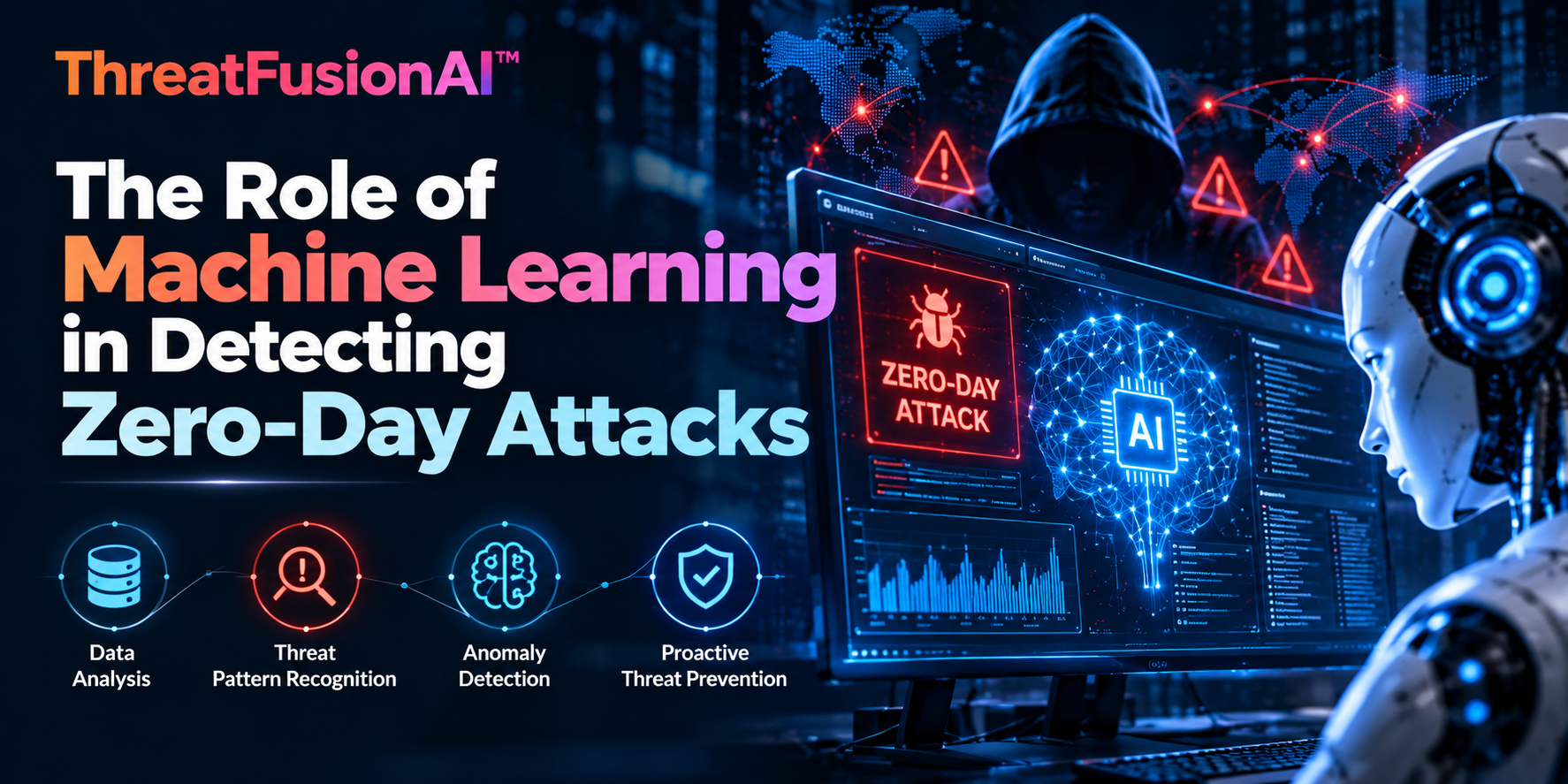
The following are the roles of ML in detecting zero-day attacks:
Automated Baseline Construction:
Creates a dynamic operating baseline without the need for human rule setting by continuously mapping common network interactions.
Supervised Feature Extraction:
Evaluates runtime execution characteristics, such as unexpected privilege escalation, by separating high-risk indications from past attack data.
Unsupervised Anomaly Clustering:
To quickly identify unknown zero-day outliers, unlabeled telemetry data is grouped into behavioral clusters.
Real-Time Telemetry Correlation:
Reveals hidden, multi-stage exploit patterns as they develop by concurrently aggregating cross-system log streams.
Predictive Risk Scoring:
Allows automated systems to prioritize severe zero-day vulnerabilities by assigning immediate threat levels to suspicious activities.
How Does AI Detect Anomalies and Unusual Network Traffic?
|
S.No. |
Factors |
How? |
|
1. |
Adaptive Baseline Profiling |
Constantly modifies detection criteria to account for shifting daily usage patterns by dynamically updating standard network activity data. |
|
2. |
Statistical Deviation Scoring |
Detects abrupt increases in bandwidth, unexpected port usage, or high-volume transfers by calculating variation from historical averages. |
|
3. |
Unsupervised Clustering Analysis |
Isolates infrequent, out-of-bounds network transactions by grouping raw, unlabeled packet streams without the need for known attack signatures. |
|
4. |
Deep Packet & Protocol Inspection |
Finds concealed command-and-control communication within legitimate traffic by continuously scanning packet payloads and header metadata. |
|
5. |
Entity & Peer-Group Mapping |
Detects infected hosts trying unauthorized lateral movements by comparing individual device traffic to peer behavior. |
How Does Behavioral Analysis Identify Suspicious Activities?
Behavioral analysis identifies suspicious activities in the following ways:
Continuous User Profiling:
Creates dynamic baselines of common user behavior to identify anomalous file accesses, location changes, and out-of-character logins.
Privilege Escalation Monitoring:
Monitors permission changes in real time to quickly identify attempts at credential harvesting and unauthorized account elevations.
Peer Group Analysis:
Detects unusual activity that goes against team norms by comparing the behavior of a single account with that of similar organizational responsibilities.
Process Lineage Inspection:
Identifies malicious child processes created by typically trusted system binaries by tracking application execution chains.
Data Exfiltration Pattern Spotting:
Keeps an eye out for unusual high-volume transfers, compressed archives, and illegal uploads to cloud storage in network outbound traffic.
How Does AI-Powered Threat Detection Work in Real Time?
AI-powered threat detection works in real time in the following ways:
Continuous Telemetry Streaming:
Maintains sub-second operational visibility by ingesting real-time data streams from network traffic, endpoints, and system logs.
Real-Time Feature Preprocessing:
Transforms unstructured data into structured machine learning inputs by instantly extracting important behavioral signals and network characteristics.
Instant Dynamic Inference:
Detects unknown anomalies without processing delays by running real-time network events through machine learning models that have been developed.
Automated Risk Scoring & Correlation:
Automatically filters out innocuous noise and computes composite threat confidence scores by aggregating multi-vector alerts.
Automated Containment Integration:
Security Orchestration (SOAR) operations are guided by triggers to isolate compromised hosts and block malicious IPs in milliseconds.
AI-Powered Threat Detection vs. Traditional Threat Detection
|
S.No. |
Topics |
Factors |
What? |
|
1. |
AI-Powered Threat Detection |
Behavioral & Predictive Analysis |
Finds new fileless attacks and zero-day exploits by examining runtime variations from typical baselines and dynamic process behaviors. |
|
Automated Real-Time Response |
Reduces false-positive noise and automatically isolates compromised assets by correlating multi-vector telemetry at machine speed without the need for human interaction. |
||
|
2. |
Traditional Threat Detection |
Signature-Based Matching |
It is ineffective against uncataloged or morphing threats since it depends on databases of known attack hashes and static rules. |
|
Manual & Reactive Workflows |
Delays containment by producing large numbers of individual alarms that need to be triaged and investigated by human security professionals. |
Benefits of Using AI to Detect Unknown Cyber Threats
The following are the benefits of using AI to detect unknown cyber threats:
Zero-Day and Fileless Threat Identification:
Evaluates dynamic runtime behavior rather than static signatures to find uncataloged exploits and in-memory attacks.
Massive MTTD Reduction:
Instantaneously correlates real telemetry data across enterprise networks, reducing dwell time from months to seconds.
Automated Alert Noise Filtering:
By employing risk scoring to suppress recurring false positives, security teams may concentrate on actual high-priority incidents.
Adaptive Continuous Learning:
Keeps up with changing attacker evasion strategies by automatically updating internal threat models as new data comes in.
Sub-Second Containment and Mitigation:
Initiates automatic orchestration in real time to isolate compromised endpoints prior to lateral movement.
The Future of AI in Proactive Cyber Threat Detection
AI threat detection in the future will change defense from reactive response to autonomous, predictive cyber resilience. Systems will anticipate breach vectors, proactively isolate zero-day vulnerabilities, and carry out self-healing countermeasures in real time before damage happens by utilizing agentic AI and multi-agent SOC frameworks.
Conclusion: How AI Strengthens Protection Against Unknown Cyberattacks?
Now that we have talked about what AI-Powered Threat Detection is, you might want to get your hands on a dedicated threat intel solution for future threats. For that, you can go for ThreatFusionAI, a dedicated threat intelligence platform offered by Craw Security.
ThreatFusionAI can help businesses by notifying them about the latest harmful cyberthreats and malicious risks so that they can enhance their systems accordingly. Thus, you can rely on this amazing platform for security. What are you waiting for? Contact, Now!
Frequently Asked Questions
About AI-Powered Threat Detection
1. How does AI-powered threat detection identify unknown cyberattacks?
AI-powered threat detection identifies unknown cyberattacks in the following ways:
a) Adaptive Baseline Profiling,
b) Unsupervised Anomaly Clustering,
c) Behavioral & Intent Analytics,
d) Real-Time Telemetry Correlation, and
e) Deep Packet & Payload Inspection.
2. What are unknown cyberattacks and zero-day threats?
The following are some unknown cyberattacks and zero-day threats:
a) Absence of Prior Signatures,
b) Exploitation Before Patching,
c) Bypass of Traditional Firewalls,
d) Evasion via Novel Techniques, and
e) Require Behavioral Detection.
3. How does AI detect zero-day attacks before they cause damage?
AI detects zero-day attacks before they cause damage in the following ways:
a) Continuous Runtime Execution Monitoring,
b) Pre-Execution Heuristic & Neural Analysis,
c) Dynamic Behavioral Anomaly Detection,
d) Predictive Lateral Movement Blocking, and
e) Automated Sub-Second Response.
4. What role does machine learning play in AI-powered threat detection?
ML plays the following roles in AI-powered threat detection:
a) Automated Pattern & Baseline Learning,
b) Unsupervised Anomaly Discovery,
c) Feature Extraction & Intent Classification,
d) Predictive Risk & Alert Prioritization, and
e) Continuous Adaptive Intelligence.
5. How does AI identify unusual network traffic and suspicious behavior?
AI identifies unusual network traffic and suspicious behavior in the following ways:
a) Dynamic Baseline Profiling,
b) Statistical & Volumetric Anomaly Scoring,
c) Unsupervised Payload & Packet Clustering,
d) Process Lineage & API Tracing, and
e) Peer Group & Entity Mapping.
6. Can AI detect new malware and previously unknown security threats?
Yes, rather than depending on pre-existing signatures, AI analyzes real-time behavioral anomalies and execution patterns to find new malware and undiscovered threats.
7. How is AI-powered threat detection different from traditional cybersecurity?
While AI-powered threat detection dynamically analyzes real-time behavioral anomalies to autonomously detect and contain novel zero-day assaults, traditional cybersecurity depends on static, signature-based rules to reactively block existing threats.
8. What are the benefits of using AI to detect unknown cyber threats?
The following are the benefits of using AI to detect unknown cyber threats:
a) Rapid Zero-Day and Fileless Detection,
b) Massive MTTD and MTTR Reduction,
c) Automated Alert Noise Filtering,
d) Sub-Second Automated Containment, and
e) Adaptive Continuous Learning.
9. What are the limitations of AI-powered threat detection systems?
The following are the limitations of AI-powered threat detection systems:
a) High False Positive Rates & Alert Fatigue,
b) Susceptibility to Adversarial Evasion & Poisoning,
c) Black-Box Explainability Challenges,
d) Model Drift & Environmental Sensitivity, and
e) High Operational & Resource Overhead.
10. How can businesses implement AI-powered threat detection to improve cybersecurity?
Businesses can implement AI-powered threat detection to improve cybersecurity in the following ways:
a) Unified Telemetry Integration,
b) Phased Deployment Strategy,
c) Human-in-the-Loop Governance,
d) Continuous Model Fine-Tuning, and
e) SOAR Ecosystem Interoperability.