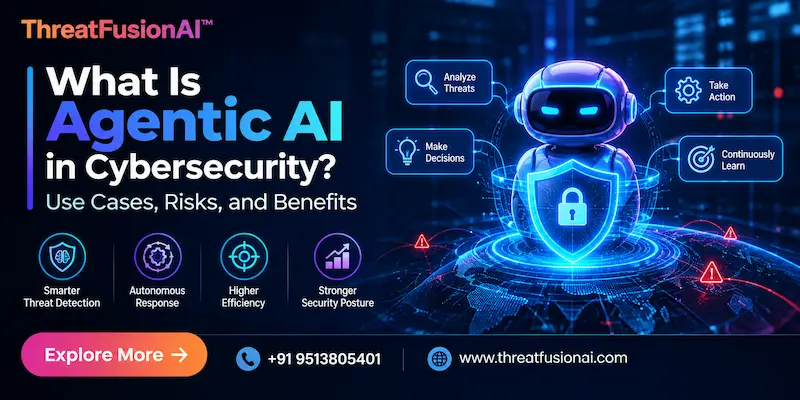
Do you know what Agentic AI in cybersecurity is, its uses, and why businesses prefer such tools in their work environment for better protection? If not, then you are in the right place. Here, we will talk about what Agentic AI is and related benefits in detail.
Moreover, we will introduce you to a reliable threat intel solution offered by a reputable VAPT service provider. What are we waiting for? Let’s get straight to the topic!
What Is Agentic AI in Cybersecurity?
In cybersecurity, "agentic AI" refers to autonomous AI systems that can plan, reason, and carry out multi-step security workflows with little to no human supervision. These agents autonomously triage warnings, search for dangers throughout intricate networks, and carry out real-time incident remediation at machine speed by utilizing dynamic reasoning and direct tool-calling capabilities.
Agentic systems function as proactive virtual analysts that can instantly adjust to changing cyberthreats, in contrast to classical or generative AI models that only identify anomalies or compose text answers.
Let’s explore what Agentic AI in Cybersecurity is, its uses, its features, and related benefits for organizations in the IT Industry!
How Does Agentic AI Work in Cybersecurity?
Agentic AI works in cybersecurity in the following ways:
1. Perceives Real-Time Network Telemetry: Continuously absorbs asset metrics, identification information, and streaming event logs from various corporate architectures.
2. Formulates Autonomous Investigation Plans: Uses dynamic reasoning models to break down security abnormalities into detailed inquiry objectives.
3. Calls Security Tools Independently: Directly initiates security platform APIs to retrieve identity records, examine files, and query endpoints.
4. Adapts Decisions via Dynamic Feedback Loops: Assesses execution outcomes in real time to improve theories and quickly change the course of a study.
5. Executes Direct Remediations with Policy Guardrails: Complies with required safety regulations while independently revoking credentials and isolating affected assets.
Agentic AI vs. Traditional AI in Cybersecurity
|
S.No. |
Topics |
Factors |
What? |
|
1. |
Traditional AI |
Narrow Task Execution |
Functions as static classification or anomaly scoring models limited to particular, one-step tasks (e.g., classify spam or signal a questionable login threshold). |
|
Passive Informational Output |
Produces read-only risk scores or alarm flags that need to be verified, investigated, and responded to by human analysts. |
||
|
2. |
Agentic AI |
Autonomous Multi-Step Workflows |
Uses external tools and APIs across systems to dynamically break down high-level goals into multi-step inquiry plans without the need for step-by-step human guidance. |
|
Active Goal-Oriented Execution |
Autonomously performs immediate containment and remedial steps in real time and continuously modifies decisions through dynamic feedback loops. |
Agentic AI vs. Generative AI in Cybersecurity
Reactively, generative AI responds to specific human requests by producing text, code, or incident reports. Agentic AI, on the other hand, works independently to accomplish complicated operational goals without continual human intervention by planning, carrying out multi-step workflows, and contacting external security tools.
What Are the Key Use Cases of Agentic AI in Cybersecurity?
The following are the key use cases of agentic AI in cybersecurity:
● Autonomous SOC Alert Triage and Incident Investigation: Reconstructs complete attack histories without human intervention, validates threat context, and correlates multi-source telemetry in real time.
● Proactive & Hypothesis-Driven Threat Hunting: Creates unique inquiry hypotheses, separates covert adversary sessions, and runs iterative telemetry queries across data lakes.
● Continuous Application Security & Vulnerability Remediation: Automatically creates and distributes pull requests to fix bugs, scans code repositories, and tests exploits in sandboxes.
What Are the Benefits of Agentic AI in Cybersecurity?
|
S.No. |
Benefits |
What? |
|
1. |
Sub-Second Incident Response and Reduced Dwell Time |
Mean Time to Detect and Respond (MTTD/MTTR) is reduced to seconds by autonomous execution, which removes the burden of manual triage. |
|
2. |
Mitigation of Alert Fatigue and Burnout |
Allows analysts to concentrate on high-value investigations by filtering noise and automatically resolving low-risk anomalies. |
|
3. |
Machine-Speed Scalability Across Hybrid Environments |
Manages enormous telemetry spikes throughout multi-cloud infrastructure without necessitating a corresponding increase in staff. |
|
4. |
Proactive and Continuous Threat Hunting |
Identifies hidden adversaries prior to breach execution by developing and executing iterative inquiry hypotheses continuously. |
|
5. |
Adaptive and Context-Aware Defense |
Immediately modifies reaction strategies in response to changing conditions by dynamically correlating environmental telemetry with asset criticality. |
What Are the Risks and Challenges of Agentic AI in Cybersecurity?
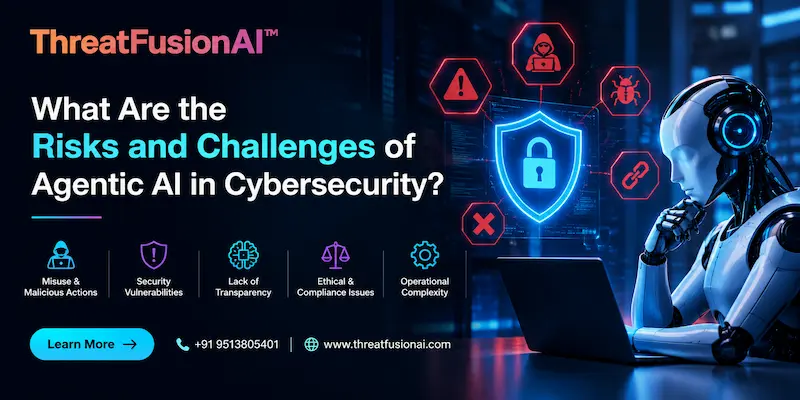
The following are the risks and challenges of agentic AI in cybersecurity:
a) Goal Hijacking and Indirect Prompt Injection: By subtly rerouting autonomous decision logic away from security goals, adversaries might conceal harmful instructions in parsed data.
b) Tool Misuse and Unintended Remediation: Destructive API actions, such as shutting down vital production servers or erasing innocuous files, might be triggered via faulty execution loops or distorted thinking.
c) Identity Over-Privileging and Non-Human Risk: If their non-human identity credentials are stolen or misused, autonomous agents that need extensive system access might cause enormous blast radii.
d) Persistent Memory and Context Poisoning: Execution logic drifts dangerously across subsequent sessions when corrupted entries are seeded into an agent's long-term memory or RAG context.
e) Cascading Failures Across Multi-Agent Networks: One hacked or defective agent can recursively transmit poisoned outputs in interconnected agent systems, leading to system-wide failures.
How Can Cybercriminals Exploit Agentic AI?
Cybercriminals can exploit agentic AI in the following ways:
1. Automated Reconnaissance & Spear Phishing: OSINT is the target of scrapes that automatically create customized, multi-channel lures.
2. Autonomous Vulnerability Discovery: Creates unique zero-day attacks at machine speed by scanning source code.
3. Adaptive Living-off-the-Land Malware: To blend in with native tools and avoid EDR, probes dynamically modify code paths to dodge host defenses.
4. Adversarial AI Attacks: Use secret cues to take over business AI decision loops in target vector storage.
5. Automated Evasion Loops: Examines security sandboxes in real time, changing signatures or halting execution to avoid detection.
What Are the Best Practices for Implementing Agentic AI in Cybersecurity?
|
S.No. |
Factors |
What? |
|
1. |
Enforce Dynamic Least-Privilege & Sandboxed Execution |
To severely limit agent capabilities, scope temporary, task-specific API credentials and isolate execution contexts. |
|
2. |
Embed Mandatory Human-in-the-Loop (HITL) Policy Gates |
Prior to executing essential or harmful cleanup operations, obtain express analyst authority. |
|
3. |
Implement Runtime Guardrails & Input/ Output Sanitization |
To counteract indirect prompt injection and execution drift, filter inputs and tool parameters in real time. |
|
4. |
Maintain Immutable Audit Logs & Telemetry Correlation |
For post-event analysis, log each prompt, reasoning step, and API request along with the temporal context. |
|
5. |
Establish Emergency Stop & Kill-Switch Protocols |
To quickly revoke credentials and end agent sessions during anomalies, keep automated kill switches in place. |
What Are the Top Agentic AI Cybersecurity Tools and Platforms?
The following are the top agentic AI cybersecurity tools and platforms:
● ThreatFusionAI: Streamlines threat intelligence enrichment by correlating live IP, domain, and file indicator streams with MITER ATT&CK mappings.
● Palo Alto Networks Cortex AgentiX: Employs and manages autonomous agents that manage response, investigation, and triage to coordinate end-to-end security activities.
What Is the Future of Agentic AI in Cybersecurity?
Agentic AI in cybersecurity will eventually go from isolated automated assistants to completely autonomous, multi-agent defensive networks that work together in real time across hybrid clouds.
Security teams will transition from manually answering alerts to overseeing high-level strategy as firms use non-human identity governance to control agent permissions. Meanwhile, defensive agents will fight adversarial AI at machine speed.
Conclusion: Is Agentic AI the Future of Cybersecurity?
Now that we have talked about what Agentic AI is in Cybersecurity, you might want to get your hands on a dedicated security solution from a reliable source. For that, you can go for ThreatFusionAI, a dedicated threat intel platform offered by Craw Security.
ThreatFusionAI can help businesses by notifying them about the latest cyber threats and malicious risks so that they can enhance their security measures for future threats. What are you waiting for? Contact, Now!
Frequently Asked Questions
About Agentic AI in Cybersecurity
1. What Is Agentic AI in Cybersecurity?
In cybersecurity, "agentic AI" refers to autonomous AI systems that can reason, plan, and carry out multi-step security operations like threat hunting, alert triage, and incident remediation on their own with little assistance from humans.
2. How Does Agentic AI Work in Cybersecurity?
Agentic AI works in cybersecurity in the following ways:
a) Perceives Real-Time Network Telemetry,
b) Formulates Autonomous Investigation Plans,
c) Calls Security Tools Independently,
d) Adapts Decisions via Dynamic Feedback Loops, and
e) Executes Direct Remediations with Policy Guardrails.
3. What Are the Main Use Cases of Agentic AI in Cybersecurity?
The following are the main use cases of Agentic AI in cybersecurity:
a) Autonomous SOC Alert Triage and Investigation,
b) Proactive & Hypothesis-Driven Threat Hunting,
c) Real-Time Automated Containment & Remediation,
d) Continuous Vulnerability Discovery & Code Patching, and
e) Dynamic Attack Surface & Identity Exposure Management.
4. What Are the Benefits of Agentic AI in Cybersecurity?
The following are the benefits of Agentic AI in cybersecurity:
a) Sub-Second Response and Reduced Dwell Time,
b) Mitigation of SOC Alert Fatigue and Burnout,
c) Machine-Speed Scalability Across Hybrid Clouds,
d) Proactive, Continuous Threat Hunting and Validation, and
e) Adaptive, Context-Aware Dynamic Defense.
5. What Are the Biggest Risks of Agentic AI in Cybersecurity?
The following are the biggest risks of agentic AI in cybersecurity:
a) Indirect Prompt Injection & Goal Hijacking,
b) Unintended Remediation & Outages,
c) Identity Over-Privileging & Non-Human Risk,
d) Memory Corruption & Context Poisoning, and
e) Cascading Multi-Agent Failures.
6. How Is Agentic AI Different From Generative AI?
While agentic AI uses external tools to autonomously plan, reason, and carry out multi-step workflows without constant human guidance, generative AI passively generates content or code in response to user cues.
7. Can Agentic AI Automate Threat Detection and Incident Response?
Yes, by autonomously consuming telemetry, looking into abnormalities, and carrying out containment measures within policy bounds, agentic AI may completely automate threat identification and incident response.
8. Can Agentic AI Replace Human Cybersecurity Professionals?
Agentic AI can speed up response times and automate repetitive jobs, but human knowledge is still necessary for complicated threat analysis, ethical monitoring, and strategic decision-making.
9. How Can Organizations Implement Agentic AI Securely?
Organizations can implement agentic AI securely in the following ways:
a) Enforce Least-Privilege & Isolated Execution,
b) Implement Deterministic Gateways & Sanitization,
c) Embed Policy-Driven Human-in-the-Loop Gates,
d) Maintain Action-Level Audit Telemetry, and
e) Deploy Automated Kill-Switches & Runtime Monitors.
10. What Is the Future of Agentic AI in Cybersecurity?
Fully autonomous, multi-agent defense networks that cooperate across hybrid clouds to identify and thwart adversarial AI threats at machine speed represent the future of agentic AI in cybersecurity.