
Do you know what Malware Analysis is, its uses, its features, and how it can help businesses to reform their security choices for better protection against online attacks? If not, then you are in the right place. Here, we will talk about what malware analysis is and related benefits in detail.
Moreover, we will introduce you to a reliable threat intelligence solution offered by a reputable VAPT service provider. What are we waiting for? Let’s get straight to the topic!
What Is Malware Analysis?
Malware analysis is the process of dissecting and inspecting suspicious software code to understand its origin, functionality, and potential impact on a target system. By combining static inspection of binary structures with dynamic execution inside isolated sandboxes, security teams extract actionable indicators of compromise and threat intelligence.
This critical technical discipline enables organizations to construct targeted defense signatures, reverse-engineer evasion mechanisms, and effectively neutralize cyber threats. Let’s take a look at what Malware Analysis is and related benefits for businesses!
Why Does Malware Analysis Matter?
Malware analysis matters for the following reasons:
1. Reveals Attack Intent & Capabilities: Exposes the underlying operational aims, target assets, and destructive potential of malicious binaries.
2. Extracts Actionable Threat Intelligence: Identifies important Indicators of Compromise (IOCs) like domain names, file hashes, and Command and Control IPs.
3. Accelerates Incident Response & Containment: Gives SecOps teams precise repair routes so they can quickly isolate compromised systems and stop lateral spread.
4. Exposes Zero-Day & Evasion Tactics: Examines advanced anti-analysis techniques, memory injection techniques, and vulnerability exploits that have never been seen before.
5. Informs Strategic Risk & Defense Engineering: Strengthens future perimeter and host defenses by directly feeding empirical malware behavior data into security controls.
What Is Static Malware Analysis?
The reverse-engineering technique of analyzing a suspicious binary's code, headers, hashes, embedded strings, and imported APIs without running the file is known as static malware analysis.
By avoiding the dangers of executing malicious code, this method enables analysts to securely collect preliminary indicators of compromise (IOCs) and evaluate prospective threat capabilities.
How Does Static Malware Analysis Work?
|
S.No. |
Factors |
How? |
|
1. |
File Fingerprinting & Hash Generation |
Identifies known dangerous binaries by computing distinct cryptographic signatures such as MD5, SHA-256, or ssdeep. |
|
2. |
Header & File Format Inspection |
Exposes anomalous section features by parsing structural metadata such as PE, ELF, or Mach-O headers. |
|
3. |
Embedded String Extraction |
Looks for readable text patterns in raw binary code, such as registry paths, hardcoded IP addresses, and URLs. |
|
4. |
Imported & Exported API Analysis |
Determines intended file, memory, network, or process actions by evaluating system library functions. |
|
5. |
Disassembly & Decompilation |
Transforms low-level machine code into comprehensible assembly or pseudo-code that resembles C for more in-depth structural analysis. |
Role of Reverse Engineering & Disassembly
The following are some of the roles of reverse engineering & disassembly:
● Decodes Obfuscated & Encrypted Logic: Reveals underlying procedures by reconstructing packed code.
● Uncovers Evasion & Anti-Analysis Mechanics: Highlights dynamic packing code, anti-sandbox, and anti-debugging.
● Maps Exact Execution Flow & Payload Triggering: Identifies specific harmful circumstances by tracking execution routes.
● Extracts Hardcoded C2 Infrastructure & Configuration: Retrieves encryption keys and embedded C2 addresses.
● Facilitates Vulnerability Exploitation Analysis: Identifies shellcode delivery techniques and exploited software vulnerabilities.
Benefits of Static Malware Analysis
The following are some of the benefits of static malware analysis:
a) Safe Inspection Environment: Prevents possible infrastructure infection or trigger activation by evaluating binary structures without execution risk.
b) Rapid Triage & Processing: Allows for automated, high-throughput filtering of numerous file submissions in a matter of seconds.
c) Discovers Embedded C2 Artifacts: Obtains cryptographic keys, domain names, and hardcoded IP addresses straight from binary memory without requiring network activation.
d) Low System Overhead: Requires less setup and processing power than spinning up fully instrumented dynamic sandboxes.
e) Exposes Underlying Program Architecture: Reveals compiler signatures, internal control flows, and imported API functions to ascertain functional purpose early.
Limitations of Static Malware Analysis
|
S.No. |
Factors |
What? |
|
1. |
Fails Against Packed and Encrypted Binaries |
Code structure is hidden by obfuscation layers, making import tables and embedded strings unintelligible until they are executed. |
|
2. |
Blind to Dynamic and Fileless Malware |
Unable to analyze threats that use living-off-the-land system binaries or operate solely in volatile memory. |
|
3. |
Susceptible to Anti-Analysis Evasion |
Malware writers can easily get around it by employing straightforward packing, dead-code insertion, or header modification techniques. |
|
4. |
Cannot Verify Operational Execution |
It is impossible to verify if a payload reaches its target network, executes successfully, or initiates its conditional logic. |
|
5. |
High Expertise Threshold |
Requires proficiency with assembly language, significant reverse-engineering skills, and specific tool expertise for comprehensive manual inspection. |
What Is Dynamic Malware Analysis?
The practice of running a suspicious file in a controlled, isolated sandbox to watch its runtime behavior and system interactions in real time is known as dynamic malware analysis. By using this method, security analysts can keep an eye on file system activity, network interactions, registry changes, and process spawning in order to identify actionable operational behavior that static analysis is unable to identify.
How Does Dynamic Malware Analysis Work?
Dynamic malware analysis works in the following ways:
1. Isolated Sandbox Execution: Runs the questionable file in a separate virtual environment set up to replicate the target user environments and OS systems.
2. Process & System Activity Monitoring: Records host interactions in real time, monitoring file system changes, memory injections, and the formation of process trees.
3. Registry & Persistence Tracking: Keeps an eye on writes made to startup services, registry keys, and system configuration files to preserve long-term access.
4. Network Traffic Analysis: Intercepts DNS searches, HTTP/HTTPS callbacks, payload download attempts, and outgoing Command & Control (C2) interactions.
5. API & System Call Interception: Hooks kernel drivers and lower-level system calls to capture the precise order in which the binary performs operational demands.
Automated Sandboxing & Evasion Techniques
In order to investigate runtime behaviors without endangering corporate networks, automated sandboxing executes questionable payloads in isolated settings. However, in order to remain quiet during sandbox investigation, modern threats often use evasion strategies including identifying hypervisor artifacts, tracking human interaction metrics, or postponing payload execution.
Benefits of Dynamic Malware Analysis
The following are some of the benefits of dynamic malware analysis:
● Bypasses Code Obfuscation & Packing: Regardless of how much the underlying source code is compressed or encrypted before execution, it captures the true operational purpose.
● Exposes Live Network Traffic & C2: Displays IP addresses, data exfiltration pathways, downloaded secondary payloads, and active domain connections in real time.
● Observes Unpacked In-Memory Payloads: Enables security teams to immediately dump decrypted payload binaries from system RAM following the completion of the earliest phases of execution.
● Captures Complete Process Chains: Monitors lateral movement scripts, privilege escalation attempts, child process generation, and process hollowing as they happen organically.
● Generates Immediate Actionable IOCs: Generates network fingerprints, host-based indications, and comprehensive behavioral reports that may be directly included into automated detection procedures.
Limitations of Dynamic Malware Analysis
The following are some limitations of dynamic malware analysis:
a) Evasion via Sandbox Awareness: In order to stay concealed, threats identify virtual environments and suppress execution.
b) Incomplete Execution Paths: Complete payload activation is prevented by conditional code blocks or absent C2 servers.
c) Resource and Infrastructure Overhead: Continuous processing power is required to spin up isolated virtual worlds.
d) Risk of Environmental Contamination: Misconfigurations or flaws in sandbox escape put live networks at danger.
e) High Operational Overhead for Analysis: It takes a lot of analyst work to sort through large log captures.
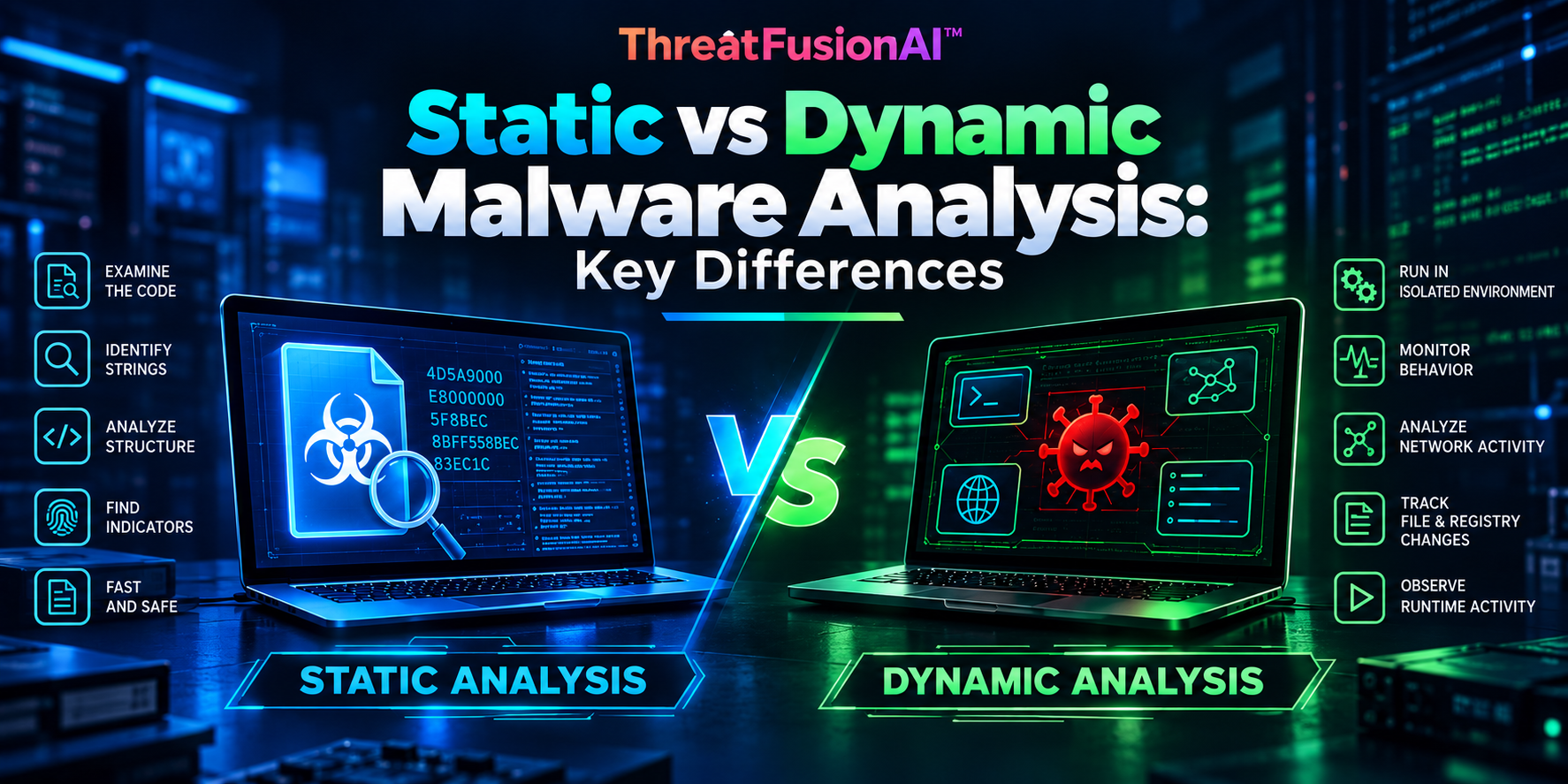
Static vs Dynamic Malware Analysis: Key Differences
|
S.No. |
Topics |
Factors |
What? |
|
1. |
Static Analysis |
Execution State |
Examines the code, metadata, and binary structure without executing the file. |
|
Primary Focus |
Early in the triage process, it finds file signatures, embedded strings, imported APIs, and structural obfuscation. |
||
|
2. |
Dynamic Analysis |
Execution State |
Observes real-time runtime behavior by running the file in a separate sandbox. |
|
Primary Focus |
Captures unencrypted memory payloads, dynamic network connections, registry changes, and process injections. |
Why Combine Static and Dynamic Malware Analysis?
You should combine static and dynamic malware analysis for the following reasons:
1. Complete Threat Visibility: Combines live runtime system characteristics with code-level architecture examination.
2. Neutralizes Obfuscation & Evasion: Defeats dynamic sandbox evasion strategies while avoiding static code packaging.
3. Correlates Static Artifacts with Live Network Calls: Directly compares observed runtime traffic with hardcoded C2 setups.
4. Accelerates Incident Response Timelines: Provides thorough dynamic validation in addition to quick initial static triage.
5. Fosters Higher-Fidelity Signature Creation: Combines behavioral threat signatures and file-based YARA rules for reliable detection.
Best Practices for Effective Malware Analysis
The following are the best practices for effective malware analysis:
● Isolate Execution Environments: To stop unintentional lateral propagation, adopt rigorous VLAN segmentation and air-gapped sandboxes.
● Establish Clean System Baselines: To guarantee precise delta comparisons and quick resets, take gold-image snapshots before execution.
● Combine Static and Dynamic Workflows: Examine files both before and during execution to find code structure and reverse evasion strategies.
● Simulate Core Network Services: To securely capture outgoing C2 requests without live internet access, use programs like INetSim or FakeNet-NG.
● Automate IOC Extraction and Distribution: For quick containment, pipeline confirmed file hashes, C2 domains, and registry keys straight into SIEM/XDR platforms.
Conclusion: Choosing the Right Malware Analysis Method
Now that we have talked about what Malware Analysis is, you might want to get your hands on a dedicated security solution from a reliable source. For that, you can go for ThreatFusionAI, a dedicated threat intel platform offered by Craw Security.
Organizations will be able to enhance their security measures by getting notified by ThreatFusionAI about the latest cyber threats and malware. Thus, you can rely on this amazing platform. What are you waiting for? Contact, Now!
Frequently Asked Questions
About Malware Analysis
1. What Is the Difference Between Static and Dynamic Malware Analysis?
While dynamic malware analysis runs the file in a separate environment to watch its actual runtime behavior, static malware analysis just looks at a file's structure and code.
2. How Does Static Malware Analysis Work?
Static malware analysis works in the following ways:
a) File Fingerprinting & Cryptographic Hashing,
b) Header & File Format Inspection,
c) Embedded String Extraction,
d) Import & Export API Analysis, and
e) Disassembly & Decompilation.
3. How Does Dynamic Malware Analysis Work?
Dynamic malware analysis works in the following ways:
a) Isolated Environment Provisioning,
b) Process & Behavioral Monitoring,
c) System & Registry Tracking,
d) Network Communication Capture, and
e) System Call & API Interception.
4. What Are the Benefits of Static Malware Analysis?
The following are the benefits of static malware analysis:
a) Zero Execution Risk,
b) Rapid High-Volume Triage,
c) Direct Artifact Extraction,
d) Minimal Computational Cost, and
e) Structural Intent Discovery.
5. What Are the Limitations of Static Malware Analysis?
The following are the limitations of static malware analysis:
a) Ineffective Against Obfuscation and Packing,
b) Blind to Dynamic and Fileless Threats,
c) Vulnerable to Anti-Analysis Tactics,
d) Inability to Verify Execution Success, and
e) High Technical Expertise Requirement.
6. What Are the Benefits of Dynamic Malware Analysis?
The following are the benefits of dynamic malware analysis:
a) Bypasses Code Obfuscation & Packing,
b) Exposes Live Network & C2 Traffic,
c) Captures Decrypted In-Memory Payloads,
d) Monitors Complex Behavioral Chains, and
e) Generates High-Fidelity Behavioral IOCs.
7. What Are the Limitations of Dynamic Malware Analysis?
The following are the limitations of dynamic malware analysis:
a) Sandbox Evasion & Anti-Analysis,
b) Incomplete Execution Coverage,
c) Resource and Infrastructure Intensity,
d) Risk of Sandbox Escape & Contamination, and
e) High Data Volume & Noise.
8. When Should You Use Static Malware Analysis?
During first triage, use static malware analysis to swiftly determine safety, collect fundamental indications such as file hashes and strings, and examine binaries without the risk or infrastructure overhead of execution.
9. When Should You Use Dynamic Malware Analysis?
When dealing with packed, obfuscated, or unknown threats that need to be executed live in a sandbox to monitor C2 traffic, memory changes, and real-time behavioral chains, use dynamic malware analysis.
10. Can Static and Dynamic Malware Analysis Be Used Together?
Yes, a hybrid strategy that uses initial static triage to direct sandbox execution is provided by combining static and dynamic malware analysis. This ensures that obfuscated code is unpacked and thoroughly examined at both the structural and operational levels.