Do you know how Threat Hunting works and related methods that can make you lose confidential information, and how you can avoid them? If not, then you are in the right place. Here, we will talk about those common threat hunting mistakes and related prevention methods in detail.
Moreover, we will introduce you to a reliable threat intelligence solution offered by a reputable VAPT service provider. What are we waiting for? Let’s find out now!
What Is Threat Hunting?
In the proactive cyber defense field of "threat hunting," security analysts iteratively explore networks and endpoints for hidden, advanced persistent threats (APTs) that have gotten past automated security safeguards.
Threat hunters create hypotheses based on threat intelligence, system anomalies, and adversary methods (like MITER ATT&CK) to find malicious activity already present in the environment instead of waiting for alarms.
By doing this, companies may reduce dwell time and neutralize silent breaches before serious harm is done. Let’s take a look at what Threat Hunting is and related mistakes to avoid!
How Does Threat Hunting Work?
|
S.No. |
Factors |
How? |
|
1. |
Hypothesis Generation |
Create practical ideas about attacker behavior based on MITER ATT&CK framework behaviors and threat intelligence. |
|
2. |
Data Collection & Telemetry Aggregation |
For correlation, collect centralized endpoint, network, identity, and log data from several security solutions. |
|
3. |
Pattern Analysis & Anomaly Detection |
Examine telemetry to find lateral movement, persistence mechanisms, and unusual baseline deviations. |
|
4. |
Enrichment & Threat Validation |
Verify true-positive harmful behavior by contextualizing abnormalities using threat intelligence feeds and manual examination. |
|
5. |
Automated Rule Creation & Remediation |
To stop recurrence, neutralize verified threats and turn hunt results into automatic detection rules. |
Why Does Threat Hunting Matter in Modern Cybersecurity?
Threat hunting matters in modern cybersecurity for the following reasons:
1. Reduces Attacker Dwell Time: Identifies and eliminates quiet, unnoticed adversaries before they have a chance to elevate access or steal data.
2. Bypasses Automated Detection Blind Spots: Finds custom malware, zero-day exploits, and living-off-the-land strategies that circumvent signature-based security regulations.
3. Matures Detection Engineering: Creates long-lasting, automated detection signatures and behavioral rules using new threat hunt findings.
4. Protects Against Supply Chain & Credential Compromises: Detects harmful activity that comes from stolen valid user credentials or exploited third-party software.
5. Validates Security Controls & Visibility: Draws attention to important logging blind spots, incorrect setups, and inadequate security measures throughout the enterprise architecture.
Why Do Threat Hunting Mistakes Happen?
Threat hunting mistakes happen for the following reasons:
● Incomplete Telemetry & Visibility Gaps: Attack chain reconstruction is hampered by unlogged endpoints, missing network logs, or shortened data streams that conceal malicious activity.
● Confirmation Bias & Cognitive Pitfalls: By fitting incoming telemetry to preconceived notions and ignoring contradicting data, analysts make snap judgments.
● Alert Fatigue & Data Swamping: Hunters are overloaded with large amounts of unindexed, raw data, which makes it difficult to identify important threat indications.
● Poorly Defined Hypotheses: Starting assumptions that are too general or vague waste analytical resources on never-ending data fishing without a clear goal.
● Lack of Environmental Context: Benign activity can be mistaken for malicious behavior due to ignorance of specialized apps, administrative routines, and standard network baselines.
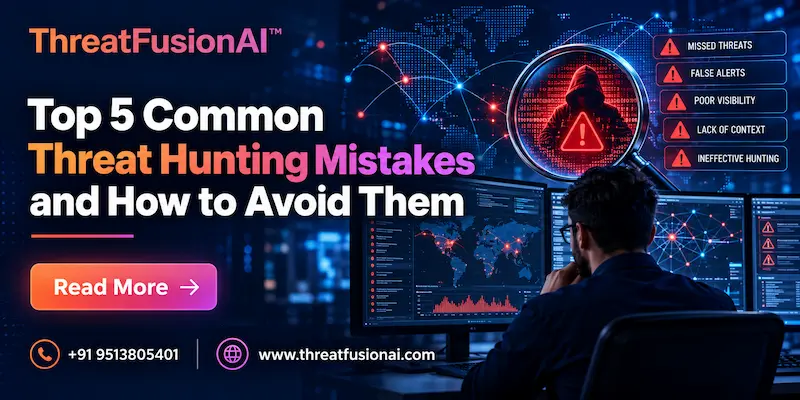
Top 5 Common Threat Hunting Mistakes
|
S.No. |
Mistakes |
What? |
|
1. |
Hunting Without a Clear Hypothesis |
Squandering time on aimless data searches rather than evaluating particular adversary strategies or actions. |
|
2. |
Relying Too Much on Security Tools |
Instead of conducting human-led behavioral analysis, automated tool alarms are treated as active hunting. |
|
3. |
Ignoring Threat Intelligence |
Not coordinating hunts with active campaign patterns, new vulnerabilities, and actual adversary TTPs. |
|
4. |
Focusing Only on Known Indicators of Compromise |
Instead of searching for dynamic, off-the-land methods, one should pursue static file hashes and IPs. |
|
5. |
Hunting Without Understanding Normal Network Behavior |
Lack of baseline awareness might lead to misinterpretations of bespoke apps or benign administrative action as threats. |
How to Avoid These Threat Hunting Mistakes?
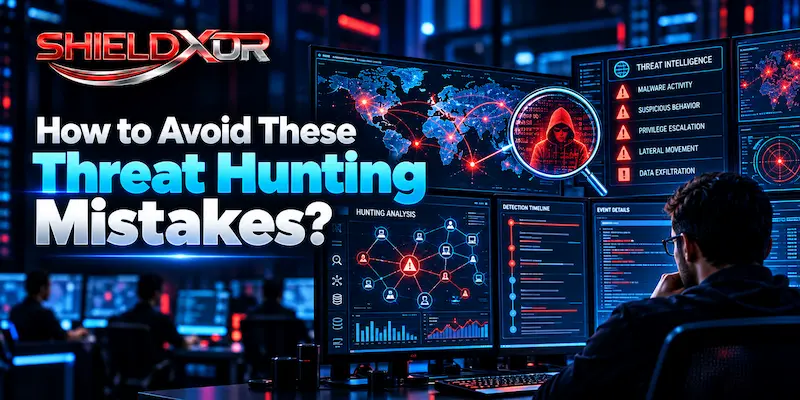
You can avoid these threat hunting mistakes in the following ways:
a) Formulate Structured, Behavior-Based Hypotheses: Instead of blindly exploring data, map hunting objectives to specific MITER ATT&CK procedures.
b) Establish Comprehensive Baseline Telemetry: To correctly identify actual anomalies, record typical administrative operations and application behaviors.
c) Integrate Actionable Cyber Threat Intelligence (CTI): Use current campaign details, active vulnerability exploits, and adversary profiles to power hunting searches.
d) Shift Focus from Static IOCs to Dynamic TTPs: Instead of focusing on IP addresses and perishable file hashes, target living-off-the-land orders and underlying attacker behaviors.
e) Ensure Operational Telemetry Coverage: To remove data blind spots across crucial endpoints, networks, and cloud resources, audit logging infrastructure on a regular basis.
How to Build an Effective Threat Hunting Process?
You can build an effective threat hunting process in the following ways:
1. Define Intelligence-Driven Hypotheses: MITER ATT&CK adversary tactics, recognized environmental concerns, and threat intelligence serve as the foundation for scope-structured hunt objectives.
2. Collect & Centralize Quality Telemetry: Combine synchronized, high-fidelity log data from cloud environments, identity systems, network perimeters, and endpoints.
3. Execute Iterative Behavioral Analysis: To identify hidden risks, examine telemetry datasets utilizing statistical stack counting, graph analysis, and anomaly visualization.
4. Validate & Enrich Findings: Verify harmful intent by cross-referencing individual abnormalities with threat intelligence feeds, sandbox executions, and contextual host forensics.
5. Operationalize & Automate Output: Transform verified hunt findings into playbooks, automated detection rules, and ongoing posture adjustments.
Best Practices for Successful Threat Hunting
|
S.No. |
Factors |
What? |
|
1. |
Adopt a Threat-Informed Mindset |
Assume that systems have already been penetrated and use real-world adversary TTPs to aggressively seek. |
|
2. |
Maintain High-Fidelity Data Visibility |
Assure uninterrupted, continuous log collection from endpoints, networks, cloud workloads, and identity providers. |
|
3. |
Establish Environmental Baselines |
To swiftly identify minute irregularities, profile typical user behavior, administrative tools, and network traffic. |
|
4. |
Combine Human Analytics with Machine Automation |
To scale hunt coverage, combine automated data processing with analyst intuition and critical thinking. |
|
5. |
Complete the Feedback Loop |
Transform verified hunt findings into revised playbooks, stronger security measures, and permanent detection rules. |
Essential Tools Used for Threat Hunting
The following essential tools are used for threat hunting:
● SIEM & Security Data Lakes: For sophisticated query searching, centralize, correlate, and index enormous amounts of historical log data across business and multi-cloud systems.
● Endpoint Detection & Response (EDR/XDR): Give hosts direct access to memory inspection, real-time response capabilities, and detailed, process-level endpoint telemetry.
● Network Detection & Forensics (NDR): Observe deep protocol behavior, record complete packet contents, and examine abnormalities in east-west traffic flow.
● Cyber Threat Intelligence Platforms (TIP): Combine, select, and incorporate threat context, dynamic indicator feeds, and external adversary TTPs into hunting processes.
● Memory & Digital Forensics Tools: Conduct accurate chronological evidence reconstruction, reverse engineering artifacts, and deep volatile memory extraction (RAM analysis).
How Can CRAW Security Help You Build Cybersecurity Skills?
CRAW Security can help you build cybersecurity skills in the following ways:
a) Hands-On Practical Lab Training: Through interactive virtual laboratories, live simulations, and practical vulnerability testing, you can acquire practical tactical experience.
b) Industry-Aligned Certification Pathways: Get ready for internationally recognized certifications such as CISSP, OSCP, CompTIA Security+, and CEH.
c) End-to-End Skill Progression: From basic networking and Linux to AI-powered ethical hacking and digital forensics, advance through structured learning.
d) Flexible Learning Formats & Dedicated Mentorship: Take advantage of instructor-led or self-paced classes taught by knowledgeable security professionals on weekdays and weekends.
e) Dedicated Career Guidance & Placement Assistance: Get assistance with job placement, technical mock interview preparation, and customized resume construction.
Conclusion
Now that we have talked about what Threat Hunting is, you might want to get your hands on a dedicated threat intel solution from a reliable source. For that, you can go for ThreatFusionAI, a dedicated threat intelligence platform offered by Craw Security.
ThreatFusionAI can help businesses to explore the latest cyber threats and vulnerabilities in their systems & networks, so that they can enhance their security measures for future threats. What are you waiting for? Contact, Now!
Frequently Asked Questions
About Threat Hunting
1. What is threat hunting in cybersecurity?
In the proactive cybersecurity field of "threat hunting," analysts explore networks and endpoints iteratively in order to find, isolate, and eliminate sophisticated threats that have gotten past automated security measures.
2. What are the most common threat hunting mistakes?
The following are the most common threat hunting mistakes:
a) Hunting Without a Clear Hypothesis,
b) Over-Reliance on Automated Tools & IOCs,
c) Ignoring Normal Baseline Behavior,
d) Neglecting Threat Intelligence, and
e) Hunting with Telemetry Gaps.
3. Why is threat intelligence important for threat hunting?
Threat intelligence is important for threat hunting for the following reasons:
a) Drives Targeted Hypothesis Generation,
b) Prioritizes High-Risk Emerging Threats,
c) Accelerates Threat Validation & Enrichment,
d) Shifts Focus from Perishable IOCs to Dynamic TTPs, and
e) Reduces False Positives & Analyst Fatigue.
4. What is hypothesis-driven threat hunting?
In a proactive security strategy known as "hypothesis-driven threat hunting," analysts develop precise, verifiable ideas about concealed attacker behaviors based on threat intelligence, environmental abnormalities, and MITER ATT&CK TTPs. They then thoroughly query telemetry to support or refute these theories.
5. How does MITRE ATT&CK help with threat hunting?
MITRE ATT&CK helps with threat hunting in the following ways:
a) Provides a Standardized Taxonomy for Hypothesis Generation,
b) Maps Detection Coverage & Identifies Blind Spots,
c) Focuses Hunting on Attacker Behaviors Over Static IOCs,
d) Contextualizes Real-World Threat Actor Profiles, and
e) Standardizes Detection Engineering & Automation Output.
6. What tools are commonly used for threat hunting?
The following tools are commonly used for threat hunting:
a) SIEM & Security Data Lakes,
b) Endpoint Detection & Response (EDR / XDR),
c) Network Detection & Response (NDR),
d) Threat Intelligence Platforms (TIP), and
e) Memory & Digital Forensics Tools.
7. Is threat hunting proactive or reactive?
Threat hunting is entirely proactive; instead of waiting for an alert or incident to react to, analysts actively look for undetected threats and quiet breaches that have already gotten past automatic security safeguards.
8. How can organizations improve their threat hunting process?
Organizations can improve their threat hunting process in the following ways:
a) Develop Intelligence-Led, Behavior-Based Hypotheses,
b) Expand and Standardize Telemetry Coverage,
c) Establish Robust Environmental Baselines,
d) Combine Human Intuition with Machine Automation, and
e) Close the Detection Engineering Loop.