Do you want to know what Threat Intelligence is and how it helps proactive cybersecurity for better security measures? If yes, then you are in the right place. Here, we will talk about what threat intelligence is and related benefits for proactive cybersecurity in detail.
Moreover, we will introduce you to a reliable threat intel solution offered by a reputable VAPT service provider. What are we waiting for? Let’s get started!
What Is Cyber Threat Intelligence?
The process of gathering, processing, and evaluating information about new or established threat actors, their tactics, methods, and procedures (TTPs), and possible attack vectors is known as cyber threat intelligence (CTI).
CTI enables cybersecurity teams to proactively comprehend enemy behavior by converting unprocessed threat data into usable context, operational insights, and strategic indications. Prioritizing vulnerabilities, expediting incident response, and fortifying defensive posture before hostile actions impact corporate operations are all made possible by this.
Let’s explore what Threat Intelligence is, its uses, its features, and related benefits for organizations in the IT Industry!
Why Proactive Cybersecurity Matters?
|
S.No. |
Factors |
Why? |
|
1. |
Dramatically Reduces Breach Costs and Downtime |
Early threat detection helps prevent expensive remediation, business suspensions, legal penalties, and ransom payments. |
|
2. |
Neutralizes Threats Before Execution |
Closes holes before adversaries can take advantage of them, preventing lateral movement, payload delivery, and data exfiltration. |
|
3. |
Protects Brand Reputation and Stakeholder Trust |
Continuous security preserves consumer trust and market standing by preventing public data releases. |
|
4. |
Optimizes Resource Allocation |
Allows security professionals to proactively plan cleanup instead of putting in long, stressful hours fighting emergency fires. |
|
5. |
Ensures Continuous Regulatory Compliance |
Prevents audit failures and fines by consistently aligning operations with industry standards (such as GDPR, HIPAA, and ISO 27001). |
Key Types of Cyber Threat Intelligence
The following are some key types of cyber threat intelligence:
1. Strategic Threat Intelligence: High-level executive views on financial risks, developing global cybersecurity trends, and adversary motivations.
2. Tactical Threat Intelligence: Technical information about attacker tactics, methods, and procedures (TTPs) that are mapped to MITER ATT&CK and other frameworks.
3. Operational Threat Intelligence: Actionable information about the capabilities, timing, intent, and precise incoming attacks of the targeted adversary groupings.
4. Technical Threat Intelligence: Malicious IP addresses, URLs, and file hashes are examples of short-term, technical indicators of compromise (IoCs).
The Cyber Threat Intelligence Lifecycle
The following is the cyber threat intelligence lifecycle:
● Planning & Direction: Establishing commercial goals, critical military priorities, and intelligence requirements to direct data collection.
● Collection: Collecting unprocessed threat information from various internal logs, technical intelligence feeds, dark web surveillance, and open-source feeds (OSINT).
● Processing & Exploitation: Organizing, standardizing, and converting unprocessed data into formats that may be used (e.g., parsing logs, extracting IOCs, filtering noise).
● Analysis & Production: Putting processed data in context to assess risks, identify trends, identify adversary TTPs, and produce useful insights.
● Dissemination & Feedback: Delivering completed intelligence reports to pertinent parties and using their input to improve requirements going forward.
How Does Threat Intelligence Help Identify Emerging Cyber Threats?
|
S.No. |
Factors |
How? |
|
1. |
Tracks Adversary TTPs in Real Time |
Identifies changing attack strategies and tactics prior to enemies initiating extensive campaigns. |
|
2. |
Monitors Dark Web and Underground Channels |
Identifies planned targeted attacks described in illegal forums, stolen access, and compromised credentials. |
|
3. |
Delivers Contextualized Indicators of Compromise (IoCs) |
Prioritizes active threats by adding threat scores to malicious IPs, domains, and hashes. |
|
4. |
Enables Predictive Vulnerability Management |
Finds vulnerabilities and zero-days that are being actively exploited in the field before fix releases. |
|
5. |
Automates Threat Hunting Signals |
Continually reveals the existence of concealed adversaries by feeding actionable detection signatures into security systems. |
The Role of Threat Intelligence in Threat Hunting
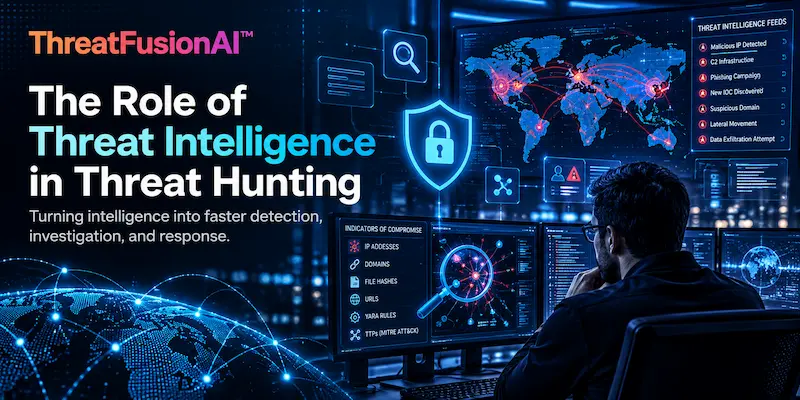
The following are some of the roles of threat intelligence in threat hunting:
a) Provides Hypothesis-Driven Triggers: Generates targeted hypotheses for proactive environment sweeps using new adversary TTPs and campaigns.
b) Delivers Enriched Context for Anomaly Analysis: Connects known threat actor infrastructure and actions with questionable network or host activity.
c) Accelerates Detection of Unknown Threats: Finds zero-day activities, living-off-the-land attacks, and hidden fileless malware before conventional security alerts go off.
d) Informs Custom Detection Rules: Creates customized YARA, Sigma, or SIEM detection rules based on recently discovered adversary behavior in order to stop future intrusions.
e) Shrinks Adversary Dwell Time: Allows hunters to quickly identify and isolate persistent attackers before they launch ransomware or steal data.
How Does Threat Intelligence Improve Vulnerability Management?
Threat intelligence improves vulnerability management in the following ways:
1. Prioritizes Flaws by Real-World Exploitation: Focuses on vulnerabilities that are actively being targeted or exploited in the wild rather than static CVSS scores.
2. Provides Adversary Context: Determines which threat organizations are taking advantage of particular vulnerabilities, their capabilities, and the industries they are targeting.
3. Predicts Threat Evolution: Predicts which new vulnerabilities are most likely to be weaponized next by using proof-of-concept surveillance and early dark web indicators.
4. Reduces Patch Fatigue and Noise: Allows security teams to concentrate resources only on high-impact vulnerabilities by filtering out theoretical or low-risk issues.
5. Accelerates Incident Response and Mitigation: While vendor updates are waiting, it provides virtual patches, workaround controls, and prompt repair information.
Using Threat Intelligence to Strengthen Security Operations
By adding contextual opponent data to real-time SIEM, EDR, and XDR telemetry, direct integration of threat intelligence into security operations turns reactive monitoring into proactive protection.
This correlation enables SOC analysts to neutralize specific assaults before they have a significant operational impact, expedites alert triage, and automates incident response workflows.
Integrating CTI with SIEM, SOAR, and XDR
Automated correlation of real-time enterprise telemetry against current indicators of compromise and adversary TTPs is made possible by integrating CTI feeds directly into SIEM, SOAR, and XDR platforms.
High-volume alerts are converted into prioritized, context-rich security incidents by this unified integration, which also significantly lowers mean time to detect and respond (MTTD/MTTR) and initiates automated playbooks.
Common Challenges in Threat Intelligence Implementation
The following are some common challenges in threat intelligence implementation:
● Data Overload and High False Positive Rates: Analysts become drowned in irrelevance and alert fatigue when they consume enormous amounts of uncurated danger feeds.
● Lack of Context and Actionability: Raw indicators frequently lack operational significance, commercial context, or precise instructions on how to mitigate the risk.
● Integration and Interoperability Hurdles: Standardized feed formats, such as STIX/TAXII, are difficult for legacy security systems to properly ingest, interpret, and synchronize.
● Skills and Resource Shortages: Specialized intelligence analysts who can transform unprocessed data into strategic, useful insights are often lacking in organizations.
● Timeliness and Freshness of Intelligence: Security teams follow old signs while neglecting ongoing efforts because outdated threat indicators soon lose their relevance.
Best Practices for Implementing a Threat Intelligence Program
|
S.No. |
Factors |
What? |
|
1. |
Define Clear Business Requirements and Objectives |
Align intelligence objectives with operational risk priorities, threat models, and key business assets. |
|
2. |
Focus on Quality and Relevance Over Volume |
Give top priority to carefully selected, context-rich threat feeds that are relevant to your sector and particular technological stack. |
|
3. |
Integrate CTI into Security Tools and Workflows |
Integrate threat intelligence streams into SOAR, EDR, and SIEM systems to facilitate automated reaction and triage. |
|
4. |
Establish Cross-Functional Dissemination Channels |
Distribute customized threat reports to executive leadership, IT teams, SOC analysts, and business stakeholders. |
|
5. |
Measure, Review, and Refine Continuously |
To systematically improve intelligence accuracy over time, monitor important metrics like time-to-detect and false positive rates. |
Conclusion: Turning Threat Intelligence Into Proactive Cybersecurity
Now that we have talked about what Threat Intelligence is, you might want to get your hands on a dedicated threat intelligence solution from a reliable source. For that, you can go for ThreatFusionAI, a dedicated threat intel platform offered by Craw Security.
ThreatFusionAI can help businesses by notifying them about the latest cybersecurity threats and malicious threats so that they can enhance their security measures for future threats. What are you waiting for? Contact, Now!
Frequently Asked Questions
About Threat Intelligence
1. What is threat intelligence in cybersecurity?
In cybersecurity, threat intelligence refers to actionable, context-rich data that is collected and examined regarding cyberthreats, threat actors, and attack vectors in order to assist companies in anticipating, preventing, and responding to security problems in a proactive manner.
2. How does threat intelligence support proactive cybersecurity?
Threat intelligence supports proactive cybersecurity in the following ways:
a) Drives Hypothesis-Based Threat Hunting,
b) Prioritizes Vulnerability Remediation,
c) Powers Predictive Security Defenses,
d) Automates Early Alert Triage, and
e) Informs Custom Detection Engineering.
3. Why is threat intelligence important for organizations?
Threat intelligence is important for organizations for the following reasons:
a) Minimizes Financial Losses and Operational Downtime,
b) Transforms Security Operations from Reactive to Proactive,
c) Reduces Alert Fatigue and Optimizes Resources,
d) Strengthens Executive and Board-Level Risk Management, and
e) Accelerates Incident Detection and Response (MTTD/MTTR).
4. What are the main types of cyber threat intelligence?
The following are the main types of cyber threat intelligence:
a) Strategic Threat Intelligence,
b) Tactical Threat Intelligence,
c) Operational Threat Intelligence, and
d) Technical Threat Intelligence.
5. How does threat intelligence help detect cyber threats early?
Threat intelligence helps detect cyber threats early in the following ways:
a) Surfaces Early Indicators of Compromise (IoCs),
b) Tracks Pre-Attack Reconnaissance,
c) Identifies Anomalous Behavioral Patterns,
d) Triggers Automated Early-Stage Playbooks, and
e) Enables Proactive Sweep Hypotheses.
6. How can threat intelligence improve threat hunting?
Threat intelligence can improve threat hunting in the following ways:
a) Generates Targeted Hunting Hypotheses,
b) Provides Context for Anomaly Disambiguation,
c) Exposes Living-off-the-Land (LotL) Tactics,
d) Accelerates Scope Identification During Intrusions, and
e) Converts Hunter Findings into Operational Rules.
7. How does threat intelligence support incident response?
Threat intelligence supports incident response in the following ways:
a) Accelerates Triage and Scoping,
b) Provides Adversary Playbooks and Intent,
c) Guides Containment and Remediation,
d) Automates Playbook Execution, and
e) Informs Post-Incident Root Cause Analysis.
8. What role does threat intelligence play in vulnerability management?
Threat intelligence plays the following roles in vulnerability management:
a) Shifts Focus to Real-World Risk,
b) Exposes Adversary Targeting,
c) Predicts Emerging Threat Vectors,
d) Eliminates Noise and Patch Fatigue, and
e) Provides Temporary Mitigation Controls.
9. How can organizations integrate threat intelligence into their security operations?
Organizations can integrate threat intelligence into their security operations in the following ways:
a) Ingest Feeds into SIEM and XDR,
b) Automate Orchestration with SOAR,
c) Enrich Endpoint and Network Security,
d) Align Threat Hunting with Adversary TTPs, and
e) Inform Risk-Based Vulnerability Prioritization.
10. What are the common challenges of implementing a threat intelligence program?
The following are the common challenges of implementing a threat intelligence program:
a) Data Overload and High False Positive Rates,
b) Lack of Context and Actionability,
c) Integration and Interoperability Friction,
d) Skills and Resource Shortages, and
e) Timeliness and Freshness Decay.